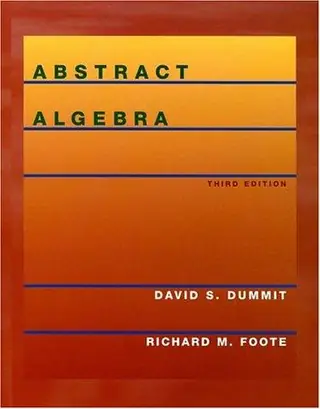
Abstract algebra
by David S. Dummit · first published 1991
42% recommend58% neutral
Why HN recommends it
Loaded with worked examples rather than dense symbolic argument, with clear theory and good writing. It suits self-study, supplementing undergraduate algebra, and working through its exercises.
Summarised by Claude from recommending comments
This book is designed to give the reader insight into the power and beauty that accrues from a rich interplay between different areas of mathematics. The book carefully develops the theory of different algebraic structures, beginning from basic definitions to some in-depth results, using numerous examples and exercises to aid the reader's understanding. In this way, readers gain an appreciation for how mathematical structures and their interplay lead to powerful results and insights in a number of different settings.
Affiliate links. As an Amazon Associate I earn from qualifying purchases.
Mentions per year
What Hacker News says
Related books
 2015–2023
Elementary differential equations
William E. Boyce, Richard C. Diprima
Recommended by 2 · mentioned by 22 recommend · 2 mention2 recommend · 22 recommend
 2018–2023
Arithmetic
Paul Lockhart
Recommended by 4 · mentioned by 54 recommend · 5 mention4 recommend · 54 recommend
 2008–2025
Topics in algebra
I. N. Herstein
Recommended by 10 · mentioned by 1110 recommend · 11 mention10 recommend · 1110 recommend
 2011–2023
Solving Mathematical Problems
Terence Tao
Recommended by 3 · mentioned by 43 recommend · 4 mention3 recommend · 43 recommend
 2013–2023
Ordinary Differential Equations
Arnolʹd, V. I.
Recommended by 3 · mentioned by 73 recommend · 7 mention3 recommend · 73 recommend
Partial Differential Equations
Lawrence C. Evans
Recommended by 5 · mentioned by 65 recommend · 6 mention5 recommend · 65 recommend
 2015–2025
Introduction to Smooth Manifolds
John M. Lee
Recommended by 5 · mentioned by 85 recommend · 8 mention5 recommend · 85 recommend
 2014–2025
Mathematical methods for physics and engineering
K. F. Riley, M. P. Hobson, S. J. Bence, Kenneth Franklin Riley
Recommended by 5 · mentioned by 55 recommend · 5 mention5 recommend · 55 recommend
…http://math.stanford.edu/~vakil/216blog/FOAGapr2915public.pd... and maybe Milne on etale cohmology: http://www.jmilne.org/math/CourseNotes/LEC210.pdf If you find that incomprehensible, start with Dummit and Foote's Abstract Algebra (read it cover to cover), Neukirch's Algebraic Number Theory, Atiyah and Macdonald's Commutative Algebra, and Fulton and Harris's Representation Theory. If you indeed want to read all that, you may as…
on “Ask HN: Understanding inter-universal Teichmüller theory?” ↗For self study of abstract algebra, I recommend Dummit & Foote. I used it as a supplement to my undergrad algebra classes and found it to be very useful. This is in contrast to some books like Artin which leave a lot to the readers,…
on “Abstract Algebra (2016) [pdf]” ↗If you want to understand Peluse's paper, I think the most directly relevant background reading would be Tao and Vu's Additive Combinatorics. Dummit and Foote's Abstract Algebra is an excellent book -- even if not very directly relevant to additive combinatorics. Analysis background would be useful, such as to be found in Stein and Shakarchi's series. Some introductory combinatorics…
on “Mathematicians Catch a Pattern by Figuring Out How to Avoid It” ↗Most people like the Dummit & Foote book; it tends to be loaded with examples rather than a lot of dense symbolic arguments: http://www.amazon.com/Abstract-Algebra-Edition-David-Dummit/... When I learned it, though, it was from this Dover book, which is more affordable: http://www.amazon.com/Elements-Abstract-Algebra-Dover-Mathem...
on “Understanding the most beautiful equation in Mathematics” ↗…textbook I bought for the course I took on group theory and ring theory [1]. It’s pretty expensive and the exercises are very challenging but if you’re a self-motivated student, you can learn a TON of abstract algebra from this one book. You may want to review some linear algebra before you dive in, if you haven’t done so in a while. You can find solutions to many of the exercises online though I can’t vouch for their…
on “Semigroup Resonance FizzBuzz” ↗Abstract Algebra: A Student-Friendly Approach by Dos Reis Paperback layout feels like a workbook, not overwhelming-- beginner friendly
on “Ask HN: Math books that made you significantly better at math?” ↗…Multivariable calculus, vector calculus - Linear algebra - Tensor calculus - Real analysis (see Walther Rudin) - Complex analysis - Ordinary differential equations - Partial differential equations - Abstract algebra - Differential geometry
on “Ask HN: Best books to self study undergrad level mathematics?” ↗An admirable attempt, but -- the formatting and the grammar are distracting detractors from the content. For anyone who is serious about learning abstract algebra but lacking mathematical background (i.e. an analysis course under the belt), consider the book "Abstract Algebra" by Dummit and Foote. It's at the undergraduate level (so it goes through the motions…
on “Abstract algebra for developers and people who hate math” ↗Abstract algebra is an old field so plenty of good options.I would recommend Abstract Algebra by Dummit and Foote. Clear theory, great examples and good writing: http://eu.wiley.com/WileyCDA/WileyTitle/productCd-0471433349...
on “Twice as happy customers means half the marketing spend” ↗I'd also like to point out that the majority of software engineers nowadays lacks the mathematical background, so it's probably worth including theoretical books like Abstract Algebra by Dummit and Foote on the 'must read' list.
on “Alan Kay's answer to ‘what are some forgotten books programmers should read?’” ↗I really like Abstract Algebra by Dummit and Foote. Get an old, used, international edition. Do exercises!
on “Galois Groups and the Symmetries of Polynomials” ↗…it is from the 1950's and there are used copies in most used book shops for cheap (or there was). It has no definition of 'equals' but does have a concept of equivalent relations. Dummit and Foote's Abstract Algebra book is a great reference, especially with the problem with AI pollution. Coming from a General Relativity background, it still took me two years to work through on my own. I don't know any suggestions…
on “Non-computability of solutions of certain equations on digital computers (2022)” ↗I'm soon starting my trek through every problem in the algebra text that Harvard's PhD prelim recommends for study: Abstract Algebra by Dummit and Foote http://www.amazon.com/Abstract-Algebra-David-S-Dummit/dp/047... I've started the first section of the first chapter, but that was only in a few hours of spare time. I'll be posting…
on “A Computational Introduction to Number Theory and Algebra” ↗…undergrad math degree. I don't want to discourage you, I'm just being realistic. If you want to work towards algebraic geometry, you can certainly do that. You'll need to first master linear algebra and abstract algebra. You should have a strong understanding of fields, groups, rings, vector spaces and modules. Someone else mentioned commutative algebra - that is more of a circular dependency with algebraic geometry…
on “How I Learned to Love Algebraic Geometry” ↗…videos + book - Calculus and basics of Analysis: Spivak - Group Theory: Visual Group Theory - Complex Analysis: Visual Complex Analysis - Writing proofs: Proofs: A Long Form Textbook by Jay Cummings - Abstract Algebra: Dummit-Foote book. First few chapters if you like. ___ Pop-Sci: 1. The Joy of X by Steven Strogatz 2. Fermat's Enigma by Simon Singh (All this books except AA are very highly recommended by me)
on “Ask HN: Serious mathematics books that can replace a good teacher?” ↗