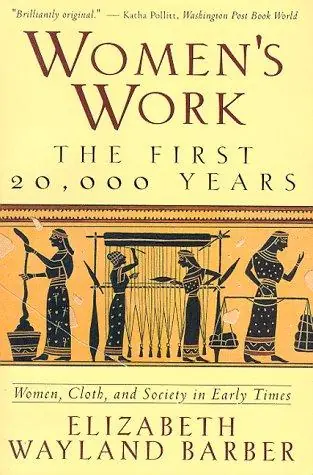
Women's Work: The First 20,000 Years
by Elizabeth Wayland Barber · first published 1994
6mentions
1recommended by
2HN commenters
2020–2024first – last mentioned
50% recommend50% neutral
New discoveries about the textile arts reveal women's unexpectedly influential role in ancient societies. Barber "weaves the strands of mythology and literature, archaeology, ethnology, and documented history into a rich tapestry" says John Noble Wilford, New York Times Book Review. Photos and drawings. Author lectures.
Affiliate links. As an Amazon Associate I earn from qualifying purchases.
I recently read and can recommend Women's Work: The First 20,000 Years as a deep perspective on the practices and participants in the making of textiles, and their societal and practical reasons. It's fascinating that historically, the practice of hand spinning thread and…
on “Clothing, How Did They Make It? Part I: High Fiber” ↗In Elizabeth Barber's Women's Work: the First 20,000 Years (1994) there's a passage where, on the basis of reconstructed PIE roots, she posits what we're fairly sure the proto-indo europeans were getting up to in the evenings around their campfires, and many…
on “Fairytales much older than previously thought, say researchers (2016)” ↗cf Barber, "Women's Work: The First 20,000 Years" Part of her thesis is that weaving and textiles have been stereotypical occupations for the distaff gender because they can be done in a single location and are interruptible, making them very suitable…
on “Kids and Time” ↗In Barber's Women's Work: The First 20,000 Years she mentions that proto-Indo-European language reconstructors are pretty sure that besides the usual set of animals and weather conditions, there was a PIE word root for "getting high". I'm guessing literacy…
on “A Goblet which arbitrates during drinking parties (2019)” ↗There was an interlude in Women's Work: The First 20,000 Years about reconstruction of early societies by their vocabulary, using reconstructed root words from Uralic: "So we can imagine them sitting around the campfire of an evening in larger groups, making and…
on “Dolphins learn from their peers to use empty shells to catch fish” ↗Elizabeth Barber's Women's Work points out that for centuries (millennia even), textile work was both economically valuable and fit the criteria for caregiving: interruptible and capable of being done at home. Then the industrial revolution…
on “Remote work appears to be here to stay, especially for women” ↗