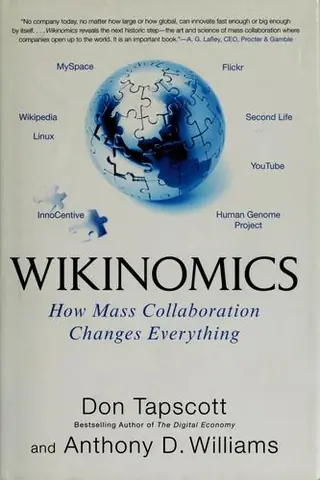
Wikinomics
by Don Tapscott · first published 2006
44% recommend44% neutral11% critical
In just the last few years, in one of the most profound changes of our time, traditional collaboration--in a meeting room, a conferencec all, even a convention center--has been superseded by collaborations on an astronomical scale. Today, encyclopedias, jetliners, operating systems, mutual funds, and many other items are being created by teams numbering in the thousands or even millions. Flickr, Second Life, YouTube, and other thriving online communities transcend social networking to pioneer a new form of collaborative production. While some leaders fear the heaving growth of these massive on
Affiliate links. As an Amazon Associate I earn from qualifying purchases.
Mentions per year
What Hacker News says
Related books
 2007–2026
The 22 Immutable Laws of Marketing
Jack Trout
Recommended by 26 · mentioned by 4226 recommend · 42 mention26 recommend · 4226 recommend
 2007–2026
The Wisdom of Crowds:Why the Many Are Smarter Than the Few and How Collective Wisdom Shapes Business, Economies, Societies and Nations
James Surowiecki
Recommended by 18 · mentioned by 5118 recommend · 51 mention18 recommend · 5118 recommend
 2007–2025
The Innovator's Solution
Clayton M. Christensen
Recommended by 22 · mentioned by 3922 recommend · 39 mention22 recommend · 3922 recommend
 2007–2023
The Art of the Start
Guy Kawasaki
Recommended by 48 · mentioned by 7948 recommend · 79 mention48 recommend · 7948 recommend
 2007–2026
The E-myth revisited
Michael E. Gerber
Recommended by 126 · mentioned by 170126 recommend · 170 mention126 recommend · 170126 recommend
 2007–2026
The 48 Laws of Power
Robert Greene
Recommended by 85 · mentioned by 19185 recommend · 191 mention85 recommend · 19185 recommend
 2007–2026
The Innovator's Dilemma
Clayton M. Christensen, L J Ganser, Don Leslie
Recommended by 148 · mentioned by 340148 recommend · 340 mention148 recommend · 340148 recommend
 2007–2026
Getting Things Done
David Allen
Recommended by 116 · mentioned by 199116 recommend · 199 mention116 recommend · 199116 recommend
It's hard to categorically state whether data should be free or not. A great book to read about this is Wikinomics: How Mass Collaboration Changes Everything (http://www.amazon.com/dp/1591841380/), which describes many cases of data being made free in order to elicit insight from the masses. I think an interesting…
on “The Economist's blog: maybe we should make our data free?” ↗…Marketing/Branding, Focus, Marketing Warfare 2. Purple Cow, All Marketers are Liars, Permission Marketing (I didn't like "The Big Moo", "Free prize inside" or "Small is the new Big"). 3. Founters At Work 4. Wikinomics, Wisdom of Crowds, The Tipping Point (Blink! was alright). I am looking forward to reading "The Long Tail" and "The starfish and the spider"...has anyone read them yet? 6. Why We Buy 7. Hackers and…
on “Startup founders, what books did you find most helpful?” ↗When I read Wikinomics things really clicked. We were entering a new world where more data is shared and more people collaborate. But that's not how things appear to have happened with the many closed platforms and publications:…
on “Ask HN: What happened to Wikinomics” ↗…Very nice of Chris to include me in his list. Though I will say that this list is missing a few good books: 22 Immutable Laws of Marketing 48 Laws of Power Antifragile The Fish That Ate the Whale Wikinomics Contagious The Pirate's Dilemma and I think PG's book of essays is worth reading for any founder as well
on “A Startup Reading List” ↗…changed the way I think about marketing. And, a few random notes on the others I've read: I found Predictably Irrational, Brain Rules and The 48 Laws of Power to be mostly garbage. The Wisdom of Crowds, Wikinomics and Made to Stick are decent essays in book form. Stumbling on Happiness is not nearly as good as Haidt's The Happiness Hypothesis which would be in the first list I made above if it were on Siver's…
on “Reading list for those who love to learn” ↗Your suggestion reminds me of the example in the book Wisdom of the Crowds (or maybe it was Wikinomics or both) "But managers did learn to type. And Goldcorp did use the internet to mine gold: in 2000, it abandoned the industry's tradition of secrecy, making thousands of pages of complex geological data…
on “Ask HN: As a non-expert, what would you do to solve the oil leak in the Gulf?” ↗Wikinomics talks about Innocentive, saying at the time there were "ninety thousand scientists from 175 countries" registered there, and that "firms will build their R&D organizations around a core of question askers…
on “Just learned of InnoCentive, cool freelance projects, not strictly programming.” ↗Well, the "end of the corporation" has been predicted (as a fad) many times post WWII, and I think it's an error to assume that the corporation will be substituted for some form of "wikinomics". Corporations will always be needed to mobilize capital for large projects (think: a steel mill or mining the moon, etc) and the author was right to point that out. Also, there will come a time when…
on “The end of management & what's next for the corporation” ↗…wikis did. But most of the reasons for the wiki no-show are external, driven by the dominant economics of the modern digital experience which despite the optimistic early book with the same title, is not Wikinomics. Yet the cognitive stress from information overload is not getting less. If we ever manage to get away from the user-as-product paradigm the design and function of wikis will be a key ingredient for…
on “The Design Space of Wikis” ↗