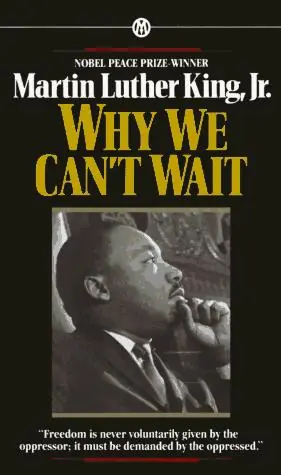
Why We Can't Wait
by Martin Luther King Jr., J.D. Jackson · first published 1963
7mentions
0recommended by
6HN commenters
2017–2023first – last mentioned
100% neutral
In 1963, Birmingham, Alabama, Dr. Martin Luther King, Jr. launched the Civil Rights movement and demonstrated to the world the power of nonviolent direct action with this letter from Birmingham Jail. Why We Can't Wait recounts not only the Birmingham campaign, but also examines the history of the civil rights struggle and the tasks that future generations must accomplish to bring about full equality for African Americans. Dr. King's eloquent analysis of these events propelled the Civil Rights movement from lunch counter sit-ins and prayer marches to the forefront of the American consciousness.
Affiliate links. As an Amazon Associate I earn from qualifying purchases.
…but not limited to, "colored people") until such time as the resulting disadvantage from that discrimination was remedied is exactly and concretely what King advocated, for example, when calling, in Why We Can't Wait, for a "Bill of Rights for the Disadvantaged" parallel to the "GI Bill" (then known as the "GI Bill of Rights") for veterans. The right wing has taken to presenting, on the basis of a single line in…
on “Twitter’s head of diversity is leaving and its chief HR officer has already left” ↗…advocated for policies that gave preferential treatment to Black people, so it's a bit surprising to see such a fan of his taking this stance by invoking King. For example, here's a quote from his book "Why We Can't Wait": > Whenever the issue of compensatory or preferential treatment for the Negro is raised, some of our friends recoil in horror. The Negro should be granted equality, they agree; but he should ask nothing…
on “Venture capital firms to include “diversity riders” in term sheets” ↗Somehow the legacy of MLK has been reduced to just that one quote, even though he wrote a a book ("Why We Can't Wait") that advocated for affirmative action programs for black people. His legacy has effectively been sanitized and "abridged" to be less challenging to persistent and harmful power structures.
on “New evidence that British workplaces are losing viewpoint diversity” ↗…this shameful episode" Unfortunately MLK didn't live to see Obama become president, Michael Jordan dominate the NBA, or Lizzo playing James Madison's crystal flute. Another MLK quote from his book "Why We Can't Wait": > "Lamentably, it is a historical fact that privileged groups seldom give up their privileges voluntarily. Individuals may see the moral light and voluntarily give up their unjust posture; but, as…
I hope so too. The disappointing revelation that follows those reveries is that, if it does come to pass, we won't be around to see it. It reminds me of Why We Can't Wait by Dr. King... >Time itself is neutral; it can be used either destructively or constructively. More and more I feel that the people of ill will have used time much more effectively than have the people…
on “CEOs made 299 times more than their average workers last year” ↗Just for your reference, here is another Martin Luther King quote. I encourage you to read more of an author's work before quoting in the future: From Why We Can't Wait : "Whenever the issue of compensatory treatment for the Negro is raised, some of our friends recoil in horror. The Negro should be granted equality, they agree; but he should ask nothing more. On the…
on “Tell HN: DEI initiatives undermine the self esteem of PoC within a company” ↗Bennett conveniently ignores one fact--King was a strong supporter of affirmative action. In “Why We Can’t Wait,” published in 1963, he argued that given the long history of American racism, blacks fully deserved “special, compensatory measures” in jobs, education and other realms. Four years later, in “Where Do…
on “Affirmative action at US colleges has been banned” ↗