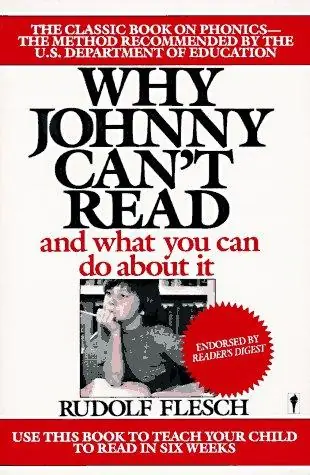
Why Johnny can't read
by Rudolf Franz Flesch · first published 1966
21mentions
2recommended by
8HN commenters
2010–2026first – last mentioned
25% recommend75% neutral
Thoroughly revised to encompass the latest research and statistics, this critical study addresses the question of literacy among American school children.
Affiliate links. As an Amazon Associate I earn from qualifying purchases.
Mentions per year
What Hacker News says
Related books
Have Space Suit Will TravelRobert A. Heinlein2009–2025
Have Space Suit Will Travel
Robert A. Heinlein
Recommended by 3 · mentioned by 123 recommend · 12 mention3 recommend · 123 recommend
 2010–2024
Rocket Ship Galileo
Robert A. Heinlein
0 recommend · 9 mentioned0 recommend · 9 mention0 recommend · 90 recommend
 2008–2026
To Kill a Mockingbird
Harper Lee
Recommended by 72 · mentioned by 24172 recommend · 241 mention72 recommend · 24172 recommend
"Why Johnny Can't Read" from 1954 is as fresh as ever. https://www.amazon.com/Why-Johnny-Cant-Read-about/dp/0060913...
on “Sold a Story: How Teaching Kids to Read Went So Wrong” ↗> but no, it isn't new. There's a war between phonetic reading and 'whole word' reading. Older than many think. Search for and read "Why Johnny can't read", and then do the same for "Why Johnny still can't read". I have an almost-five child who is reading simple books with no pictures. Reading those two essays above, then buying "Teach your child to read…
on “Nearly half of teenagers globally cannot read with comprehension” ↗…what it did, but my point about high school diplomas is that what most everyone got, as of say the Silent Generation (my parents'), used to mean quite a lot. However, by or sometime after say 1955 when Why Johnny Can't Read was published it apparently wasn't even a guarantee of functional reading (I wouldn't directly know, having grown up in a city that Reader's Digest reported on a year or two later with the title "Why…
on “The Coming Disruption” ↗…Unitarians capturing Harvard from the Congregationalists in the 1810-20 period, I use the 1930 when phonics were successfully attacked. That we're still arguing that, 50 years after the publication of Why Johnny Can't Read, tells us just about all we need to know about the US educational establishment.
on “Techies Who Are Homeschooling Their Kids” ↗Also note that the US high school diploma has been massively devalued over this period (well, Why Johnny Can't Read was published in 1955 and we're still fighting Dick and Jane and Their Running Dog Spot). So as a signal it's nearly worthless, it's not even a guarantee someone can read. A college degree is probably…
on “Is a college degree still worth it?” ↗…example of bogus "research" about this from way back when: a study showing US public school scores falling ... that didn't mention this wasn't happening in private schools. Needless to say this was in the "Why Johnny Can't Read" era where we were realizing that US public school education had started going downhill fast a bit before WWII (Dick and Jane and Their Running Dog Spot).
on “How The World Nuked Itself Over 2000 Times” ↗…against a more reliable inflation metric than what the necessarily biased US government puts out). One would also want to look at when the 4 year college bachelor's degree replaced a high school degree. Why Johnny Can't Read was published in 1955; not too many years/decades after that it was widely recognized that a high school degree no longer signaled much of anything.
on “The Higher Education Bubble: It's About to Burst” ↗…inspired stuff. US K-12 education has been horrible for nearly 3/4 of a century. The most basic, fundamental skill, the foundation for all other learning, was in such bad shape in 1955 that the whole Why Johnny Can't Read thing got started, along with a furious debate then or a little later on "Federal Aid to Education", which then was pushed through in the '60s. (Note, however, that a large fraction of kids, almost certainly…
on “Thomas Friedman-- We’re No. 1(1)” ↗To emphasize just how long this has been an issue: Why Johnny Can't Read was published in 1955. "Federal Aid to Education" was a big political issue before "Sputnik ended that debate" (it was launched in 1957; http://www.jerrypournelle.com/view/2010/Q1/view613.html). Heinlein…
on “The Real Problem with Waiting for Superman” ↗…And of course it had that obvious effect (at least for me). This was in Joplin, MO, one of the reddest Red State parts of the country, albeit in a school district famous after the 1955 publication of Why Johnny Can't Read for still being able to teach its students how to read. But the language arts were always very capably taught in the district, generally better than math.
on “2+2=What? Parents rail against Common Core math” ↗That was exactly how phonics were tossed in the middle of the last century, resulting in a huge cohort of people no longer being able to read, as scathingly detailed in the 1955 Why Johnny Can't Read (followed in 1958 with a small item in the Reader's Digest, "Why Johnny Can Read in Joplin", my home town; read that in the early-mid '70s from ones my grandmother saved). From memory, it was justified…
on “2+2=What? Parents rail against Common Core math” ↗…many schools weren't even pretending to teach their students the most basic of things, including the 3Rs (heck, phonics vs. "Dick and Jane and Their Running dog Spot" is still being fought 60 years after Why Johnny Can't Read was published). I'm certain it's being taken too far without caring about the consequences (which we could point out as another example of how dysfunctional our public schools have become, see above,…
on “Study says standardized testing is overwhelming nation’s public schools” ↗Which is named for "Why Johnny Can't Read" - a book from 1955 (by Rudolf Flesch, co-creator of the Flesch–Kincaid readability test)
on “Doug Tygar, author of Why Johnny Can't Encrypt, has died” ↗…important cause of the modern literacy rate issues in the US. Why? Because "whole word" teaching was the conventional wisdom since at least the 1950s[1,2]! Most articles on the topic reference the book Why Johnny Can't Read (1955) which was written to argue in favour of phonics as a response to (perceived?) child illiteracy at the time and claims (page 1): > Since the 1920s, most American schoolchildren have been taught…
on “Building a real-time AI tutor for 5-year-olds” ↗…trillion dollar annual Federal deficits and compensation for public sector employees at all levels of government. A figuratively criminal education system that was clearly so in 1955 (publication of Why Johnny Can't Read) that just keeps getting worse with each new top down nostrum. And I could go on and on. That said, we have some advantages that are simply not shared by many of our up and coming competitors. The…
on “Blockbuster is going bankrupt.The U.S. falling victim to a similar complacency?” ↗