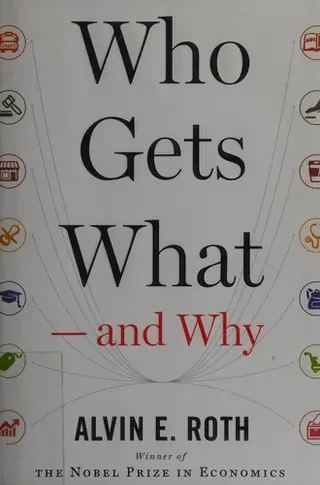
Who gets what--and why
by Alvin E. Roth · first published 2015
100% recommend
Why HN recommends it
Accessible account of matching markets and market design, drawing on examples like job hunting, school choice, and organ donation; useful for readers curious how markets get built and why they work.
Summarised by Claude from recommending comments
"A Nobel laureate reveals the often surprising rules that govern a vast array of activities -- both mundane and life-changing -- in which money may play little or no role. If you've ever sought a job or hired someone, applied to college or guided your child into a good kindergarten, asked someone out on a date or been asked out, you've participated in a kind of market. Most of the study of economics deals with commodity markets, where the price of a good connects sellers and buyers. But what about other kinds of "goods," like a spot in the Yale freshman class or a position at Google? This is t
Affiliate links. As an Amazon Associate I earn from qualifying purchases.
…should actually read up on some of the work of some of these prize winning economists - lots of them actually have very insightful and useful contributions to society. I cannot recommend enough the book "Who Gets What and Why" by Alvin Roth, a former Nobel Prize winner. Among other things, he created the world's first successful Kidney exchange program for donors. The book eloquently lays out how to design functional markets…
…market/auction design. I found that stuff to be profoundly useful, so I’ll definitely dive into mechanism design. Have you found any particularly good resources/books on this? FWIW I loved Alvin Roth’s “Who gets what and why” which is about market design mostly.
on “Theory X and Theory Y management” ↗…I have come to expect from Substack writers at this point. If you are actually interested in how supply and demand work in non-monetary markets (like the POW camp example), I cannot recommend enough "Who Gets What and Why" by Alvin Roth, the father of Kidney exchange programs.
on “Prices aren't just about supply and demand, but control over supply and demand” ↗…to fraud. Things are improving: someone like me would be long dead a generation ago. Yet even with truly superb doctors and insurance, we have many opportunities to improve. I like Alvin Roth's book, "Who Gets What and Why". It talks about identifying market failures and thinking about how to address them. We need to look at these challenges holistically and think about better fiscal/social engineering of our marketplaces.
on “The bureaucracy blocking the chance at a cure” ↗…vote between two choices". The Gibbard–Satterthwaite shows the difficulty in extending this to more choices (in that Arrow's theorem sort of way). The best thing I've read on this stuff is Alvin Roth's "Who Gets What and Why" (2015) [1] which is worth a read in any case. Repugnant markets! [0] https://en.wikipedia.org/wiki/Incentive_compatibility [1] https://en.wikipedia.org/wiki/Alvin_E._Roth#Market_design
on “Incentives Are for Losers” ↗…written parables or examples. Disagree or whatever, but it's an excellent and often trite way to understand classic principles. A couple books I would add to the list: Why Nations Fail Red Plenty Who Gets What and Why
on “Books to Understand Economics” ↗I'm not such a huge supporter of the invisible hand deciding "who gets what and why" (funnily enough there is a good book about markets by that name), rather I think freedom of association is important, especially when it comes to hosting someone in your home. However, if you're doing…
on “AirBnbWhileBlack Highlights Discrimination Faced by Black Travelers” ↗…employers) must locate each other and agree on each other then you enter the realm of matching theory. https://en.wikipedia.org/wiki/Matching_theory_(economics) There's a great book on this called "Who Gets What—and Why". The book talks about lots of matching markets: job hunting, school selection, kidney exchange, etc. It talks about the reasons why these markets work and how we might improve them. http://www.hmhbooks.com/whogetswhat/…
on “Google Jobs Search” ↗paired kidney exchange is a Market Design, see “Who Gets What and Why” by Alvin Roth
on “How to stop losing 17,500 kidneys” ↗…collectively govern them, a polycentric approach that is neither governmental nor proprietary. She abstracts 8 principles of governance, elements of successful community based resource governance. Alvin Roth's Who Gets What — and Why: Matchmaking, Mismatch, and Market Design Roth discusses market failures and how one builds market coordination organizations to perform matchmaking. He focuses on non-monetary markets such as paired…
on “Ask HN: What are you reading?” ↗