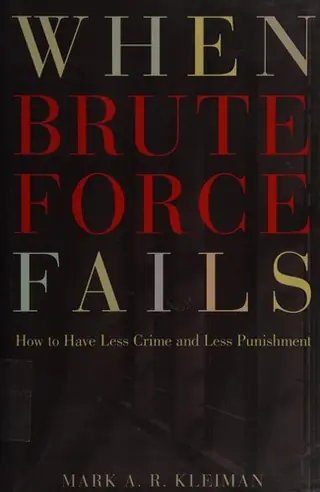
When brute force fails
by Mark Kleiman · first published 2009
71% recommend29% neutral
Why HN recommends it
Argues that swift, certain punishment, even if mild, deters crime better than severe but delayed sanctions. It presents evidence-backed ideas for reducing criminality, including Hawaii's HOPE probation program.
Summarised by Claude from recommending comments
Since the crime explosion of the 1960s, the prison population in the United States has multiplied fivefold, to one prisoner for every hundred adults, a rate unprecedented in American history and unmatched anywhere in the world. Even as the prisoner head count continues to rise, crime has stopped falling, and poor people and minorities still bear the brunt of both crime and punishment. This work explains how we got into the current trap and how we can get out of it: to cut both crime and the prison population in half within a decade. The author demonstrates that simply locking up more people fo
Affiliate links. As an Amazon Associate I earn from qualifying purchases.
…the victim, who is the one we should pay most attention to, is mostly ignored. For more on this controversial standpoint read up on how Tutsi & Hutu learnt to live together after the genocide. or: When Brute Force Fails: How to Have Less Crime and Less Punishment http://www.amazon.de/gp/product/0691148643
on “John Carmack on government” ↗…and more risk. At the same time there are not enough resources to enforce a low level crime so fixing the underlying problems is a much better idea. If you're interested in this topic take a look at When Brute Force Fails (http://www.amazon.com/When-Brute-Force-Fails-Punishment/dp/0...) - I found it a good take on crime in the US.
on “Teen Arrested for 30+ Swattings, Bomb Threats” ↗Anyone interested in the topic should take a look at _When Brute Force Fails_, by Mark Kleiman[1]. Briefly, a drug policy guy makes the case that "swift and certain" punishment with pretty usually not very severe outcomes does a lot better as deterrence than what we do now. There's…
on “Hitman hires hitman who hires hitman who hires hitman who hires hitman” ↗For anyone trying to figure out how to build a society where no one wants to be a criminal, I highly recommend When Brute Force Fails: How to Have Less Crime and Less Punishment by Mark Kleiman. There are evidence-backed ways of reducing criminality. One counterintuitive way of reducing crime is to increase the likelihood of being…
on “A walking tour of surveillance infrastructure in Seattle” ↗See Mark Kleiman's - When Brute Force Fails. The book mentions the Hawaiian HOPE project. The dealt with parolees by punishing violations with immediate mild punishment (i.e. you're back in jail over this weekend)instead of allowing violations…
on “What California is learning from solar panels built over irrigation canals” ↗…One approach would be to target a geographic area and communicate (and follow through on) a threat to throw the book at anyone caught stealing a bike. (pretty much all of these are stolen from the book When Brute Force Fails).
on “What Happens to Stolen Bicycles?” ↗Thanks so much for taking the time to write this. Do you have recommended followup resources? Opinions on recent books such as New Jack or When Brute Force Fails?
on “Satellite Images of North Korea Prison Camps Find 200,000 Living as Slaves” ↗