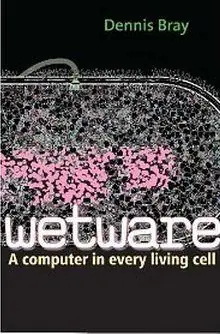
Wetware
A Computer in Every Living Cell
by Dennis Bray · first published 2009
100% recommend
"How does a single-cell creature, such as an amoeba, lead such a sophisticated life? How does it hunt living prey, respond to lights, sounds, and smells, and display complex sequences of movements without the benefit of a nervous system? This book offers a startling and original answer. The author taps the findings of the new discipline of systems biology to show that the internal chemistry of living cells is a form of computation. Cells are built out of molecular circuits that perform logical operations, as electronic devices do, but with unique properties. Bray argues that the computational
Affiliate links. As an Amazon Associate I earn from qualifying purchases.
…connections rather than the particular biochemical processes of the brain. It's a very reductionist view that drastically underestimates the biological complexity of even individual cells. There's a good book, Wetware: A Computer in Every Living Cell, by Dennis Bray going into detail on how much functionality and physical processes are at work even in the most simplest cells that is routinely ignored by these analogies…
on “Mind Emulation Foundation” ↗Someone else in another thread on here recommended the book “Wetware: A Computer in Every Living Cell” by Dennis Bray and I really enjoyed it. The idea of looking at complex protein interactions as logical circuits kind of makes sense as we try to map out the complexities…
on “A physical wiring diagram for the human immune system” ↗When I read articles like this, I dream of Wetware: http://manybooks.net/titles/ruckerrother10rucker_ware_tetral... http://www.amazon.com/Wetware-Computer-Every-Living-Cell/dp/... Why do so much work if you don't have a dream?
on “Harvard creates cyborg flesh that’s half man, half machine” ↗…our carbon based systems that can't be theoretically replicated on silicon. Organical systems convey much more, and predominantly analog signals, that don't have any sort of equivalent silicon basis. Wetware, a computer in every living cell by Dennis Bray goes into detail in how multidemnsional and complex the information processing in even individual cells is, down to single celled organisms executing complex…
on “Intelligent Machinery (1948) [pdf]” ↗Anyone interested in a more scientifically sound treatise of cellular biology and from a computational perspective should instead read "Wetware: A computer in every living cell" by Dennis Bray. It's very approachable and, despite its unfortunate title, has nothing to do with the absurd anthropomorphising suggested in the posted Brian Ford paper.
on “On Intelligence in Cells: The Case for Whole Cell Biology (2009) [pdf]” ↗…mysterious process unrelated to conventionally understood mechanisms, such as synaptic transmission, axonal transport, and gap junction connections. One of the most humbling books I have ever read is Wetware by Dennis Bray. There is an unbelievable richness when it comes to computation and storage/transport of information in biological organisms and cells that are simply unparalleled. I feel this is especially…
on “Neuroscientists Say They've Found an Entirely New Form of Neural Communication” ↗