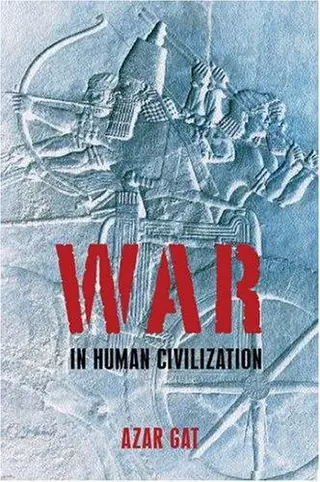
War in human civilization
by Azar Gat · first published 2006
83% recommend17% neutral
Why HN recommends it
Long, evidence-heavy survey of war across human history, drawing on archaeology and anthropology to examine how and why warfare shaped civilizations; suggested for readers wanting a serious academic take on the topic.
Summarised by Claude from recommending comments
Why do people go to war? Is it rooted in human nature or is it a late cultural invention? How does war relate to the other fundamental developments in the history of human civilization? And what of war today--is it a declining phenomenon or simply changing its shape? In this sweeping study of war and civilization, Azar Gat sets out to find definitive answers to these questions in an attempt to unravel the riddle of war throughout human history, from the early hunter-gatherers right through to the unconventional terrorism of the twenty-first century. In the process, the book generates an ast
Affiliate links. As an Amazon Associate I earn from qualifying purchases.


If you don't like games, read War In Human Civilization by Azar Gat. Note: it's over 800 pp. Bret's piece is about how this game somehow manages to reflect Gat's theory (and actual history).
on “The Ruin of War” ↗…what our evidence suggests. This article examines existing hunter gatherers: https://www.economist.com/christmas-specials/2007/12/19/nobl... For a book that dives into the archaeological evidence, see War in Human Civilization by Azar Gat.
on “Town Seized Building, Offered to Return It If Owners Bought Two Cars for Police” ↗I don't know how good that book actually is, but I read acoup blog and it criticizes that book very often. Instead it recommends readers to Azar Gat's War in Human Civilization instead https://www.amazon.com/War-Human-Civilization-Azar-Gat/dp/01...
on “America’s incarceration rate is in decline” ↗…contentious points of view if you include Japanese, Korean, Chinese and other perspectives. On general anthropology, maybe try JAred Diamond's Guns, Germs and Steel or for a more academic take, Azar Gat's War in Human Civilization. For the history of Japan, Mason & Caiger's History of Japan is comprehensive without being a huge study commitment.
on “Overtourism in Japan, and how it hurts small businesses” ↗…European Neolithic, which are on the order of 2–5%. To recap: Hunter-gatherers: 10-20% rate of people die violent deaths. Agriculturalists: 2-5% Industrialized societies: 1-2%, maybe even under 1% See War In Human Civilization by Azar Gat for a detailed explanation of the shift in warfare between hunter gatherers, agriculturalists, and industrial societies. The proportion of people who died violent deaths was way higher in…
on “Why Hunter-Gatherers' Work Was Play” ↗I highly recommend reading War in Human Civilization, excellent book related to this topic.
on “Civilization Is Not the Default. Violence Is” ↗…per-industrialization mindset while the economics and destructive power of post-industrialization applied. (very selective) Quote: Historically speaking, there is actually something to this. As Azar Gat notes in War in Human Civilization (2006), for most of human history, war ‘paid,’ at least for the elites who made decisions. In pre-industrial societies, returns to capital investment were very low. ( ...) For antiquity, the Roman Empire…
on “Those who witnessed Castle Bravo looked into Armageddon” ↗The only thing I know about the book is from this article https://acoup.blog/2021/10/15/fireside-friday-october-15-202... which recommends Azar Gat, War in Human Civilization instead.
on “Analyzing the Historical Rate of Catastrophes” ↗