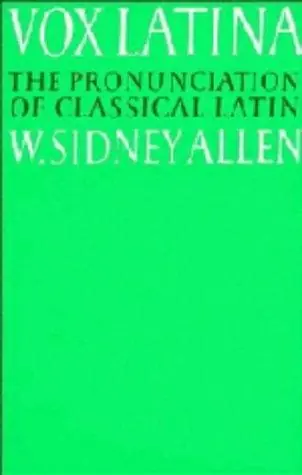
Vox Latina
a guide to the pronunciation of classical Latin
by W. Sidney Allen · first published 1965
11mentions
7recommended by
10HN commenters
2010–2025first – last mentioned
70% recommend30% neutral
Why HN recommends it
Standard reference for reconstructed classical Latin pronunciation. Explains the evidence for how the language sounded and how scholars arrived at that reconstruction. Written in accessible prose for English speakers.
Summarised by Claude from recommending comments
Affiliate links. As an Amazon Associate I earn from qualifying purchases.
…Just The Way It Is. A new collection of stories from the best writer about rural America out there. Three are extraordinary, two so-so, the rest very good. Non-fiction: W. Sidney Allen, Vox Graeca and Vox Latina. If you want to know how ancient Greek and Latin sounded, these are the books to read. Elizabeth Lloyd. The Case Of The Female Orgasm. An interesting study into how available evolutionary explanations…
on “Ask HN: Great books you read in 2009?” ↗…* comparative reconstruction of the Romance languages * evidence from metrical poetry, which provides particular clues about consonant and vowel length A very readable book on is W. Sidney Allen's _Vox Latina_. [edit: meant to reply to immediately following sister of this post.]
on “Latin Lives” ↗…Those are the main points that irk me. The best approximation we have is what's called the "restored" pronunciation. If you're interested in all the nuances the best book for this in my opinion is Vox Latina by Allen. Alternatively, just listen to anything by Evan der Miller on his YouTube channel: http://www.youtube.com/user/evan1965. His Latin pronunciation is the restored Classical and extremely good.…
on “Latin Lives” ↗It would more likely be pronounced with a vowel sound similar to a long i in Italian, but this is a pretty good approximation for English speakers. [Vox Latina](https://www.amazon.com/Vox-Latina-Guide-Pronunciation-Classi...) is a good resource for reconstructed classical pronunciation.
on “Words for “yes” in Romance languages” ↗Giving your friend the benefit of the doubt, sometimes one gets the wrong perspective from a careful, qualified statement. W. Sidney Allen wrote Vox Graeca[1] and Vox Latina which are well-known works which detail both what we know about pronunciation as well as explaining how we came to know these things. We surely don't know everything and scholarship evolves, but it is…
on “How did Ancient Greek music sound?” ↗Warning: I'm not an expert on this or on anything. W. Sidney Allen's old Vox Latina https://www.cambridge.org/core/books/vox-latina/0D460CEF06E5... is apparently still the standard starting reference for classical Latin pronunciation, at least for English-speakers. (Many nineteenth-century…
on “Schola Latina Europæa and Universalis” ↗I've heard that "Vox Latina" is really good for classical pronunciation. https://www.cambridge.org/core/books/vox-latina/0D460CEF06E5...
on “Speaking Latin” ↗…the preceding vowel was already happening in classical latin, including the one spoken by ruling elites and is attested through poetic metric and other sources. See Classical Latin. W. Sydney Allen, in Vox Latina 30–31 Also youtuber ScorpioMartianus has invested some time into training himself into using reconstructed pronunciation and has talked extensively about that, see for example https://youtu.be/psYM-LvBplw
on “A Spectre Is Haunting Unicode” ↗…Ancient Greek was pronounced but also how we know. The evidence includes explicit notes from grammarians and other writers, graffiti, borrowings, puns, and later forms of Greek. Allen also has another book _Vox Latina_ which does the same thing for Latin.
on “Ancient Greek accents in ten rules” ↗…the original pronunciation of Latin for the public. Today every Latin primer, especially the British and the American ones, insist that you read Latin in the reconstructed way. WS Allen in his book, Vox Latina, actually explains how Latin might have been pronounced in the Roman period. Interestingly his theories have universal acceptance today.
on “‘Frenssh’ as it was ‘spak’ in medieval England” ↗…sense that it had a consonantal use and a vowel use. But they did not, themselves, perceive the two sounds as being different sounds. They are, to the Romans, one sound in two different contexts. Quoting Vox Latina: > There is also a much-quoted anecdote of Cicero's, which tells how, when Marcus Crassus was setting out on an ill-fated expedition against the Parthians, a seller of Caunean figs was crying out 'Cauneas!';…
on “Surprising Shared Word Etymologies” ↗