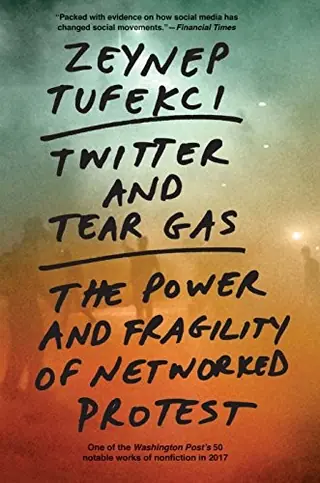
Twitter and tear gas
by Zeynep Tufekci · first published 2017
78% recommend22% neutral
Why HN recommends it
Analyzes how social media changed protest and social movements, arguing digital tools reshape how movements gain strength. Readers find it thorough and useful for anyone studying the internet's effect on power.
Summarised by Claude from recommending comments
A firsthand account and incisive analysis of modern protest, revealing internet-fueled social movements' greatest strengths and frequent challenges. To understand a thwarted Turkish coup, an anti-Wall Street encampment, and a packed Tahrir Square, we must first comprehend the power and the weaknesses of using new technologies to mobilize large numbers of people. Tufekci explains the nuanced trajectories of modern protests--how they form, how they operate differently from past protests, and why they have difficulty persisting in their long-term quests for change. Tufekci speaks from direct expe
Affiliate links. As an Amazon Associate I earn from qualifying purchases.

If you want to understand why protesting can be inneffective, I highly recommend "Twitter and Tear Gas" by Zeynep Tufekci (https://www.twitterandteargas.org/ with CC version available - but buy it!). One important factor: protests are only effective if they demonstrate the ability of the movement to affect…
on “US Senate passes sweeping tax overhaul bill” ↗Zeynep Tufekci (the author of the piece) also wrote an excellent book, Twitter and Tear Gas, about modern protests and social movements in the age of social media. It’s available online under a CC license: https://www.twitterandteargas.org
on “Preparing for Coronavirus to Strike the U.S.” ↗…Disconnects Us Catherine Price How to Break Up With Your Phone Thomas Kersting Disconnected: Protect Your Kids Against Device Dependency Nicholas Kardaras Glow Kids Zeynep Tufekci Twitter and Tear Gas Lelia Green Technoculture Douglas Rushkoff Team Human Jaron Lanier Ten Arguments For Deleting Your Social Media Carissa Véliz Privacy is Power: Why You Should Take Back…
on “Are smartphones serving as adult pacifiers?” ↗I agree. I've always been in the camp favoring freedom of speech and the marketplace of ideas. My thinking became more nuanced when I read the book Twitter and Tear Gas by Zeynep Tufekci [0]. Changes in technology alter the playing field for culture—and we've seen this in practice as the Internet and social networking have caused a fundamental shift in what it means…
on “Facebook to ban white nationalist content” ↗…privacy law is Ashkan Soltani, and his twitter account (@ashk4n) is worth a follow. And I think no one thinks more deeply or incisively about these issues than Zeynep Tufekci. If you haven't read her book (Twitter and Tear Gas) it's fantastic. I know it seems otherwise because of my fundraising work last year, but I really don't have strong connections to D.C. or any inside knowledge on what is on the regulatory agenda. Everyone…
on “Senate Testimony on Privacy Rights and Data Collection in a Digital Economy” ↗…you're interested in the effects social media has on political and civic life, these are two great books to read. One is recent, the other is a foundational classic of social psychology: - Zeynep Tufekci, Twitter and Tear Gas, The Power and Fragility of Networked Protest (2017). - Erwin Goffman, The Presentation of Self in Everyday Life (1956) Goffman uses a theatrical metaphor to talk about how our behavior and social life…
on “Ask HN: Which books do you consider real gems in your field of work/study?” ↗Zeynep Tufecki's boom Twitter and Tear Gas argues this exact point very thoroughly. Would recommend to anyone interested by this discussion.
on “Is There Any Point to Protesting?” ↗…people. We have a r/w bus - the internet. What we don't have are rules. We can think of rules - the kind Wolfram talks about in NKofS - instead as a language. A language in the sense of Sapir-Whorf. "Twitter and Tear Gas" (Zeynep Tufecki) is a good illustration of Sapir-Whorf in internet languages. (Available as a pdf I think) That language is the missing link. In Real Life there is a language for collaboration. Perhaps…
on “Did you spot a fish? Press the Fish Doorbell” ↗…pizza, hamburgers and coke, aren't those companies evil". No. Zeynep Tufekci (the author of the article) has written about this for years, including a book about social media in political movements (Twitter and Tear Gas), a popular TED talk (https://www.ted.com/talks/zeynep_tufekci_we_re_building_a_dy...), a series of New York Times op-eds, and more besides. A more productive answer to someone saying something you agree…
on “Facebook’s Surveillance Machine” ↗Zeynep Tufekci's book Twitter and Tear Gas talks about this. In Tunisia circa 2010, Twitter was part of the new tactics used by social movements and enabled their early success. Establishment groups weren't ready for it and in some ways ignorant…
on “The world that Twitter never made” ↗…remarkable example of a website that provides value to the community, a service and a piece of history. If you are interested in the idea of what different social platforms provide/afford (Zeynep Tufecki's Twitter and Tear Gas) this is great example of what could be done. [edit for typo]
on “Unix Wars (2000)” ↗…who are contrarians, it a function of the machine. Zeynep Tufekci talked about how twitter affords outrage and the Arab Spring, but did not afford a way to do anything constructive with that outrage. (Twitter and Tear Gas, available as a pdf). HN commenting system affords .... what you see here.
on “US scientists boost clean power hopes with fusion energy breakthrough” ↗