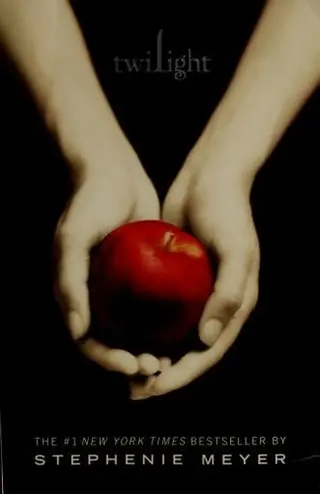
Twilight
by Stephenie Meyer · first published 2005
50% neutral50% critical
About three things I was absolutely positive. First, Edward was a vampire. Second, there was a part of him -- and I didn't know how dominant that part might be -- that thirsted for my blood. And third, I was unconditionally and irrevocably in love with him. When Isabella Swan moves to the gloomy town of Forks and meets the mysterious, alluring Edward Cullen, her life takes a thrilling and terrifying turn. With his porcelain skin, golden eyes, mesmerizing voice, and supernatural gifts, Edward is both irresistible and impenetrable. Up until now, he has managed to keep his true identity hidden, b
Affiliate links. As an Amazon Associate I earn from qualifying purchases.
Mentions per year
What Hacker News says
Related books
 2007–2025
The Long Tail
Chris Anderson
Recommended by 7 · mentioned by 307 recommend · 30 mention7 recommend · 307 recommend
 2010–2026
Jane Eyre
Charlotte Brontë
Recommended by 6 · mentioned by 326 recommend · 32 mention6 recommend · 326 recommend
 2008–2026
A Song of Ice and Fire
George R. R. Martin
Recommended by 41 · mentioned by 18841 recommend · 188 mention41 recommend · 18841 recommend
 2009–2026
The Count of Monte Cristo
Alexandre Dumas
Recommended by 128 · mentioned by 260128 recommend · 260 mention128 recommend · 260128 recommend
 2007–2026
Lord of the Flies
William Golding
Recommended by 32 · mentioned by 33632 recommend · 336 mention32 recommend · 33632 recommend
 2009–2026
Hamlet
William Shakespeare
Recommended by 15 · mentioned by 12015 recommend · 120 mention15 recommend · 12015 recommend
 2007–2026
The Wheel of Time
Robert Jordan
Recommended by 57 · mentioned by 20857 recommend · 208 mention57 recommend · 20857 recommend
Harry Potter
J. K. Rowling
Recommended by 55 · mentioned by 25555 recommend · 255 mention55 recommend · 25555 recommend
…something is or how unique it is, but eventually you're just assigning arbitrary values to complex things, and you're forced to let people decide what they like on their own. My big sticking point was Twilight. Shittiest book ever. I couldn't write that bad if I tried. So I used to tell myself that I disliked people because they were brainwashed by the modern culture that told them it was okay to like Twilight.…
on “_why's best twitter posts” ↗…great books and practicing writing is critical to becoming a great writer, we've never been in worse time for writing development. The average person grows up reading--if they read at all--Harry Potter, Twilight, etc., being inundated with inane advertising, steeped in piss-poor social media posts, etc. The most writing the average person does is work email. Contrast that to, e.g., Herman Melville, who grew…
on “Why Read the Classics? (1986)” ↗…the statewide system is getting thinner and thinner, and inter-library loan beyond that, well, it used to be great, but they're shoveling out books (and I'm not talking about that thirty-ninth copy of Twilight which was once in hot demand but isn't any longer) that were once in most branches I visited. Many academic libraries are playing a game of Hearts. There's only two ways to win Hearts. The first involves…
on “Have You Been to the Library Lately?” ↗Sex is a useful tool in a book if it's used well. Same thing with kissing, which Twilight uses for its disgusting soft pornography. But both are misused more often than not. (Twilight teaches an important and saddening lesson, namely: if you give people exactly what they think they want,…
on “Study: Old Age Begins at 27” ↗…reading Atlas Shrugged. When John Galt starts making his speech, skip to the next chapter. You have now gained the ability to skip pieces of a book that are really, incredibly tedious. 2. Start reading Twilight. When it starts feeling like torture to continue, stop. Use the rest as fire starters for your grill. You have gained the ability to not read books you discover that you don't like. Take those unfinished…
on “Nancy Pearl’s Rule of 50 for dropping a bad book” ↗It's possible that both of these are true. To be clear, when I say quality, I don't just mean this in the narrow sense of following the rules that writing teachers say you should. Harry Potter and Twilight both became popular because of some essence that they had---in my opinion, probably related to the world building and a certain difficult-to-describe experience of reading. Both of those books had "flaws"…
on “Writing books is not really a good idea” ↗I think the point 2 will rub many people the wrong way (me included) though. That would make reading Fourth Wing or Twilight a more connecting experience than most classics. (Nothing inherently wrong with that, but... you know...)
on “Sora 2” ↗…fantasy but to me they are quite a different niche to Tolkien. Traditionally vampires and werewolves would probably be considered horror rather than fantasy, though it's a bit more complicated now as Twilight is clearly not horror. I think the author's point stands regardless, as there has been a resurgence across all of those keywords, but I do think the reasons for the resurgence in magic and dragons aren't…
on “Where did all the starships go?” ↗…want. Forcing them to do so on the other hand helps no one." I have to disagree here. Certainly, you can make the "at least they're reading something!"-type of argument. That is, when you let them read Twilight or something of similarly less literary value than The Adventures of Huckleberry Finn, well, "at least they're reading something!" I think this is doing a disservice to "the kids", though. I mean, it's…
on “Brave New World banned from High School curriculum” ↗…comment, which does not necessarily imply that the poster is a fan of "Atlas Shrugged" or Ayn Rand in general; I could probably find myself in a situation where I could consider a comment from Meyer's "Twilight" relevant, without changing my opinion that "Twilight" is an utter piece of crap. I used the quote I posted to express my opinion of "Atlas Shrugged". Which brings me to the next assumption I would like…
on “Yahoo scanned customer emails for US intelligence” ↗…Lua or SQLite codebases as examples. But the majority of novels are not at that level and the majority of code is not at that level. I certainly have no respect for, say Stephanie Meyer (the author of Twilight) as an author, but I'm not going to look at her writing and say she's illiterate. In some sense, one could argue that it's more important a measure of code literacy for people to be able to read code…
on “Coding is not the new literacy” ↗…millionaires/billionaires because they knew what the market liked and how to sell themselves/their work, but many people would not consider them the pinnacle of their craft. It's undeniable that something like Twilight or 50 Shades of Grey is extremely successful, but whether that makes Stephanie Meyer and EL James better authors than Stephen King or George RR Martin is debatable at least. But I guess the question…
on “The Myth of the Myth of the 10x Programmer (2020)” ↗…that you shouldn't group it with his others. I want recommendations based on the book I like, not the author I mostly might-not. A better example might be how Stephenie Meyer wrote the extremely popular Twilight books, and also The Host which is much less well-known, and better in many respects. Probably qualifies as more profound, too—it's told from the perspective of a parasitic alien. Picture the Yeerks from…
on “A Visual Book Recommender” ↗