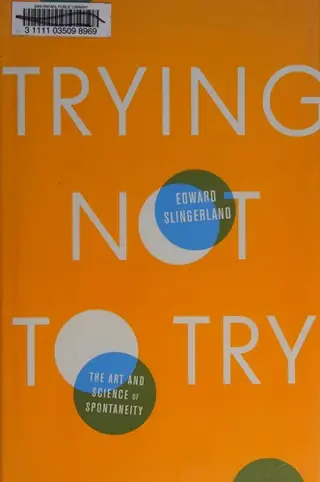
Trying not to try
by Edward G. Slingerland · first published 2014
11mentions
6recommended by
6HN commenters
2016–2023first – last mentioned
100% recommend
Why HN recommends it
Accessible introduction to wu-wei and early Chinese philosophy that connects Daoist ideas to flow, cognitive science and neuroscience; suits readers new to Chinese thought and those interested in effortless action.
Summarised by Claude from recommending comments
Affiliate links. As an Amazon Associate I earn from qualifying purchases.
You'd probably be interested in reading Edward Slingerland's Trying Not to Try for a take on the parallels between wu wei and current research in cognitive science.
on “The Genius of Learning” ↗…that point. But from then on, the daoist classics suddenly looked very different to me. They took on a depth that I hadn't seen in them before. A related book I would recommend is Edward Slingerland's Trying Not to Try[1]. A very interesting dive into the concept of Wu Wei. His interpretations of the old texts get a little one/two dimensional at times, but he also brings along a lot of insight. 1: https://eslingerland.arts.ubc.ca/tryingnottotry/
on “Translations of the Dao De Jing” ↗They [the runners] are suffused with the Daoist ideal of wu-wei that sees effortlessness as the epitome of human action I found Edward Slingerland’s “Trying Not to Try” very interesting in terms of making connections between classical Chinese philosophy and contemporary US/western thought about neuroscience. https://www.goodreads.com/book/show/18050134-trying-not-to-t...
on “Thinking on Your Feet” ↗> A more useful understanding of morality is that it’s a framework for cultivating individually and socially desirable behavior. This reminds me of Edward Slingerland's definition of Virtue from "Trying Not To Try": Stable dispositions to perform socially desirable actions in manner that is sincerely motivated by shared values. https://www.amazon.com/Trying-Not-Try-Science-Spontaneity/dp...
on “The radical moral implications of luck in human life (2020)” ↗Trying Not To Try by Slingerland is a great accessible introduction to the different modes of Chinese philosophy, and the two approaches to Daoism by Laozi and Zhuangzi are discussed. For more depth I highly recommend…
on “Tao Te Ching” ↗…'The Book on the Taboo Against Knowing Who You Are' as well as 'The Wisdom of Insecurity' - The Suzuki's: Shunryu Suzuki for practice and 'contemplation', and D.T. Suzuki one for the academic stuff) - Trying Not To Try, somewhat practical, mostly insightful, and just fun to read And there's other stuff I can't think of right now.
on “LSD: My Life-Saving Drug” ↗…it's a specific form of 'wu-wei' ("natural action, or in other words, action that does not involve struggle or excessive effort"). A great book on wu-wei which also references the concept of flow is 'Trying Not To Try'. I can strongly recommend this book as well. Especially it's final chapter(s) provided a lot of food for thought. [1]: https://en.wikipedia.org/wiki/Flow_(psychology)
on “Mr. Money Mustache’s retirement (sort of) plan” ↗If this interests you I can highly recommend the book 'Trying Not To Try'!
on “Raymond Smullyan has died” ↗…Buddhism and comparing their similarities is a great way to get the best out of both. A book that's been sitting on my shelf waiting for me to read it that might also be of interest is Edward Slingerland's Trying Not to Try, which focuses on the Chinese concept of wu wei which has much in common with flow.
on “The ages of distraction” ↗…https://hubermanlab.com/dr-alia-crum-science-of-mindsets-for... Virtue: "Stable dispositions to perform socially desirable actions in a manner that is sincerely motivated by shared values." --Edward Slingerland from "Trying Not To Try" [1] 1. https://www.amazon.com/Trying-Not-Try-Science-Spontaneity/dp... 2. https://en.wikipedia.org/wiki/Cargo_cult
on “All You Need to Become a Servant Leader” ↗However tenuous the connection may be, this makes me thing of the central 'point' of the book Trying Not To Try. The author argues that societies oscillate between favoring conservative and 'liberal' values over time, and that neither extreme is ideal. In a way, perhaps capitalism can be seen as the 'liberal'…
on “Wealth doesn't trickle down – it just floods offshore, research reveals (2012)” ↗