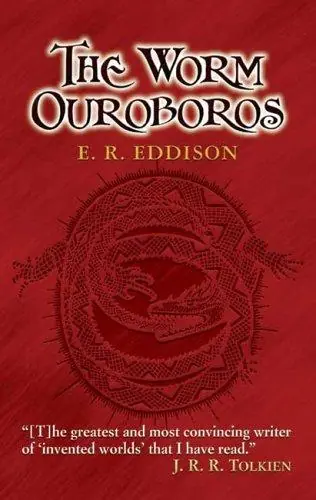
The worm Ouroboros
by Eric Rücker Eddison · first published 1900
25% recommend63% neutral13% critical
A unique work of 20th Century prose following the epic power struggle and conflict between two peoples, the Demons and the Witches. Pre-dating the much better known works of Tolkein, it involves quests and battles on land and sea, heroic acts and deceits, love, lust and infidelity; all in settings so lavishly and extravagantly described as to stretch even the most vivid imagination. Although this work has been described as 'flawed' by many critics, because of a few minor glitches, if read with an open mind, and heart, it will transport the reader to realms of delight of a kind few authors ar
Affiliate links. As an Amazon Associate I earn from qualifying purchases.
Mentions per year
What Hacker News says
Related books
 2014–2026
A Voyage to Arcturus
David Lindsay
Recommended by 5 · mentioned by 145 recommend · 14 mention5 recommend · 145 recommend
 2009–2026
Titus Groan
Mervyn Peake
Recommended by 9 · mentioned by 139 recommend · 13 mention9 recommend · 139 recommend
Permutation City
Greg Egan
Recommended by 256 · mentioned by 354256 recommend · 354 mention256 recommend · 354256 recommend
…Ofterdingen, The Ancient Mariner and Christabel, Beckford's Vathek, Morris's Jason and the Prologue (little else) of the Earthly Paradise, MacDonald's Phantastes, Lilith, and The Golden Key, Eddison's Worm Ouroboros, Tolkien's Lord of the Rings, and that shattering, intolerable, and irresistible work, David Lindsay's Voyage to Arcturus. Also Mervyn Peake's Titus Groan.
on “Harold Bloom: Anti-Inkling?” ↗Of these I've only read The Worm Ouroboros, and I cannot recommend it enough. The structure is a bit weird at first—you gotta get past the first chapter—but after that it settles and is astounding. If you have any passing interest in Lord of…
on “My favorite cult sci-fi and fantasy books you may not have heard of before” ↗I never had a problem with either of them, for some reason, but E.R. Eddison's The Worm Ouroboros had that effect on me pretty heavily. To this day I've never read more than 100 pages of that book in a single attempt (where attempt can be a couple weeks of concerted effort).
on “Samuel Delany and the Past and Future of Science Fiction” ↗At the risk of contributing to the AI fatigue: The 4 GTP papers in order of publication. I'm also in the middle of the following: 1. Software Engineering at Google (O'Reilley) 2. The Worm Ouroboros by E. R. Eddison 3. Titus Groan by Mervyn Peake
on “Ask HN: Books to Read?” ↗Elves and dwarves didn't strictly mean children's fairy tales prior to Tolkien. There's plenty of semi-popular prior art where they feature, like the Worm Ouroboros or The King of Elfland's Daughter. Poul Anderson also published The Broken Sword the same year as LOTR, which shows a lot of the same influences as written by a very different author. Tolkien's importance…
on “Selling 'Ghost in the Shell'” ↗…Robert E. Howard, etc. For most of these, we still follow the Mickey Mouse rule, and do not proceed until we are absolutely sure they're safe. Case in point, I've been thinking about transcribing The Worm Ouroboros[0] for some time, as it should be in the public domain even by conservative estimates, and yet I can't formally verify its copyright status, so I haven't yet. [0] https://en.wikipedia.org/wiki/The_Worm_Ouroboros
on “Secretly Public Domain: Most books published in the US before 1964” ↗…is PD by any measure. According to the article, it looks like Gutenberg adds a layer of "let a lawyer sign off on it", presumably to keep them from getting sued out of existence. Is that the case for Worm Ouroboros?
on “Secretly Public Domain: Most books published in the US before 1964” ↗…difficult (not always, of course). Just like you can't go from a couch potato to running a marathon in one day, you can't jump from Brandon Sanderson to enjoying Gormenghast (or something like the The Worm Ouroboros). It's impossible. It takes effort, it takes time and it takes a lot of reading to appreciate what the real masters can do with mere words.
on “2026 Unslop AI-Written Fiction Contest Results (judged by Gwern Branwen)” ↗