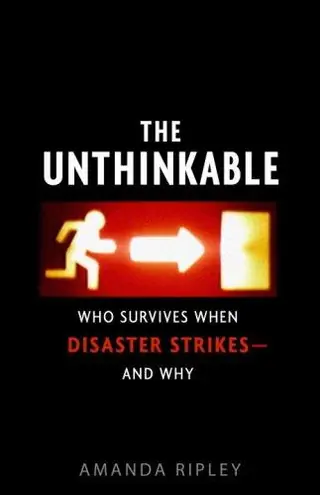
The Unthinkable
who survives when disaster strikes and why
by Amanda Ripley · first published 2008
75% recommend25% neutral
Why HN recommends it
Explores how people behave in disasters, drawing on several real events and the psychology of victims, with practical advice on preparing as an individual; suits readers interested in disaster psychology and planning.
Summarised by Claude from recommending comments
It lurks in the corner of our imagination, almost beyond our ability to see it: the possibility that a tear in the fabric of life could open up without warning, upending a house, a skyscraper, or a civilization. Today, nine out of ten Americans live in places at significant risk of earthquakes, hurricanes, tornadoes, terrorism, or other disasters. Tomorrow, some of us will have to make split-second choices to save ourselves and our families. How will we react? What will it feel like? Will we be heroes or victims? Will our upbringing, our gender, our personality--anything we've ever learned, th
Affiliate links. As an Amazon Associate I earn from qualifying purchases.
…Ever: How 1999 Blew Up the Big Screen by Brian Raftery * A Fabulous Creation: How the LP Saved Our Lives by David Hepworth * 1983: Reagan, Andropov, and a World on the Brink by Taylor Downing * The Unthinkable: Who Survives When Disaster Strikes and Why by Amanda Ripley * In Your Defence: Stories of Life and Law by Sarah Langford * Springfield Confidential: Jokes, Secrets, and Outright Lies from a Lifetime…
on “Ask HN: Favorite Nonfiction Books of 2019?” ↗Around 2015 or so I audiobook'd the book "The Unthinkable: Who Survives When Disaster Strikes and Why" by Amanda Ripley [2009]. This book covers similar topics that you do in your comment. One is from a chief security employee in the Twin Towers, along the…
on “How to Escape a Sinking Ship” ↗I strongly recommend "The Unthinkable: Who Survives When Disaster Strikes - and Why" by Amanda Ripley [1]. It is a terrific look of the character traits and behavior of people who survive life-threatening circumstances and those who don't.…
on “Bed that saved me from the Taliban” ↗A good citation for this phenomenon is Amanda Ripley's book "The Unthinkable", especially the chapter on the Beverly Hills Supper Club fire.[1] In that fire, entire tables of guests were found dead because they had come to a group decision to remain where they were, while other…
on “Woman Partially Sucked Out of Jet When Window Breaks” ↗This is so true. In fact, there's an excellent book by a journalist named Amanda Ripley that describes this phenomenon called The Unthinkable: Who Survives When Disaster Strikes[0]. 0. http://www.amandaripley.com/book
on “Meteorite crash in Russia” ↗If you are interested in disaster psychology and planning like this, you might also enjoy "The Unthinkable" by Amanda Ripley. It covers several notable disasters and the environment that shaped them. It gives advice on the psychology of victims of a disaster, how to prepare for one as an individual, and how…
on “How one ED mobilized his department during a mass casualty incident (2017)” ↗Continuation because noprocrast locked me out awhile: As pointed out in Jeff's article, McQueen's character knows what questions to ask. And per The Unthinkable [ISBN 0307352897], Rescorla knew what mistakes people were likely to make. An expert can anticipate problems and raise good questions.
on “Coding Horror: Are You An Expert?” ↗…workers who, on Sept. 11, dithered at their desks, calling relatives, turning off computers and pondering which mementos to rescue from their desks even as the doomed jets burned above their heads. In The Unthinkable, Ripley cites a National Institute of Standards and Technology study that showed that those who made it out of the WTC waited an average of six minutes after the plane hit their building before heading…
on “Why do you grab your bag when running off a burning plane?” ↗