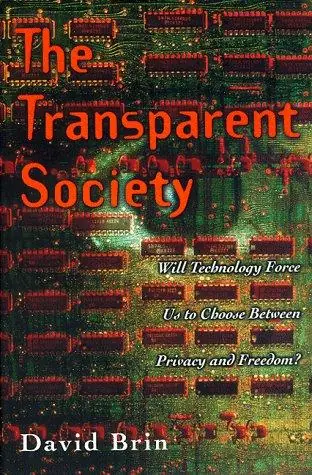
The transparent society
will technology force us to choose between privacy and freedom?
by David Brin · first published 1998
49% recommend49% neutral2% critical
Why HN recommends it
Argues that pervasive surveillance is coming regardless, so the real choice is whether only governments and elites watch or everyone can. Recommended for anyone thinking about privacy, cameras and sousveillance.
Summarised by Claude from recommending comments
The Transparent Society is a call for "reciprocal transparency," If police cameras watch us, shouldn't we be able to tune into police stations? If credit bureaus sell our data, shouldn't we know who buys it? Rather than cling to an illasion of anonymity - a historical anomaly, given our origins in close-knit villages - we should focus on guarding the most important forms of privacy and preserving mutual accountability. The biggest threat to our freedom, Brin warns, is that surveillance technology will be used by too few people, not by too many.
Affiliate links. As an Amazon Associate I earn from qualifying purchases.
Mentions per year
What Hacker News says
Related books
 2009–2025
Earth
David Brin
Recommended by 12 · mentioned by 3312 recommend · 33 mention12 recommend · 3312 recommend
 2008–2026
Sundiver
David Brin
Recommended by 9 · mentioned by 239 recommend · 23 mention9 recommend · 239 recommend
 2010–2026
Eating animals
Jonathan Safran Foer
Recommended by 20 · mentioned by 2620 recommend · 26 mention20 recommend · 2620 recommend
 2011–2026
The Light of Other Days
Stephen Baxter, Arthur C. Clarke
Recommended by 23 · mentioned by 5023 recommend · 50 mention23 recommend · 5023 recommend
 2009–2026
Discipline and Punish
Michel Foucault, Simon Prebble
Recommended by 36 · mentioned by 7036 recommend · 70 mention36 recommend · 7036 recommend
 2008–2026
Little Brother
Cory Doctorow
Recommended by 60 · mentioned by 12960 recommend · 129 mention60 recommend · 12960 recommend
Man's Search for Meaning
Viktor Emil Frankl
Recommended by 250 · mentioned by 325250 recommend · 325 mention250 recommend · 325250 recommend
 2008–2026
The moon is a harsh mistress
Robert A. Heinlein
Recommended by 139 · mentioned by 305139 recommend · 305 mention139 recommend · 305139 recommend
…"available only for law enforcement agencies and select security professionals to use as an investigative tool." I'm fairly convinced by David Brin's argument that this is exactly the wrong approach. In The Transparent Society he argues that privacy is no longer an option; our choice is between a society where the police surveil us all, and one where we all surveil each other. He says only the latter is compatible with freedom.…
on “Before Clearview Became a Police Tool, It Was a Secret Plaything of the Rich” ↗David Brin's "The Transparent Society" talks about this. http://www.amazon.com/dp/B004P5O37W/?tag=dedasys-20 http://en.wikipedia.org/wiki/The_Transparent_Society In short, the idea is to allow lots of watching, because it'll help reduce…
on “What happens when you give 4chan images of the Boston Marathon?” ↗The battle for privacy is already lost. David Brin's approach is what is remaining. THE TRANSPARENT SOCIETY.
on “Automated License Plate Readers Threaten Our Privacy” ↗…large gaps in footage, etc.. Gunshot detection and localization is pretty easy, but goes beyond the camera systems. There is a book everyone interested in the topic needs to read on the subject: The Transparent Society http://www.amazon.com/Transparent-Society-Technology-Between... The solution is not regressing. The systems are here. The solution is openness. Almost all government CCTV feeds should be open to public…
on “Tens of thousands of CCTV cameras, yet 80% of crime unsolved” ↗Speaking of feeling like science fiction, I wish everyone had read David Brin's The Transparent Society in 1998. Such a prescient book. https://en.wikipedia.org/wiki/The_Transparent_Society
on “Surveillance and the Internet of Things” ↗…the world and abandoning the convenience of modern technology. I feel like at some point we just have to accept the loss of privacy to gain better harmony within our communities. I would recommend The Transparent Society by David Brin to anyone interested in this matter: https://en.wikipedia.org/wiki/The_Transparent_Society
on “Alternatives to Google Products” ↗For some perspective on this level of surveillance (and what it's like when the technology extends to the consumer level) check out this 21 year old book by David Brin, "The Transparent Society: Will Technology Force Us to Choose Between Privacy and Freedom". (Preferably get it from your local library, if you still have one, or a small independent bookseller.)
on “All Activities Monitored” ↗David Brin's Transparent Society gets more relevant every day. http://www.amazon.com/The-Transparent-Society-Technology-Bet...
on “Aerial photography ban proposed for all but government” ↗…knowledge and citizens recording others. If I knew that constantly being on camera would be inevitable in the future, I would definitely choose Glass over CCTV and the NSA. David Brin puts it best in The Transparent Society (which I would strongly recommend to anyone concerned about privacy): "We may not be able to eliminate the intrusive glare shining on citizens of the next century, but the glare just might be rendered…
on “Google Deal With Luxottica Will Bring Glass to Ray-Ban, Oakley” ↗I agree that we will have a different conception of privacy. I'm hopeful (but not particularly optimistic) that we can have something like David Brin's "Transparent Society" (https://en.wikipedia.org/wiki/The_Transparent_Society).
on “Google Home: An Insight Into a 4-Year-Old’s Mind” ↗…opinion that people take 1984 as prophetic gospel when there are multiple scenarios that include mass ubiquitous surveillance that could come to pass. David Brin looks through several alternatives in "The Transparent Society" that seem to reflect more closely the nature of the modern world. Assuming the worst-case scenario is as much an anti-pattern for planning as assuming the best-case scenario.
on “London to deploy live facial recognition to find wanted faces in a crowd” ↗…and manipulation is ever becoming easier. The only actual choice is between a society where we're lied to about surveillance, or one where surveillance is generally available. https://www.amazon.com/Transparent-Society-Technology-Betwee... laid out the case for this over 20 years ago. Here are the realistic choices. On the one hand, we can create any set of rules we want on paper. We can get governments to officially…
on “Google has been testing a replacement for third-party cookies” ↗My feeling is that David Brin's notion of a transparent society is probably a more sensible policy than trying to maintain privacy: https://www.davidbrin.com/transparentsociety.html In the twentieth century world most of us were born into, there was an assumption…
on “The data brokers quietly buying and selling your personal information” ↗Have any of you read David Brin's "Transparent Society" http://www.amazon.com/Transparent-Society-Technology-Between... He makes the argument that universal monitoring is going to happen, almost certainly, and the only real alternatives is who gets to watch,…
on “Life Recorders May Be This Century’s Wrist Watch” ↗I suspect that people will have no choice but to be more tolerant as there won't be people who are entirely blemish free when faced with the increased level of scrutiny. David Brin's "The Transparent Society" has some interesting things to say about this sort of transparency. While I'm not 100% sold on his conclusions the analysis is well worth reading and thinking about.
on “William Gibson: "Google's Earth"” ↗