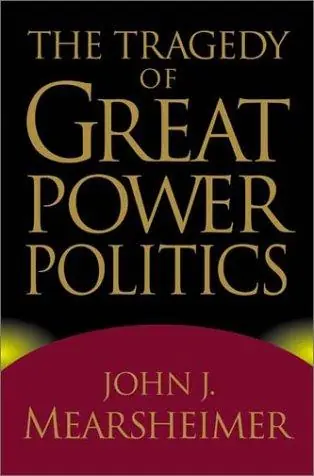
The Tragedy of Great Power Politics
by John J. Mearsheimer · first published 2001
9mentions
4recommended by
7HN commenters
2012–2024first – last mentioned
57% recommend43% neutral
Explaining his theory of "offensive realism," the University of Chicago professor of political science discusses the methods used by states to ensure their survival through military strength and regional dominance.
Affiliate links. As an Amazon Associate I earn from qualifying purchases.
I read Mearsheimer's "Tragedy of Great Power Politics", and I think it's one of the most important books ever written. It completely changed the way I think about what's going on in the world. That being said, I think on the topic of Russia and Ukraine,…
on “Why John Mearsheimer Blames the U.S. for the Crisis in Ukraine” ↗Highly recommend "The Tragedy of Great Power Politics" by John Mearsheimer. For Russia, annexing (all or part of) Ukraine now is too good a deal to pass. Russia knows that invading with an overwhelming force will result in a virtually bloodless annexation,…
on “Russia says Ukraine talks hit 'dead end', Poland warns of risk of war” ↗…Stratfor is they assume the reader has a theoretical foundation in geopolitics, economics, and military strategy and history. The core they're running on here is best summarised by John Mearsheimer in The Tragedy of Great Power Politics [1]. Much of the rest arises from macroeconomics, game theory, and military strategy. If nothing else this is valuable in that it follows closely the mindset of the US intelligence community (and many…
on “The Geopolitics of the United States” ↗…way too far in ascribing motives to Putin/Russia that he doesn't have evidence for) and I think states are generally security maximizing and not power maximizing. But Mearsheimer's book title of "The Tragedy of Great Power politics" is apt. Because the tragedy is that states have different interests than the well being of the people that live in them. I don't think pointing that out is immoral, quite the opposite; hard truths are…
on “Why John Mearsheimer Blames the U.S. for the Crisis in Ukraine” ↗…introduction. On the topic of a systemic drive to increase ones power at the expense of others, leading to escalatory and conflictual international dynamics, your go-to book is John Mearsheimer's The Tragedy of Great Power Politics. He is also in the realist school of thought like Morgenthau, although you'll find that his style of writing is much punchier and pugilistic than Morgenthau's. On the attempt to build systemically de-escalatory…
on “U.S. seeks to revive idled shipyards with help of Japan, South Korea” ↗…which I label “offensive realism,” is essentially realist in nature; it falls thus in the tradition of realist thinkers such as E. H. Carr, Hans Morgenthau, and Kenneth Waltz.”: John J. Mearsheimer. The Tragedy of Great Power Politics. >>That being said, I think on the topic of Russia and Ukraine, Mearsheimer is not consistent with his own theory (defensive realism). I completely understand why Putin is doing what he's doing, his…
on “Why John Mearsheimer Blames the U.S. for the Crisis in Ukraine” ↗I had just started reading Mearsheimer's book (The Tragedy of Great Power Politics). It's quite depressing to say the least. My plan is to finish it and then read a critique or a competing viewpoint. What would you recommend as a follow-up as a critique of Mearsheimer? Thanks in advance!
on “Overton's window creates opportunities for the brave” ↗Timothy Snyder is a historian who has written on extensively on the history of Ukraine (Bloodlands) and Putin (The Road to Unfreedom). I'm not familiar with The Tragedy of Great Power Politics, but Dr. Snyder makes some strong counterpoints to the Mearsheimer way of thinking on Ukraine in this [1] podcast and others. He has also given a timely history on modern Ukraine [2], but I have not…
on “Overton's window creates opportunities for the brave” ↗…books include Conventional Deterrence (1983), which won the Edgar S. Furniss Jr. Book Award; Nuclear Deterrence: Ethics and Strategy (co-editor, 1985); Liddell Hart and the Weight of History (1988); The Tragedy of Great Power Politics (2001), which won the Lepgold Book Prize; The Israel Lobby and U.S. Foreign Policy (2007); and Why Leaders Lie: The Truth About Lying in International Politics (2011). His articles have appeared in academic…