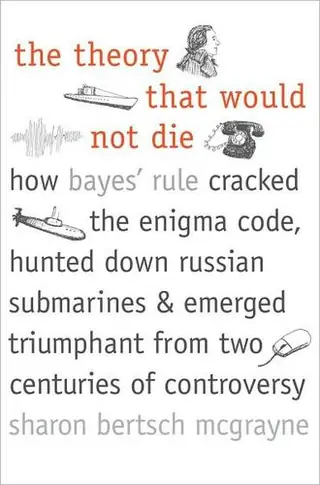
The Theory That Would Not Die
by Sharon Bertsch McGrayne · first published 2011
67% recommend33% neutral
Why HN recommends it
Entertaining, non-technical history of Bayes' rule and the long fight to legitimize it, told through a large cast (Laplace, Fisher, Pearson, Turing) and wartime uses; suits readers wanting story over math.
Summarised by Claude from recommending comments
Bayes' rule appears to be a straightforward, one-line theorem: by updating our initial beliefs with objective new information, we get a new and improved belief. To its adherents, it is an elegant statement about learning from experience. To its opponents, it is subjectivity run amok. In the first-ever account of Bayes' rule for general readers, Sharon Bertsch McGrayne explores this controversial theorem and the human obsessions surrounding it. She traces its discovery by an amateur mathematician in the 1740s through its development into roughly its modern form by French scientist Pierre Simon
Affiliate links. As an Amazon Associate I earn from qualifying purchases.
Mentions per year
What Hacker News says
Related books
 2009–2026
Bayesian data analysis
Andrew Gelman, John B. Carlin, Hal S. Stern, Donald B. Rubin
Recommended by 27 · mentioned by 4927 recommend · 49 mention27 recommend · 4927 recommend
 2012–2026
Quiet
Susan Cain
Recommended by 43 · mentioned by 5743 recommend · 57 mention43 recommend · 5743 recommend
 2010–2026
The Box
Marc Levinson
Recommended by 53 · mentioned by 6353 recommend · 63 mention53 recommend · 6353 recommend
 2016–2026
Statistical Rethinking
Richard McElreath
Recommended by 81 · mentioned by 9281 recommend · 92 mention81 recommend · 9281 recommend
 2012–2026
The Signal and the Noise
Nate Silver
Recommended by 47 · mentioned by 7947 recommend · 79 mention47 recommend · 7947 recommend
 2009–2026
The mathematical theory of communication
Claude Elwood Shannon
Recommended by 47 · mentioned by 10347 recommend · 103 mention47 recommend · 10347 recommend
 2007–2026
The Code Book
Simon Singh
Recommended by 98 · mentioned by 12198 recommend · 121 mention98 recommend · 12198 recommend
 2008–2026
Probability Theory
E. T. Jaynes
Recommended by 77 · mentioned by 13877 recommend · 138 mention77 recommend · 13877 recommend
…this your experience?). For those interested in learning more about this topic, an excellent book on the history of the Bayes theorem controversies was recently published by Yale Unviersity Press: _The Theory That Would Not Die_ by Sharon Bertsch McGrayne To be fair to Judea Pearl, I do see that he wrote an essay entitled, "Bayesianism and causality, or, why I am only half-bayesian". Nonetheless, much of his work appears to…
on “Judea Pearl, big brain behind AI, wins Turing Award (Nobel Prize in Computing)” ↗I haven't read this particular book but enjoyed "The Theory that would not die"[1] which also details the historic conflict between frequentists and the bayesian statisticians. Not sure which is the better book but "The Theory..." has a lot more Goodreads ratings than this one.…
on “Book Review: Bernoulli's Fallacy” ↗The Theory That Would Not Die [1] is a great read. It's a complete history of the fight to legitimize Bayes' theory from Bayes' original experiment through Turing and Nazi subs and beyond. Probably not the quickest way to learn…
on “Bayes' rule in Haskell (2007)” ↗"the theory that would not die" I didn't expect much, and don't think I was a fan of the first chapter because the story is pretty well known atleast in my circles. But it grows exponentially interesting as the chapters roll https://yalebooks.yale.edu/book/9780300188226/theory-would-n...
on “Ask HN: What article/book do you recommend for my next flight?” ↗The Theory That Would Not Die, by McGrayne was fun, about the history of Bayesian statistics. Also not exactly what was asked, but so good: James Gleick’s ”Information”. It is about the history of information theory or how to statistically…
on “The long story of how neural nets got to where they are [video]” ↗"The Theory that Would Not Die" by Sharon McGrayne has a good chapter on this, book is a more general history of Bayesian statistics.
on “Bletchley code breaker Betty Webb dies aged 101” ↗…Designing Secure Systems that People Can Use. Broad Band: The Untold Story of the Women Who Made the Internet. The Well: The Epic History of the First Online Community. Programmers at Work. Science The Theory That Would Not Die: How Bayes' Rule Cracked the Enigma Code, Hunted Down Russian Submarines, and Emerged Triumphant from Two Centuries of Controversy Darwin's Ghosts: In Search of the First Evolutionists The Dinosaur Hunters:…
on “Ask HN: What are your favorite non-fiction books of all time?” ↗…using code - Allen Downey's think bayes builds up bayes theorem from Numpy arrays. He's also a brilliant instructors * I want to read about the history and people and politics - Bernoulli's fallacy, The Theory That Would Not Die:, and Probably Overthinking it are all "non mathy" great armchair readings https://cup.columbia.edu/book/bernoullis-fallacy/97802311999... https://www.amazon.com/Theory-That-Would-Not-Die/dp/03001882...…
on “Bayesian Analysis with Python” ↗Bayesian here. 'The theory that would not die' is a wonderful read, and notes how many scientists used Bayesian techniques (subjective probability) in a variety of contexts while the field was still unpopular (arguably, heretical) in the mainstream…
on “How Bayes’ Rule Emerged Triumphant from Two Centuries of Controversy” ↗It looks like there are two books with similar titles - which one are you reading? Blind Man's Bluff is good, as another poster suggests. Another fun one is "The theory that would not die," about the history of Bayes rule.
on “Area 51 'declassified' in U-2 spy plane history” ↗…disagreed with the premise of prior probability. Set Bayesian research back decades. He was a strong proponent of the p-value causing some of the reproducibility crisis in scientific publications. See: "The theory that would not die" by Sharon Bertsch for a very entertaining read of the entire conflict. Full disclosure: I've published papers in Bayesian statistics.
on “Andreas Osiander: The greatest villain in the history of science?” ↗I highly recommend, 'The theory that would not die' as a highly entertaining account of the history of Bayesian statistics. It is not a technical text on the subject, but it provides some of the high level reasoning as well as several of the most important…
on “How to become a Bayesian in eight easy steps: An annotated reading list” ↗The Theory That Would Not Die (http://amzn.to/w0N2Q6)is a non-technical and nice historical overview of Bayes theorem and its applications. Another one I've enjoyed recently is Evening's Empire: A History of the Night in Early Modern…
on “Ask HN: Best non-technical book you've read lately? ” ↗There's a good book on the subject, "The theory that would not die", which covers the history and sheds some light on the people (Fisher, Laplace, Bayes, Pearson) behind the names. Reviewed: http://www.ams.org/notices/201205/rtx120500657p.pdf
on “The Great Statistical Schism” ↗Mostly crawling through ml papers on arxiv. Also going over "The Theory That Would Not Die", though this is in the realm of popular science books but it's an enjoyable getaway from it all. Edit: How to by Randall Munroe for the math-comedy realm.
on “Ask HN: What kind of math do you study in your free time?” ↗