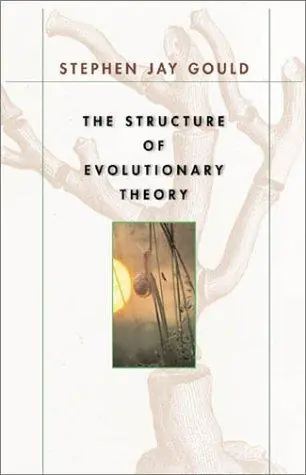
The Structure of Evolutionary Theory
by Stephen Jay Gould · first published 2002
3mentions
2recommended by
3HN commenters
2013–2017first – last mentioned
67% recommend33% neutral
The world's most revered and eloquent interpreter of evolutionary ideas offers here a work of explanatory force unprecedented in our time--a landmark publication, both for its historical sweep and for its scientific vision. With characteristic attention to detail, Stephen Jay Gould first describes the content and discusses the history and origins of the three core commitments of classical Darwinism: that natural selection works on organisms, not genes or species; that it is almost exclusively the mechanism of adaptive evolutionary change; and that these changes are incremental, not drastic. Ne
Affiliate links. As an Amazon Associate I earn from qualifying purchases.
…lay text like this, and would be entirely addressed if it had a good set of citations. It's interesting to contrast this with another book that came out around the same time, Stephen J. Gould's "The Structure of Evolutionary Theory". They are of similar size and scope, but Gould does a much better job of presenting some of his own ideas in the larger context, and giving both credit and useful pointers into that context. As far…
on “A New Kind of Science: A 15-Year View” ↗Stephen Jay Gould published a lot of books about evolution. "Evolution and Extinction" is a nice light read to get started (just to pick a random book of his). "The Structure of Evolutionary Theory" is a more formal book where he pulls together a lot of the ideas from the other books and from his research. He develops a lot of ideas in "The Structure of Evolutionary Theory"... basically: * Organisms…
on “Evolution’s Random Paths Lead to One Place” ↗…an incredibly wasteful and extravagant way to simulate the paper book UI, especially given that paper books have wildly different form factors. Do you really want to lug around a device the size of The Structure of Evolutionary Theory† to read a comic book? † 1464 pages, weighs more than 11 Kindle Paperwhites in hardcover
on “62% of 16-24s prefer books as physical products” ↗