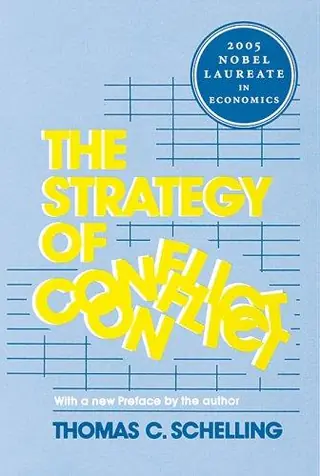
The strategy of conflict
by Thomas C. Schelling · first published 1960
64% recommend36% neutral
Why HN recommends it
Accessible, math-free game theory applied to negotiation, deterrence and commitment, showing how limiting your own options can win. Suits general readers, with or without a game theory background.
Summarised by Claude from recommending comments
Explores the international politics of threat, or, deterrence.
Affiliate links. As an Amazon Associate I earn from qualifying purchases.
Mentions per year
What Hacker News says
Related books
 2009–2022
The Time Traveler's Wife
Audrey Niffenegger
Recommended by 2 · mentioned by 82 recommend · 8 mention2 recommend · 82 recommend
 2009–2025
Taiko
Eiji Yoshikawa
Recommended by 5 · mentioned by 55 recommend · 5 mention5 recommend · 55 recommend
 2010–2025
Demian
Hermann Hesse
Recommended by 11 · mentioned by 1611 recommend · 16 mention11 recommend · 1611 recommend
 2009–2025
The Pleasures and Sorrows of Work
Alain De Botton
Recommended by 9 · mentioned by 119 recommend · 11 mention9 recommend · 119 recommend
 2008–2021
Buffett
Roger Lowenstein
Recommended by 10 · mentioned by 1210 recommend · 12 mention10 recommend · 1210 recommend
 2009–2022
Freedom from the Known
Jiddu Krishnamurti
Recommended by 14 · mentioned by 1814 recommend · 18 mention14 recommend · 1814 recommend
 2009–2024
Awaken the giant within
Tony Robbins
Recommended by 15 · mentioned by 1915 recommend · 19 mention15 recommend · 1915 recommend
 2007–2021
Voltaire's bastards
John Ralston Saul
Recommended by 9 · mentioned by 109 recommend · 10 mention9 recommend · 109 recommend
I quite agree, and think that anyone who participates on Hacker News would probably get a lot out of reading Schelling's book The Strategy of Conflict.
on “Princeton bans academics from handing copyright to journal publishers” ↗…the books that rearranged my understanding of the world the most. In no particular order. "Thinking Fast and Slow" by Daniel Kahneman. "Quantum Computing since Democritus" by Scott Aaronson. "The Strategy of Conflict" by Thomas Schelling. "Guns, Germs, and Steel" and "The World until Yesterday" by Jared Diamond. "The Retreat To Commitment" by W. W. Bartley. "The Myth of the Rational Voter" by Bryan Caplan. Despite…
on “Ask HN: What is the most mind blowing book you've ever read?” ↗…are spared. Many laws banning sexual practices are more justifiable under such laws. If society were different, such a law would be net negative, but instead it's a good idea. Thomas Schelling's "The Strategy of Conflict" talks a lot about ideas like these style arguments and I would recommend reading it. For example, it is often illegal to take or display a picture of your voting ballot, since making that universally…
on “Show HN: Compare LGBT Rights Between Any Country, State, or Province” ↗I agree but also recommend the book "strategy of conflict" by Thomas Schelling. It's a counterpoint that shows why highly specific contracts are important, especially with regards to binding oneself to future actions.
on “Falklands minefields: de facto nature reserves for penguins” ↗Not Sun Tzu. Thomas Schelling. His books "The Strategy of Conflict" and "Arms and Influence" are essential reading. They were influential bringing game-theory into the nuclear strategy, disarmament and foreign policy.
on “China's fragility is as worrying as its strength” ↗…to the French Revolution on what are states, where do they come from, and how do they work? The Vital Question: Energy, Evolution, and the Origins of Complex Life is just what it says on the tin. The Strategy of Conflict is the original book on game theory which stands up pretty well. Consciousness and the Brain: Deciphering How the Brain Codes Our Thoughts on the modern science of what we know about what consciousness…
on “Ask HN: What are your favorite non-fiction books of all time?” ↗Thomas Schelling - The Strategy of Conflict Frans P.B. Osinga - Science, Strategy, and War: The Strategic Theory of John Boyd
on “What Would You Recommend to a Bright 14 Year Old?” ↗> "The Strategy of Conflict" by Thomas Schelling. "Strategy: The Logic of War and Peace" by Edward N. Luttwak
on “Ask HN: What is the most mind blowing book you've ever read?” ↗…literally entered Paris because of the resulting mutually assured destruction. This lead to the formation of ideas like the tripwire force [1]. If you're interested in such topics, I can recommend "The Strategy of Conflict" by Thomas C. Schelling. If there were credibility problems then, when America was on a much more martial and pro-free-europe footing, the situation is hardly any better now. Although there is a lot…
on “Declassified videos of atmospheric nuclear tests (2017)” ↗…dilemma..." turns out to be a very useful vocabulary for thinking about situations, from everyday life up to superpower conflict. For a great introduction from this point of view, check out Thomas Schelling's Strategy of Conflict. No maths, just a great read from a Nobel prize winner.
on “Game Theory (2007)” ↗…theory of proliferation and how an arms race works, or is there just not that much information available? I don't have a youtube video for you, but I do have a book recommendation: Thomas Schelling's "The Strategy of Conflict" from 1960. The writing is extremely clear and accessible, by the standards of nobel-prize-winning economists.
on “The Vela Incident (1979)” ↗Classic text that discusses some of this: The Strategy of Conflict by Thomas Schelling. He has, for example, an interesting discussion showing how having less information about one's opponent or less freedom of decision can actually put that party in a stronger position.
on “Terence Tao: Game theory, politics and control of information” ↗…utterly brilliant. I cannot recommend all three of the books wikipedia classed as his notable works highly enough: https://en.wikipedia.org/wiki/Thomas_Schelling#Notable_works There are footnotes in "The Strategy of Conflict" containing more profound insight than whole books that are published today. On this particular topic though "Strategy and Arms Control" is the one to go for.
on “Pacing the frontier” ↗…long (and I am OLD) science fiction fan, the fawning over The Remembrance of Earth's past is just silly. The concept of "suspicion". Might I suggest that people read Thomas Schelling's seminal work The Strategy of Conflict to begin with since if you want to understand concepts like brinksmanship and the push and pull of actual inter-civilization (or society or nation state) conflicts then you might want to start there and…
The beginning of PART II in his book "The Strategy of Conflict" is good intro to what he was thinking. PART II. A REORIENTATION OF GAME THEORY 4. TOWARD A THEORY OF INTERDEPENDENT DECISION On the strategy of pure conflict - the zero-sum games - game theory has…
on “Thomas Schelling has died” ↗