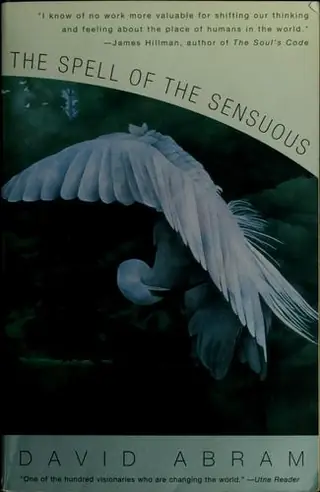
The spell of the sensuous
by David Abram · first published 1996
89% recommend11% neutral
Why HN recommends it
Dense but rich philosophy on how the alphabet and literacy shape perception, drawing on phenomenology and oral cultures; recommended as a starting point for readers curious about embodied, non-symbolic ways of thinking.
Summarised by Claude from recommending comments
[In this book, the author] draws on sources as diverse as the philosophy of Merleau-Ponty, Balinese shamanism, Apache storytelling, and his own experience as an accomplished sleight-of-hand magician to reveal the subtle dependence of human cognition on the natural environment. He explores the character of perception and excavates the sensual foundations of language, which - even at its most abstract - echoes the calls and cries of the earth.
Affiliate links. As an Amazon Associate I earn from qualifying purchases.
Mentions per year
What Hacker News says
Related books
 2015–2024
Becoming animal
David Abram
Recommended by 5 · mentioned by 55 recommend · 5 mention5 recommend · 55 recommend
 2007–2026
The origin of consciousness in the breakdown of the bicameral mind
Julian Jaynes
Recommended by 52 · mentioned by 10652 recommend · 106 mention52 recommend · 10652 recommend
…a judgement on the basis of a summary. From another angle, I enjoy (if don't quite know what to make of) David Abram's critique of the Enlightenment in his Becoming Animal and (more particularly) The Spell of the Sensuous. His target is really disembodied/symbolic thinking as such, but the Enlightenment might be considered a (proclaimed) victory of that line of human cognitive history.
on “The Myths of Enlightenment” ↗There's a book called The Spell of the Sensuous by David Abram, and a sequel called Becoming Animal, that I think are relevant. They aren't based on neuroscience but philosophy (mostly Merleau-Ponty phenomenology, a little bit of McLuhan, plus an interesting…
on “This Is Your Brain on Nature” ↗For a phenomenological treatment, see The Spell of the Sensuous by David Abram. The idea that consciousness exists throughout the world as a gradient is not new. The modern industrial conception of mind (newly transformed by the technological revolution) prescribes…
on “Is Matter Conscious? (2017)” ↗I agree. You should check out “Becoming Animal” and “The Spell of the Sensuous”, both by David Abram
on “Are animals conscious? New research” ↗David Abram's 1996 book The Spell of the Sensuous a good starting point. This was also a central theme in a lot of the late John Moriarty's work (although approached more obliquely and holistically than Abram imo). That mantle has been picked up by…
on “Rewilding the Self” ↗…The letters themselves are completely different from the things they are describing. And they might be one of the first objects in human history that work like this... Anyway, the book is called the Spell of the Sensuous, and it's dense af, but bursting with fascinating lines of inquiry.
on “The Cult of the Root Cause” ↗…(memory aids) — the more extreme the story, the easier it is to remember / recall the underlying message. That's how our brains work. I recommend a book about oral cultures (and storytelling) called: The Spell of the Sensuous.
on “How Inuit parents teach kids to control their anger (2019)” ↗women hold up half the sky. i was ignorant to a lot of suffering in the world before I read this book. very emotional read. spell of the sensuous. mind bending history of the alphabet, the effect of being literate on your ways of thinking and an introduction to phenomenology and our original sin of considering "nature" to be an "other"
on “Ask HN: Which non-fiction books had the biggest impact on you?” ↗David Abrams wrote a book called The Spell of the Sensuous (1996) that's related. The subtitle is "Perception and Language in a More-Than-Human World." TL;DR: modern life is rubbish; go hiking. Humans grew up in "nature," whatever that means. Basically they…
on “Can a Wandering Mind Make You Neurotic?” ↗There's some tangentially relevant ideas in a book called "The Spell of the Sensuous," and also in various works by McLuhan. I think the basic idea is attributed to Eric Havelock. This essay seems to be relevant though I just started skimming it: http://journal.oraltradition.org/files/articles/1i/6_haveloc...…
on “I have five digital ‘personal assistants’ and still can’t get anything done” ↗…countries. The book confronts issues like gender inequality, sexual violence, maternal mortality and economic disparity while highlighting the resilience and strength of ordinary women in overcoming them. * "Spell of the Sensuous" (1 mention, author not specified) * Summary: This book offers a radical reinterpretation of our relationship with the natural world. It critiques Western civilization’s estrangement from nature,…
on “Ask HN: Which non-fiction books had the biggest impact on you?” ↗