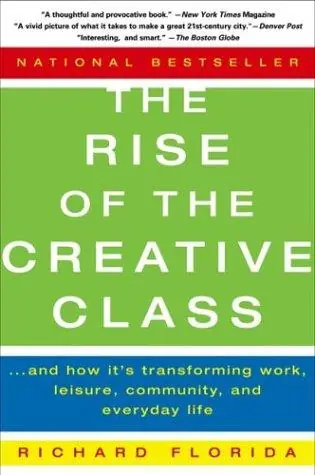
The Rise of the Creative Class
And How It's Transforming Work, Leisure, Community and Everyday Life
by Richard Florida · first published 2002
12mentions
3recommended by
10HN commenters
2009–2022first – last mentioned
30% recommend70% neutral
Here, Richard Florida traces the fundamental theme that runs through a host of seemingly unrelated changes in American society: the growing role of creativity in our economy. He describes a society in which the creative ethos is increasingly dominant.
Affiliate links. As an Amazon Associate I earn from qualifying purchases.
Richard Florida's fascinating Rise of the Creative Class purports to explain this. In short, startup culture heavily correlates with acceptance and welcoming of diverse lifestyles, and distaste for conformity and conventions --- things which correlate heavily…
on “Ask HN: Does innovation have a liberal bias?” ↗…while espousing sardine can overcrowding, bicycles and public transport for the plebs. There is no reason to continue to expand giant historic cities at this point in history, that era is now over. ' The Rise of the Creative Class hit on what now seems blindingly obvious: that the “clustering force” of young creatives and tech workers in metropolitan areas was leading to greater economic prosperity. Don’t waste money on stadiums…
on “What Happened When The San Francisco Bay Area Rejected Growth” ↗I recommend The Rise of the Creative Class.
on “The first non-bullshit book about culture I've read” ↗…knowledge work becomes largely remote then I think cities could lose a lot of this vibrancy as people may not have a lot of reason to cluster in this way in the future. Side note, Richard Florida's "Rise of the Creative Class" talks about a lot of the effects and benefits of people clustering in cities (but in my opinion he only does a so-so job talking about the causes), and I'd be curious to see what other urban planners…
on “Facebook to shift permanently toward more remote work after coronavirus” ↗See Richard Florida's "Rise of the Creative Class" or sequels for a broad overview of talent concentration.
on “The New San Francisco Suburbs, a Plane Ride Away” ↗In Richard Florida's "The Rise of the Creative Class", he describes an experiment, complete with empirical data, that show an overwhelming positive correlation between gay-friendliness and positive economic outlook.
on “Why One of Silicon Valley’s Savviest Investors Has Shut His Wallet” ↗It's worth noting that this article is written by Richard Florida (http://en.wikipedia.org/wiki/Richard_Florida), whose 2002 book The Rise of the Creative Class (http://www.creativeclass.com/richard_florida/books/the_rise_...) introduced the idea that struggling cities could find new prosperity by reinventing themselves to become more attractive to the "creative…
on “One Reason It’s So Hard to Become a 'Creative Superstar City'” ↗You may be thinking of Richard Florida - https://en.wikipedia.org/wiki/Richard_Florida - he talked about economic megaregions in his book 'The Rise of the Creative Class'.
on “Megacities, not nations, are the world’s dominant, enduring social structures” ↗While I was in prison, I received The Rise of the Creative Class. I also received an Artificial Intelligence textbook as well. And I received Headstrong. I did a lot of reading. In fact, once I got a chance to go to the computer lab, I wrote upwards of 100 articles.…
on “Sharing Books with My Dad in Prison” ↗This essay sets up a straw man. The "creative class" was originally defined, in the book "Rise of the Creative Class," as people working in industries "from technology to entertainment, journalism to finance, high-end manufacturing to the arts."[1] The essay focuses on the worst performing of these industries to imply…
on “The creative class is a lie” ↗Top right shelf contains "Jonathan Strange & Mr Norrell" (in black) and the Harry Potter series. Below that "The Rise of The Creative Class" (green). Middle left contains "America (The Book)" (red). Fun exercise.
on “Rands: The Book Stalker” ↗…associate this idea with Richard Florida, who has written about the Creative Class and the Tolerance Index: "The map above shows how metros across the U.S. score on the Tolerance Index, as updated for The Rise of the Creative Class, Revisited. The chart below shows the top 20 metros. Developed by my Martin Prosperity Institute colleague Kevin Stolarick, it ranks U.S. metros according to three key variables—the share of immigrants…
on “Trying to ‘Save’ the Rural Economy” ↗