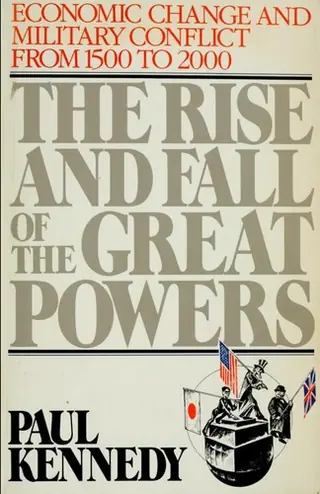
The Rise and Fall of the Great Powers
Economic Change and Military Conflict from 1500 to 2000
by Paul M. Kennedy · first published 1987
54% recommend38% neutral8% critical
Why HN recommends it
A readable history of how great powers gain and lose dominance, framed around economic growth, technology, and overextension; praised as engaging for armchair historians and readers who found school history dull.
Summarised by Claude from recommending comments
El eminente historiador Paul Kennedy analiza y describe el auge y la caída de las grandes potencias a lo largo de los últimos cinco siglos. La nación proyecta su poder militar según sus recursos económicos, pero el alto coste de mantener la supremacía militar la precipita a la decadencia. las grandes potencias en crisis reaccionan gastando más en defensa y se debilitan desviando recursos productivos. A lo largo de la historia ha existido una significativa correlación entre las capacidades productivas y la fuerza militar. Una obra esencial para comprender la actual encrucijada mundial.
Affiliate links. As an Amazon Associate I earn from qualifying purchases.
Highly recommended: Rise and Fall of the Great Powers (Paul Kennedy) - http://en.wikipedia.org/wiki/The_Rise_and_Fall_of_the_Great_... You're absolutely right about the Spanish, but it would be more appropriate to say the Hapsburgs, because what we're really…
on “China bans English words in media” ↗I've read Kennedy's The Rise and Fall of the Great Powers too (good book). However it's hard to see how the Great Powers "model" applies when everyone has nuclear weapons or can acquire them relatively easily.
on “Why 1866 Set the Stage for Two World Wars” ↗…that India was fabulously, spectacularly wealthy… like all of the gold and silver (taken and squandered in China by the Spanish) from the Americas plus some to spare. "The Anarchy" and Kennedy's "The Rise and Fall of the Great Powers" make for great reading for the armchair historian.
on “Some things to learn from the British East India Company's growth and demise” ↗I kind of agree. I hated History all through school but I found a copy of Paul Kennedy's "The Rise and Fall of the Great Powers" I all of a sudden found myself engrossed by it. It was a bit above my level when I first picked it up but I kept going back to it.
on “Why Most People Think Memorizing Historical Facts is Useless (and Why It Isn’t)” ↗On the flip side, Paul Kennedy's "The Rise and Fall of the Great Powers" is a fascinating read on the benefits of decentralization. The premise is that in the 1500s, no one thought Europe was going to be the next great power. The dominant civilizations at the time were the…
on “The Tyranny of Structurelessness (1970)” ↗Check out Paul Kennedy's "The Rise and Fall of the Great Powers" for an interesting take on this dynamic for nation-states and political economies. His core thesis is that dominant powers rise as new players leverage new technologies (especially energy technologies),…
on “Solar power has begun to transform the world’s energy system” ↗…major conflict, this was always going to happen. Two things are important to think about. 1. Power should be measured in relative terms not absolute. (For a good treatise on this, read Paul Kennedy's Rise and Fall of the Great Powers). The US would have to be keeping up with China, India, and rest of world to maintain its previous pole position. 2. Great nations/empires generally become so at least partially through population growth.…
on “Thomas Piketty: 'The reality is the US is losing control of the world'” ↗…freedom where people can come and build great lives. But that is not the direction we are going, and one might reasonably forecast that no country can maintain indefinite dominance. Paul Kennedy wrote "The Rise and Fall of the Great Powers" almost 40 years ago. Regression to the mean and all that, but also, great powers tend to overstep.
on “De-dollarization: Is the US dollar losing its dominance?” ↗…in its ex-colony. If you join British Empire and American hegemony together, get 400 years of expanding Anglo-Saxon culture with internal power shifts (like different dynasties in China). In the "The Rise and Fall of the Great Powers", Kennedy argues that all Western powers in last 500 years are drawn into strategic entanglements that force them to spend more of their GDP on defense. This leads to domestic underinvestment. First…
on “The decline of US power?” ↗As Paul Kennedy explains in The Rise and Fall of the Great Powers, one consequence of the unending warfare in Europe was the development of better financial institutions such as central banks. The problem is that warfare is very expensive, so states were always going…
on “Why the Industrial Revolution Didn’t Happen in China” ↗Similar arguments made by Paul Kennedy in his seminal work Rise and Fall of the Great Powers (1987): https://en.wikipedia.org/wiki/The_Rise_and_Fall_of_the_Great...
on “‘Content network effect’ makes TikTok tough to copy” ↗…spent in other books. For example, the non-technical books I just finished are Madame Bovary (translated by Lydia Davis. Highly recommend), On the Move (autobiography by Oliver Sacks). I am re-reading The Rise and Fall of the Great Powers. Also, I don't like beer. When I go out with colleagues, I drink wine or strong liquors. I can tell my colleagues what I like now, but it was different when I first joined the industry. I cram-watched…
on “What Really Keeps Women Out of Tech” ↗…I’m reading “The New Leviathans” by Gray right now. It includes the ideas of Turchin in its analysis of the “decline of liberalism” and I’m intrigued (and concerned) by the arguments. But I read “The Rise and Fall of the Great Powers” when in came out in 1987, found it convincing, and yet practically everything it predicted went wrong within 5 years.
on “Turchin's Terrifying Predictions” ↗