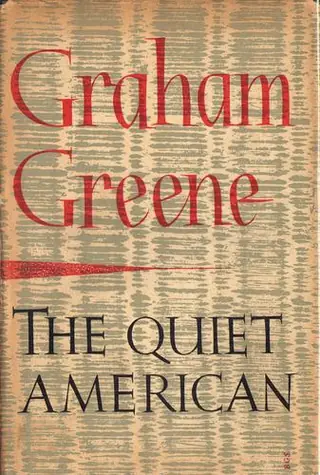
The Quiet American
by Graham Greene · first published 1940
54% recommend46% neutral
Why HN recommends it
A taut spy novel set in Vietnam, offering insight into American foreign policy and regime change through a strong story. A good pick for readers who like political thrillers.
Summarised by Claude from recommending comments
One of Graham Greene's best works. The story is set at the time of the French war against the Viet Cong and tells the story of liberal British journalist Thomas Fowler, his mistress Phuong, and their relationship with American idealist Pyle. The latter is an earnest young man indocrinated with geo-political theory and whose attempts to shape the world to American ideals ends in his own personal tragedy and drastically alters the lives of the other two participants. Written before the US involvement in Vietnam this is a strangely prophetic work and seriously encapsulates the British viewpoint t
Affiliate links. As an Amazon Associate I earn from qualifying purchases.
Mentions per year
What Hacker News says
Related books
 2010–2024
Our Man in Havana
Graham Greene
Recommended by 8 · mentioned by 178 recommend · 17 mention8 recommend · 178 recommend
 2020–2021
Unquiet Englishman
Richard Greene
0 recommend · 4 mentioned0 recommend · 4 mention0 recommend · 40 recommend
 2009–2025
The Power and the Glory
Graham Greene
Recommended by 7 · mentioned by 137 recommend · 13 mention7 recommend · 137 recommend
 2016–2021
The Comedians
Graham Greene
Recommended by 3 · mentioned by 43 recommend · 4 mention3 recommend · 43 recommend
 2020–2023
Monsignor Quixote
Graham Greene
Recommended by 3 · mentioned by 43 recommend · 4 mention3 recommend · 43 recommend
 2016–2025
The Spy Who Came in from the Cold
John le Carré
Recommended by 14 · mentioned by 2614 recommend · 26 mention14 recommend · 2614 recommend
 2007–2026
Foundation
Isaac Asimov
Recommended by 143 · mentioned by 487143 recommend · 487 mention143 recommend · 487143 recommend
While on the topic of Graham Greene - I recommend his novel Quiet American. Written in the mid 50s it shows amazing insight into the future of American foreign policy and regime change. And does so through a great story.
on “How Orson Welles Stole ”The Third Man”” ↗Just to add to the recommendation of The Quiet American: my edition includes a collection of Greene’s screenplay treatments, which is basically a master class in plot development.
on “Unmasking Graham Greene” ↗Graham Greene's The Quiet American has a similar feel. About an American spy in Vietnam. Edit: Also, Mick Heron's Slow Horses series, based on a group of outcaste MI5 spies in London. (The first book was made into a TV series on Apple…
on “John le Carré's 'The Spy Who Came in from the Cold' is the ultimate spy novel” ↗Just about any Graham Greene book: The Power and the Glory. The Quiet American, The Ministry of Fear, The Comedians, Our Man in Havana etc.
on “Ask HN: What are some great fiction reads for someone that reads non-fiction” ↗…still a poor assumption to think the fiction ever got it right, starting with the confusion over what an “agent” is but including everything else. Excepting Graham Greene’s “Our Man in Havana” and “The Quiet American,” which I suspect nailed the respective damnfool incompetence and arrogant ignorance of a certain type of mid-century patriot keenly. “Harlot’s Ghost,” though mystical, may also speak bizarro truth.
on “CIA director says he is escalating efforts to solve 'Havana Syndrome'” ↗…doom and unease just comes with his world view I think and you can never escape that in his novels. Our man in Havana is quite fun without being too heavy, so that might be a good place to start. The Quiet American is also good and concerned with the end of another empire (the French colony in Vietnam), and the sharp end of the US intervention there.
on “Unmasking Graham Greene” ↗…little tale of a small-town thug. The Power and The Glory: A very, very catholic novel, but also a cracking thriller. The End of the Affair: Another very catholic novel, but also very different. The Quiet American: Hard to express exactly how good this one is. Vietnam, spies, and a huge indictment of "decent people". Monsignor Quixote: Life after fascism, and a ridiculous priest who may, in fact, be a saint.
on “The paradox of Graham Greene” ↗Always throws me off when I see his name because I first think of the actor rather than the author! The part about being prophetic about the Cuban Missile Crisis was interesting, and I think I'll add The Quiet American to my reading list: [Greene's] previous full-length novel, The Quiet American (1955), anticipated tragic US military entanglement in Vietnam a decade later. Meanwhile, his Havana-based story would prove…
on “Our Graham Greene in Havana” ↗…Communications at the CFR; Scott Malcolmson, former senior State Department advisor; and Jared Cohen, advisor to both Hillary Clinton and Condoleezza Rice, a kind of Generation Y Kissinger figure — a noisy Quiet American as the author Graham Greene might have put it. Google started out as part of Californian graduate student culture around San Francisco’s Bay Area. But as Google grew it encountered the big bad world.…
on “Google and the NSA: Who’s holding the ‘shit-bag’ now?” ↗Exactly. I hadn't read any Graham Greene previously. I went and bought "Our Man in Havana" and "The Quiet American" because of this submission, and threw in a copy of Hemingway's "The Old Man and the Sea" because it was suggested by Amazon and a pal of mine raves about it. This is what I like about HN, pointers to…
on “Agents of Betrayal: A Reconsideration of Graham Greene’s Our Man in Havana” ↗…technology to a grand house in the country and membership in the upper classes--almost like flotsam on the rising tide of economic progress. There's a lot of Gatsby in there and some hints of Graham Greene's quiet American as well. Just as you can argue that AI the technology is part and parcel of industrialization, its social effects recall recurring conflicts in American society and culture that authors like Fitzgerald…
on “The Artificial Intelligentsia” ↗Another critique of the same war from a more famous author, Graham Greene, with a similar title, published three years earlier than Burdock, The Quiet American , set the narrative for future generations of political analysts and pundits for years to come. Greene, himself a former member of the intel community, penned this to explain that no matter how "in touch"…
on “The 480” ↗Greene is certainly a more literary writer with more human insight, and le Carré would be more plot driven. I read Havana, Brighton, and Quiet American decades ago now. Genre wise, Alan Furst apparently took up the gauntlet, but his characters seemed like unmemorable plot devices to me.
on “Graham Greene Against the World” ↗