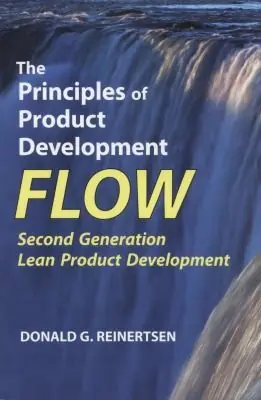
The Principles of Product Development Flow
by Donald G. Reinertsen · first published 2009
85% recommend15% neutral
Why HN recommends it
Applies queueing theory, cost of delay, and variability to product and software development, explaining the principles behind Scrum and kanban. Suits engineers and managers who want rigor and accept dense prose.
Summarised by Claude from recommending comments
Affiliate links. As an Amazon Associate I earn from qualifying purchases.
Mentions per year
What Hacker News says
Related books
 2021–2023
Lean Product and Process Development
Allen C. Ward, Ward, Allen, C.
Recommended by 1 · mentioned by 21 recommend · 2 mention1 recommend · 21 recommend
 2008–2026
The goal
Eliyahu M. Goldratt, Jeff Cox, Ensemble cast, Dwight Jon Zimmerman
Recommended by 85 · mentioned by 12085 recommend · 120 mention85 recommend · 12085 recommend
 2013–2026
The Phoenix Project
Gene Kim, Kevin Behr, George Spafford
Recommended by 166 · mentioned by 270166 recommend · 270 mention166 recommend · 270166 recommend
Large-Scale C++ Volume I
John Lakos
Recommended by 2 · mentioned by 42 recommend · 4 mention2 recommend · 42 recommend
 2021–2022
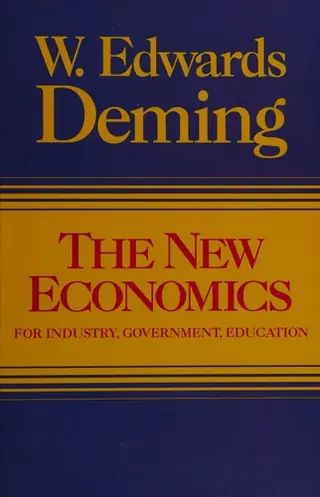
The new economics for industry, government, education
W. Edwards Deming
Recommended by 2 · mentioned by 42 recommend · 4 mention2 recommend · 42 recommend
 2011–2024
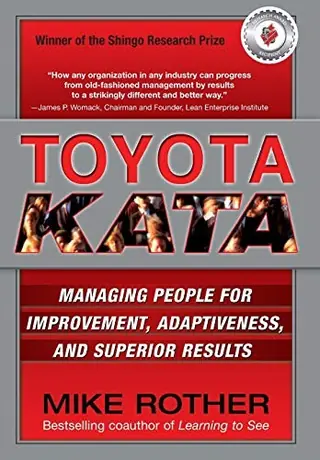
Toyota kata
Mike Rother
Recommended by 4 · mentioned by 64 recommend · 6 mention4 recommend · 64 recommend
 2008–2025
The machine that changed the world
James P. Womack
Recommended by 24 · mentioned by 3324 recommend · 33 mention24 recommend · 3324 recommend
Debugging Teams
Brian W. Fitzpatrick, Ben Collins-Sussman
Recommended by 4 · mentioned by 84 recommend · 8 mention4 recommend · 84 recommend
…they probably don't know any better. I was drawn to SAFe after posting a lot of venting thoughts on my blog, that got picked up here and somebody on this forum recommended a fantastic book to me. The Principles of Product Development Flow: 2nd Generation Lean Product Development by Donald Reinertsen. https://news.ycombinator.com/item?id=17154355 This book is not rigid, nor are the principles within it. I used those principles to very…
on “The SAFe Delusion” ↗…ought to do are not actually necessary. There are way too many books to recommend here, but perhaps some of the most relevant are - Deming's The New Economics, and Out of the Crisis, - Reinertsen's Principles of Product Development Flow, - Ward's Lean Product and Process Development.
on “Ask HN: Best books on managing software complexity?” ↗Don Reinertsen mentioned it. At least in a talk, and maybe in his book "The Principles of Product Development Flow". That's only 1 example, but in my personal estimation he's one of the two most effective management theorists I know. Though I wish he were a better explainer. (The other of course is Shanley Kane.)
on “How to use your full brain when writing code” ↗…focusing on the wrong metric. In order to deliver more customer value faster focus instead on driving down the cost of delay. For a detailed quantitative economic analysis of why this works please read "The Principles of Product Development Flow" by Donald G. Reinertsen. (Trust me it's one of the 10 best books on practical software management and will recalibrate your thinking in multiple areas.) For large complex software systems every team…
on “Working remotely with 150+ people” ↗A favorite quote of mine from Donald G Reinertsen's Principles of Product Development Flow: I used to think that sensible and compelling new ideas would be adopted quickly. Today, I believe this view is hopelessly naive. After all, it took 40 years before we recognized the power of the Toyota…
on “Why Japan lost its comparative advantage in producing electronic parts” ↗This hits on exactly why I was drawn to SAFe. After all the feedback I got from this... https://news.ycombinator.com/item?id=17154355 Someone pointed me to Reinertsen's Principles of Product Development Flow book, which put into numbers and models everything I'd been trying to say (and then some). It worked great with my team, but I was failing hard at communicating and involving everyone on the business…
on “Driving engineers to an arbitrary date is a value destroying mistake” ↗…underlying theory, but these books swing the pendulum more towards the theory side of things: Lean Software Development (Mary and Tom Poppendieck) - if you only read one, this is the one to read The Principles of Product Development Flow (Tom Reinertsen) Agile Software Development, 2nd. ed. (Alistair Cockburn) Extreme Programming Explained, 2nd ed. (Kent Beck) The Lean Startup (Eric Ries)
on “Ask HN: Does the Scrum Framework Work?” ↗…than inventing a programming language. They are different kinds of things. Many operations principles however can be successfully applied to innovation. For an excellent read on the topic, read "The Principles of Product Development Flow" by Reinertsen. To get a better understanding of operations in general, and not the hyperbole advanced in the article a good starting place is "The Goal" by Goldratt. One big revelation I learned while…
on “An Operations Mindset is at Odds with Innovation” ↗For a more detailed explanation of the importance of minimizing work in progress (i.e. inventory) I highly recommend "The Principles of Product Development Flow" by Donald G. Reinertsen. It contains a thorough economic analysis based on queuing theory. http://www.leanproductflow.com/buy-the-books/
on “Why Is Your Team Falling Behind? Ask ‘The Penny Game’” ↗That's an interesting idea. I picked up this book, Principles of Product Development Flow, based on some recommendations I think I came across here on HN: https://www.goodreads.com/book/show/6278270-the-principles-o... Reinertsen really helps you appreciate the costs associated with queues…
on “Show HN: Tet – A todo app that deletes your tasks at the end of the day” ↗The Principles of Product Development Flow: Second Generation Lean Product Development http://amzn.to/2DK6kVP
on “Ask HN: Best books you read in the past decade?” ↗…"Simple Excellence: Organizing and Aligning the Management Team in a Lean Transformation", but there are a bunch. And for software specifically, Mary Poppendieck's work is great, as well as Reinertsen's "Principles of Product Development Flow".
on “Managers, not workers, are losing jobs to AI and robots: study” ↗…https://en.wikipedia.org/wiki/Toyota_Kata For applying it in software, I loved Mary Poppendieck's books, which are listed about half-way down the page here: http://www.poppendieck.com/ And for the math-inclined, Reinertsen's "Principles of Product Development Flow" is very insightful: https://www.amazon.com/Principles-Product-Development-Flow-G...
on “The Toyota Production System (2013)” ↗1) Meditations, Marcus Aurelius 2) Principles of Product Development Flow, Donald G. Reinertsen 3) Step Away from the Computer or Hammock Driven Development, Rich Hi ckey https://github.com/matthiasn/talk-transcripts/blob/master/Hi...
on “Ask HN: Books that impacted your work that few other people seem to care about?” ↗If you want someone to translate it to software for you, Reinertsen's Principles of Product Development Flow is about adapting the philosophy to knowledge work. Ward's Lean Product and Process Development is also a good take on those ideas.
on “Deming's Red Bead Experiment (2002)” ↗