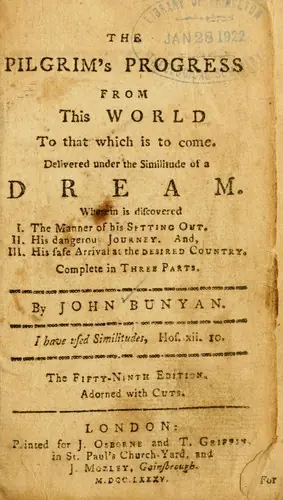
The Pilgrim's Progress
by John Bunyan · first published 1678
25% recommend75% neutral
Why HN recommends it
An allegorical Christian classic and one of the most widely owned and influential books ever written, frequently paired with the Bible. A strong choice for those interested in religious literature.
Summarised by Claude from recommending comments
Bunyan's allegory uses the everyday world of common experience as a metaphor for the spiritual journey of the soul toward God. The hero, Christian, encounters many obstacles in his quest: the Valley of the Shadow of Death, Vanity Fair, Doubting Castle, the Wicket Gate, as well as those who tempt him from his path (e.g., Talkative, Mr. Worldly Wiseman, the Giant Despair). But in the end he reaches Beulah Land, where he awaits the crossing of the river of death and his entry into the heavenly city. "Pilgrim's Progress" was enormously influential not only as a best-selling inspirational tract in
Affiliate links. As an Amazon Associate I earn from qualifying purchases.
Mentions per year
What Hacker News says
Related books
Plague
Albert Camus, Laura Marris
Recommended by 8 · mentioned by 118 recommend · 11 mention8 recommend · 118 recommend
 2018–2026
The Broken Earth Trilogy
N. K. Jemisin
Recommended by 21 · mentioned by 2921 recommend · 29 mention21 recommend · 2921 recommend
 2010–2024
Civil Disobedience
Henry David Thoreau
Recommended by 5 · mentioned by 235 recommend · 23 mention5 recommend · 235 recommend
 2010–2025
Narcissus and Goldmund
Hermann Hesse
Recommended by 19 · mentioned by 2719 recommend · 27 mention19 recommend · 2719 recommend
 2008–2026
A Portrait of the Artist as a Young Man
James Joyce, J Joyce
Recommended by 11 · mentioned by 3311 recommend · 33 mention11 recommend · 3311 recommend
 2011–2026
Bleak House
Charles Dickens
Recommended by 7 · mentioned by 357 recommend · 35 mention7 recommend · 357 recommend
 2007–2026
The Sound and the Fury
William Faulkner
Recommended by 7 · mentioned by 327 recommend · 32 mention7 recommend · 327 recommend
 2008–2026
Lord of Light
Roger Zelazny
Recommended by 37 · mentioned by 4437 recommend · 44 mention37 recommend · 4437 recommend
The Pilgrim's progress. John Bunyan
on “Ask HN: Which book would you pick to re-read for the rest of your life?” ↗Yeah, I was surprised to not see any religious books. That's a good one I hadn't thought of. I was thinking of Pilgrim's Progress by John Bunyan, one of the most popular books ever written by American and probably the most owned book in the country for an era.
on “Books That Shaped America” ↗The Bible, definitely. Pilgrim's Progress, by John Bunyan. Those are the two most published books in history and have changed more people's thinking than any two other books.
on “Ask HN: What books changed the way you think about almost everything?” ↗…you have never scrambled through a dirty valley? How do you know that your gourmet meal is perfect of its kind if you have never eaten a roadside hot dog? If you want to know what a masterpiece The Pilgrim's Progress is, read Bonfire of the Vanities, and if you have any taste -- which of course may not be the case -- you will quickly find out. So I advise you, as well as reading great books that I have been talking…
on “On the Digestion of Great Books” ↗1) The Pilgrim's Progress, and 2) The Holy War - John Bunyan
on “Ask HN: Great fiction books that have had a positive impact on your life?” ↗…with Douglas back in the day and we worked together a bit. Douglas once told me he got sent a very detailed PhD thesis that described how The Hitchhikers Guide was an elaborate parody of John Bunyan's "Pilgrim's Progress" (1678). The main evidence was that "Pilgrim's Progress" is known to be partly inspired by a pamphlet called, "The Plain Man's Path to Heaven", written by, get this, a puritan named Arthur Dent. Douglas…
on “1984: The Hitchhiker's Guide to the Galaxy” ↗…probably psychologically insupportable; even Muslims and Calvinists, who believe in double predestination (and Marxists, who believe in historical determinism), live as if free will was true. (Read _The Pilgrim's Progress_ and tell me that Bunyan really believed Puritan doctrines...)
on “Think You're Operating on Free Will? Think Again” ↗(Very) OT: I would hazard a guess the striking phrase in the title originates (indirectly if not intentionally by the author) from "Slough of Despond" in The Pilgrim's Progress by John Bunyan. https://en.wikipedia.org/wiki/Slough_of_Despond https://www.gutenberg.org/ebooks/131
on “How to Escape the Startup Trough of Sorrow” ↗…the comments there, a list of "that" usages where you would dictate "who": "a woman that feareth the Lord" (Proverbs 31:30, King James Bible) "Then I saw the man that sat upon the cloud" (John Bunyan, Pilgrim's Progress) "While I stood thus amusing the Lady that was with me" (Daniel Defoe, Roxana) "The man that hath no music in himself" (William Shakespeare, The Merchant of Venice) "He, the most excellent Man that can…
on “The 34 Women That Won The Nobel Prize” ↗yeah, but if it wasn't assigned reading for History and African-American Studies classes, who'd be reading it? I read Pilgrim's Progress in high school, too. That doesn't mean it's a popular book.
on “The Life, Death–and Afterlife–Of Literary Fiction” ↗…stimulating musical experience. Nothing, I mean nothing, in the rock music catalog comes close to what the Lamb achieves: what other album weaves in references to Sondheim's West Side Story, Bunyan's Pilgrim's Progress, Keats' Lamia, and Carl Jung? The storyline was almost entirely written by Peter Gabriel, who loves word play, which is peppered throughout the lyrics. Even the title itself is an allegorical word play,…
on “Music vs. Lyrics” ↗…exchanged there, and even more contracts for goods. Nearby Stourbridge fair was the largest in Europe: https://en.m.wikipedia.org/wiki/Stourbridge_fair and the inspiration for Bunyan's "Vanity fair" in "Pilgrim's Progress"
on “Cows get GPS collars to stop them falling in river” ↗Yes, I've read the History of Redemption by Edwards, The Pilgrim's Progress and Holy War by Bunyan, quite a few Spurgeon sermons, and Holiness by Ryle in addition to (parts of) his commentaries on the gospels. I also read the puritans - I read Thomas Brook's Precious Remedies…
on “TimeCapsuleLLM: LLM trained only on data from 1800-1875” ↗Ben Franklin imitated John Bunyan from Pilgrim's Progress if I am not wrong.
on “Ask HN: How can I become more eloquent?” ↗It seems like most of the Christian books on SE are Roman Catholic in orientation (Belloc, Chesterton, etc.) Pilgrim's Progress is a Protestant work, but it would be good to see a better representation of both pre-Reformation and Protestant titles.
on “Standard Ebooks” ↗