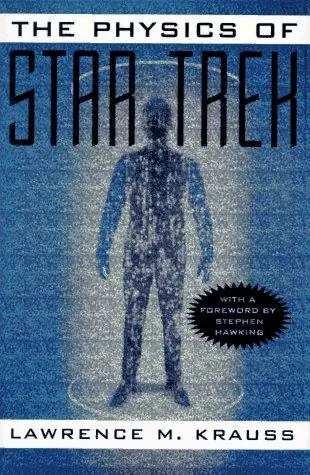
The physics of Star trek
by Lawrence Maxwell Krauss · first published 1995
7mentions
4recommended by
7HN commenters
2010–2021first – last mentioned
57% recommend43% neutral
With a foreword by Stephen HawkingAustralian Institute of Physics (Tas.) Schools Physics Quiz, 1997 - School Participation Awa rd awarded to The Hutchins School.
Affiliate links. As an Amazon Associate I earn from qualifying purchases.

Don't bother trying to make sense out of this fantastically idiotic article, but, if you are interested in the subject, look at some of the references at the end. Krauss' book The Physics of Star Trek discusses some of these ideas, and reiterates the conventional conclusion, which is that even if travel-by-warping is possible, it would require us to manipulate an amount of energy comparable to that…
on “Faster than light travel” ↗…Series (http://www.participations.org/Volume%208/Issue%202/1d%20Smit...) (PDF) - Star Trek and The Kiss That Changed TV (http://www.bbc.com/culture/story/20160707-star-trek-turns-50...) (BBC) - The Physics of Star Trek (http://amzn.to/2k4hU8i), by Lawrence M. Krauss
on “Star Trek is the richest and most positively impactful franchise of all time” ↗I see it more like the show is a focal point of for the broader discussion that's happening in the class. Also, there is actually a "Physics of Star Trek" book (with a forward by Stephen Hawking) that's pretty good.
on “Why We're Teaching 'The Wire' at Harvard” ↗Sometimes you can combine an answer to such a question by getting someone to read a relatively compact one like "The Physics of Star Trek". That won't work for people that don't like technology or science, but there are similar examples on other subjects. Works well for people who haven't started asking detailed questions yet, but may expect…
on “Ask HN: Are books worth it?” ↗…equation (if someone has it I'd love to plug in some numbers) but I'm guessing it would require on the order of the total energy output of the sun to get even a modest spacecraft to that velocity. "The Physics of Star Trek" by Lawrence Krauss had the equation I believe, but I can't find it!
on “US scientists find potentially habitable planet near Earth” ↗As mentioned on the Kickstarter campaign page: """Given the success of Krauss's The Physics of Star Trek (Harper, 1996), – which only touched on the issues, not the possibilities – I am confident that such a companion book would be well received."""
on “Making Progress on Star Trek Physics” ↗He discusses it extensively in The Physics of Star Trek. Also, supposed locally FTL travel for subatomic particles is pretty different from locally non-FTL but globally FTL travel a la Star Trek, Alcubierre drives, etc
on “Numerics applied to Casimir geometry generates intersection with Alcubierre warp” ↗