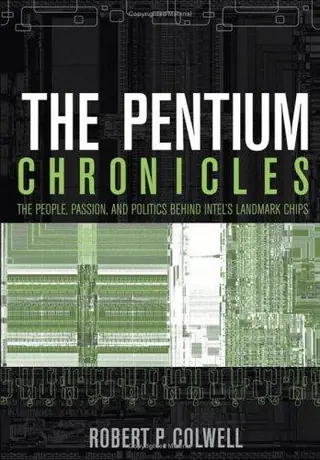
The Pentium Chronicles
by Robert P. Colwell · first published 2005
82% recommend18% neutral
Why HN recommends it
Insider account by the P6 chief architect of how Intel's Pentium Pro CPU got designed, with lessons on the social and managerial side of big chip projects; suits aspiring hardware engineers and architecture fans.
Summarised by Claude from recommending comments
"As chief architect of the P6, Robert Colwell offers a unique perspective as he unfolds the saga of a project that ballooned from a few architects to hundreds of engineers, many just out of school. Far more than a treatise on project management, The Pentium Chronicles gives the rationale, the personal triumphs, and the humor that characterized the P6 project, on undertaking that broke all technical boundaries by being the first to try an out-of-order, speculative superscalar architecture in a microprocessor." "In down-to-earth language, organized around a framework "we wish we had known about
Affiliate links. As an Amazon Associate I earn from qualifying purchases.
…flamewar fodder. A lot of respect is owed to computer engineers at corporations that are defunct or a fraction of their former greatness (e.g., SGI, DEC, HP). As a further example, Bob Colwell's book, "The Pentium Chronicles", is a great read and teaches some powerful lessons about how to successfully do engineering in the kind of large organizations that can scale production of a design. But if you take it at face value,…
on “Intel Lines Up ThunderX ARM Against Xeons” ↗…Intel leaps ahead on x86 microarchitecture, a lead they’d hold with only a few minor stumbles for two decades. Bob Colwell (mentioned elsewhere ITT) wrote a fascinating technical history of the P6: The Pentium Chronicles.
on “What Came After the 486?” ↗Read "The Pentium Chronicles" by Bob Colwell. The Pentium 4 is the time frame when marketing took over Intel and fed this Ghz myth when many knew it was a doomed long term path.
on “Intel predicts 10GHz chips by 2011 (from 2000)” ↗There's little open development, so there's little incentive to write up public articles. You could try something like Bob Colwell's "The Pentium Chronicles".
on “Sometimes the bug isn't in your code, it's in the CPU” ↗My favorite books on computer architecture: _Modern Processor Design_ (Shen and Lepasti). Lots of material on superscalar processors, with some nice examples from existing work. _The Pentium Chronicles_ (Robert Colwell). Much less technical, but a lot about the social nature of getting a significant CPU design done.
on “Advanced Computer Architecture Reading List” ↗Soul of a New Machine is fantastic! Also on computer architecture / story of developing a new processor, "The Pentium Chronicles" by Robert Colwell is a really interesting book on the story of the Pentium Pro, the first out-of-order CPU from Intel.
on “Ask HN: Computer Science/History Books?” ↗I believe there is a lot of overlap between the transcript of an interview Robert Colwell did [1] with his book The Pentium Chronicles. I've read and liked both. I'm linking to archive.org's copy as the original site appears to be defunct. [1] Oral history of Robert P. Colwell (1954- ) Interviewed by Paul N. Edwards, Assoc. Prof.,…
on “Pentium floating-point division bug (1994)” ↗…can't find the email now, it was pre-gmail. Some really good columns that he wrote for "Computer" magazine: https://people.computing.clemson.edu/~mark/330/colwell/at_ra... Highly recommend his book "Pentium Chronicles" Edit: found the talk! It was ee380 at Stanford 2003/2004. Sadly the video links seem to be broken... https://web.stanford.edu/class/ee380/ay0304.html
on “Oral History of Robert P. Colwell – Chief Architect for Intel's IA32 [pdf]” ↗…Engineers, and Validation/Verification Engineers. Those roles in turn specialize into e.g. Physical Design Engineer, Pre-Silicon Validation Engineer, RTL Design Engineer, etc. I recommend a book "The Pentium Chronicles" by Robert Colwell, if you want to learn more about this field before diving deeper into technical details.
on “Ask HN: What job titles involve designing chips?” ↗…see how far along this is. The issue with x86 and clocks had little do with Windows, and more with the Blue Crystal effect (MHz sell CPUs not perf). There's a great insider book about this called "The Pentium Chronicles" by the chief architect of the P6.
This is extremely cool. It sort of begs the question: does Intel have a golden formal model? They must right? The most recent thing I’ve read about it is The Pentium Chronicles (highly recommended incidentally), but that’s eons ago. Does anyone happen to know (and be at liberty to share) how the vendors cope with this internally?
on “Stratified Synthesis: Automatically Learning the x86-64 Instruction Set (2016) [pdf]” ↗I have to second the recommendation for The Pentium Chronicles. I bought that book at the Computer History Museum in Mountain View and thought that it looked a bit overpriced at $35... but it was worth every penny. Robert Colwell tells the story of the P6 architecture…
on “Social aspects of chip design” ↗This looks like it has a lot of overlap with his book The Pentium Chronicles, which I've read a couple of times, and highly recommend.
on “Oral history of electrical engineer Robert P. Colwell [pdf]” ↗…Amdahl's Law came up in at least three separate classes, most notably my computer architecture course and my operating systems course. Side note, we were assigned to read Soul of a New Machine and the Pentium Chronicles in the computer architecture course, and most everyone enjoyed the books.
on “Gene Amdahl has died” ↗…process technology to a two node lag, you’re fucked either way. This article is rambling and over-complicated. For a much more insightful and compelling view into Intel at its greatest I recommend “The Pentium Chronicles”.
on “The Intel Split” ↗