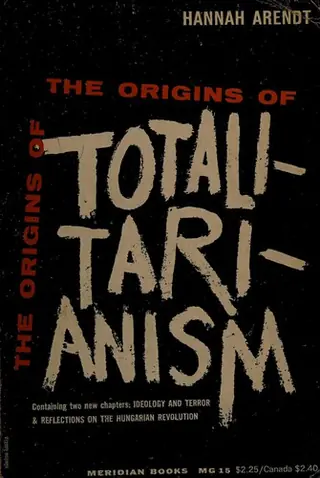
The Origins of Totalitarianism
by Hannah Arendt · first published 1951
36% recommend64% neutral
Why HN recommends it
Analysis of how totalitarian movements arise, including the final chapter on ideology and terror, which one reader credits with predictive power. Suggested to readers wanting historical context for current politics.
Summarised by Claude from recommending comments
Hannah Arendt's definitive work on totalitarianism and an essential component of any study of twentieth-century political history The Origins of Totalitarianism begins with the rise of anti-Semitism in central and western Europe in the 1800s and continues with an examination of European colonial imperialism from 1884 to the outbreak of World War I. Arendt explores the institutions and operations of totalitarian movements, focusing on the two genuine forms of totalitarian government in her time—Nazi Germany and Stalinist Russia—which she adroitly recognizes were two sides of the same coi
Affiliate links. As an Amazon Associate I earn from qualifying purchases.
Mentions per year
What Hacker News says
Related books
 2012–2026
Eichmann in Jerusalem
Hannah Arendt
Recommended by 21 · mentioned by 5021 recommend · 50 mention21 recommend · 5021 recommend
 2017–2023
At the Existentialist Café
Sarah Bakewell
Recommended by 5 · mentioned by 75 recommend · 7 mention5 recommend · 75 recommend
 2016–2025
The Human Condition
Hannah Arendt
Recommended by 4 · mentioned by 124 recommend · 12 mention4 recommend · 124 recommend
Gay Science
Friedrich Nietzsche, Dennis Sweet, Thomas Common
Recommended by 19 · mentioned by 3319 recommend · 33 mention19 recommend · 3319 recommend
 2013–2026
Ur-Fascism
Umberto Eco
Recommended by 17 · mentioned by 4817 recommend · 48 mention17 recommend · 4817 recommend
Thus Spoke Zarathustra
Friedrich Nietzsche
Recommended by 31 · mentioned by 5831 recommend · 58 mention31 recommend · 5831 recommend
Myth of Sisyphus
Albert Camus, Daniel Ortega
Recommended by 36 · mentioned by 7036 recommend · 70 mention36 recommend · 7036 recommend
 2008–2026
Starship Troopers
Robert A. Heinlein
Recommended by 57 · mentioned by 21857 recommend · 218 mention57 recommend · 21857 recommend
Arendt is the most relevant political writer of our current time, imo. The final chapter of her book, "Origins of Totalitarianism," was added in later editions, and it is called "Ideology and Terror." Beyond criticism and explanation, I think it is a rare model with predictive power. The challenge with that book is that unless you…
on “Hannah Arendt: Reflections on Violence (1969)” ↗Slightly tangential, but Hannah Arendt, in addition to being a political philosopher, wrote a fairly thought-provoking tome called 'The Origins of Totalitarianism'. Worth a read if one is interested in such things. https://en.wikipedia.org/wiki/The_Origins_of_Totalitarianism I'm not completely well-versed in Heidegger, but is it possible that he did not hold…
on “Heidegger, the homesick philosopher” ↗If you haven't read it, you may find Hannah Arendt's Origins of Totalitarianism a worthwhile read. She offers a lot of analysis on the rise of a classless society, paired with a deep sort of aimlessness in state leadership. It doesn't end well.
on “The Origins of the American Military Coup of 2012 (1992) [pdf]” ↗…book with universal acclaim from all across the political spectrum, from socialists, liberals, and conservatives. https://libcom.org/files/Robert%20O.%20Paxton-The%20Anatomy%... [2] Hanah Arendt's The Origins of Totalitarianism. It's an older book and it has a perspective attractive to centrists that tries to establish common patterns between Stalinism and fascism. That approach is considered more tenuous these days but it's…
on “Google's stance on neo-Nazis 'dangerous', says EFF” ↗Well one of the best is Hannah Arendt's "The Origins of Totalitarianism". Also worth looking at the concept of inverted totalitarianism, by Sheldon Wolin.
on “Libertarian communism” ↗> "what would it take to rob a person of their humanity?" It really is a big question, but this bit by Hannah Arendt in "The Origins of Totalitarianism" (a book I highly recommend, it's as timely as ever sadly) really struck me.. it's on page 667 in the German version, this is my crappy translation: > Humans, in so far as they are more than a completion…
on “How Technology Hijacks People’s Minds” ↗Pretty much what others have suggested, but I would weigh in and say The Genealogy of Morality is the work I find myself revisiting the most recently. That along with Hannah Arendt's Origins of Totalitarianism and Guy Debord's Society of the Spectacle form a fairly interesting exploration into modern society, in my opinion. Not one I always agree with, but certainly one that makes you think. Also, is it ironic…
on “How to Be a Stoic” ↗"Meditations" by Marcus Aurelius, "To Have or to Be?" and "Sane Society" by Erich Fromm, "Origins of Totalitarianism" by Hannah Arendt, and before that several books by Sebastian Haffner about the Nazis, who also had a very keen eye for the things that truly mattered, as unflattering as they are.
on “Ask HN: What books changed the way you think about almost everything?” ↗…undeniable and it appears some people think LLMs are a wonderful tool for this purpose, and should have a default mode that reflects a certain sociopolitical ideal. Recommended reading: 1984, Brave New World, Origins of Totalitarianism, by Orwell, Huxley and Arendt respectively. Some people's interpretation of 'safe AI' is that it serves this rather authoritarian-dystopian goal. A better definition of 'unsafe AI' is just inaccurate…
on “Defamed by ChatGPT: Law professor libeled from whole cloth” ↗…animals who need community and social structures, and making everyone into an individual creates instability and allows for sociopaths to rise to power to fill those gaps. I suggest reading the book The Origins of Totalitarianism by Hannah Arendt.
on “Adam Curtis on the dangers of self-expression (2017)” ↗My 2 cents: The Origins of Totalitarianism by Hannah Arendt
on “Books That Changed How I Hear Music” ↗Now is a good time to read Hannah Arendt's The Origins of Totalitarianism.
on “FBI Making List of American "Extremists," Leaked Memo Reveals” ↗…dense, lots of data. Suggests that our current political turmoil is due to our economy and society expecting unrealistic growth, and a disconnect between reality and the expectation of citizens. - The Origins of Totalitarianism: "Slippery slope" gets thrown around a lot w.r.t. suspicious legislation. This book provides context on past societies that slipped, and where we stand on that slope. - "Connectography: Mapping the Future…
on “The Griffin Warrior Tomb Upends What We Know About the Roots of Mycenae” ↗…espoused just because they were handy, and which had nothing to do with "the ideology" because there isn't one? This is people talking to me about grammar who don't even know what a letter is. Read "Origins of Totalitarianism". Read Sebastian Haffner. Everybody is so interested in the subject, so knowledgeable about it, and so against Nazis. The proof is in the pudding. You cannot disprove my with your straw men and having…
…the examples of how George Carlin was right when he said "Germany lost WW2, fascism won it". etc. So? Doesn't make me excuse concentration camps or pretend totalitarianism isn't totalitarianism. Read "Origins of Totalitarianism". Actually do visit concentrations, and actually live in cities where you know Jews have been dragged from their homes, as the neighbours looked away. But spare me your assumptions about what "the people…
on “I Quit Google Over Its Censored Chinese Search Engine” ↗