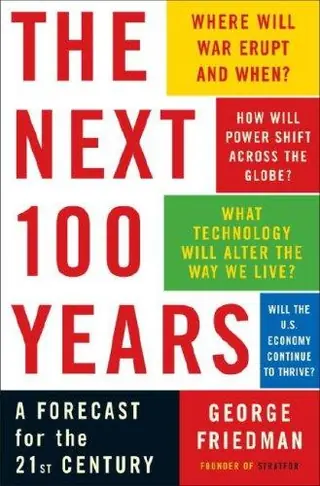
The Next 100 Years
A Forecast for the 21st Century
by George Friedman · first published 2008
13% recommend87% neutral
"Conventional analysis suffers from a profound failure of imagination. It imagines passing clouds to be permanent and is blind to powerful, long-term shifts taking place in full view of the world." --George FriedmanIn his long-awaited and provocative new book, George Friedman turns his eye on the future--offering a lucid, highly readable forecast of the changes we can expect around the world during the twenty-first century. He explains where and why future wars will erupt (and how they will be fought), which nations will gain and lose economic and political power, and how new technologies and
Affiliate links. As an Amazon Associate I earn from qualifying purchases.
Feel free to read Stratfor's site (I named an extension that allows full free access) or George Friedman's "The Next 100 Years" book. Stratfor employs many ex-US-intelligence-agency people who use the same geopolitical analysis methods for a corporate audience (though without classified data) and their views are a close approximation…
on “Germany records first monthly trade deficit since 1991 as inflation soars” ↗…as liberal. If you want a good understanding of the geopolitical actions of the countries of the world, a good place to start is with one of the two books by George Friedman (The Next Decade, and The Next 100 Years). These books give compelling reasons why Russia is doing what it is doing, why we need to work with Iran, and the demographic reasons for turmoil in the middle east. I think the difference between the…
on “Global Markets, Initially Shaken, Edge Higher After Trump Victory” ↗…region. So yes, it will say something if it feels like that is under threat. Not saying this is a good or bad thing. Depends on your perspective and what country you live in. [1] https://www.amazon.com/Next-100-Years-Forecast-Century/dp/07...
on “America’s aggressive use of sanctions endangers the dollar’s reign” ↗FWIW, George Friedman (of STRATFOR) predicted this, except he believed the implosion of China would be on a truly catastrophic scale. So they could still be at the edge of a much deeper hole. See: The Next 100 Years: A Forecast for the 21st Century https://www.amazon.com/dp/0767923057
on “China's Subprime Crisis Is Here” ↗Copyright 2009 The Next 100 Years: A Forecast for the 21st Century https://www.amazon.com/dp/0767923057/ref=cm_sw_r_cp_api_e-6u...
on ““Toward the Year 2018”, a speculative book from 1968” ↗In Defense of Food by Michael Pollan (excellent; recently saw Food, Inc. as well) The Next 100 Years by George Friedman (amusing; was given to me as a gag gift) Currently reading: Infinite Jest by David Foster Wallace
on “Ask HN: What was the latest book you read? ” ↗…invoke the banking system. If the banking system falls, the general rule of thumb is a minimum 10 year recovery. It’s worth noting that this is the position adopted by George Friedman in his book “The Next 100 Years” where he predicts the fall of China and also North Korea by 2030 at the very latest. Also check out “This Time Is Different: Eight Centuries of Financial Folly” by Carmen Reinhart from Princeton University…
on “S&P Cuts China’s Credit Rating, Citing Risk from Debt Growth” ↗In the book, "The Next 100 Years: A Forecast for the 21st Century" by George Friedman, the author predicts that China will start to fragment. Although this hasn't been happening probably because of the increase in strict authoritarian…
on “How the United States threatens our security” ↗See chapter 6 of this book that was published in 2009 (The Next 100 Years by George Friedman): http://www.mysearch.org.uk/website1/pdf/715.2.pdf If nothing else, it outlines the strategic situation that is providing some of Putin's underlying motivation, namely, declining…
on “Ask HN: Where is the best analysis of the situation in Ukraine?” ↗…is to tie down potential enemies in land-based confrontations so that they are forced to exhaust their military dollars on troops and tanks, with little left over for navies. -- Friedman, George. The Next 100 Years (p. 45). Knopf Doubleday Publishing Group. Kindle Edition. Basically he says that the USA can spend recklessly, be astoundingly inefficient, etc and still remain in power due to this.
on “The Collapsing Leviathan” ↗George Friedman wrote a book of creative predictions called "The Next 100 Years" that argued mounting depopulation pressures and labor shortages would lead countries to begin competing for migrants. Interesting that has not been Europe's solution so far... https://en.wikipedia.org/wiki/The_Next_100_Years:_A_Forecast...…
on “Japan Is Giving Away 8M Abandoned Houses” ↗In "The Next 100 Years," Friedman predicted that globally declining birth rates would lead states to start fighting to attract immigrants. That book is full of incorrect predictions that are nonetheless interesting. It's weird…
on “Businesses are scrambling for workers in Hungary” ↗On the Iraq war being over, I would have doubted it before yesterday when I started reading George Friedman's new book, The Next 100 Years. He would be the first to say that his predictions at a granular level are often wrong but that his methodology is a decent way of understanding how the world works and what might happen next. Anyway,…
on “‘Don’t Be Evil,’ Meet ‘Spy on Everyone’: How the NSA Deal Could Kill Google” ↗…global military presence and there is no evidence this will change until another state actor (or a coalition of state actors) forcibly shrinks the US global footprint. In George Friedman's book, "The Next 100 Years" the central theme to current US foreign policy is that, as a global super power, the US will actively seek to destabilize regions of the world that threaten its interests now and in the future. That…
on “Author of cURL denied entry to the USA” ↗…heavy bombardment of the Earth from there, using the Earth's gravity well, rail guns on the Moon, and lunar rocks. Next time I saw the Moon mentioned in a military context was in George Friedman's "The Next 100 Years", where he tries to predict what will happen throughout the rest of this century. The books gets very sci-fi towards the end, but it's a fun read. I wonder if Friedman has read Heinlein.
on “Robert Heinlein and the Harsh Politics of Science Fiction (2013)” ↗