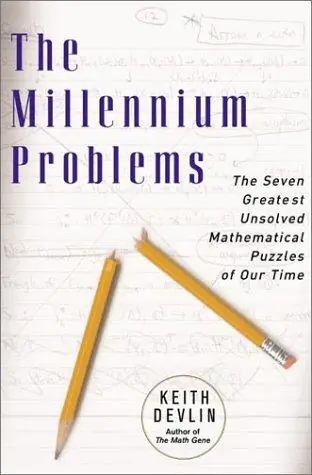
The Millennium Problems
The Seven Greatest Unsolved Mathematical Puzzles of Our Time
by Keith J. Devlin · first published 2002
100% recommend
In 2000, the Clay Foundation announced a historic competition: whoever could solve any of seven extraordinarily difficult mathematical problems, and have the solution acknowledged as correct by the experts, would receive 1 million in prize money. There was some precedent for doing this: In 1900 the mathematician David Hilbert proposed twenty-three problems that set much of the agenda for mathematics in the twentieth century. The Millennium Problems--chosen by a committee of the leading mathematicians in the world--are likely to acquire similar stature, and their solution (or lack of it) is lik
Affiliate links. As an Amazon Associate I earn from qualifying purchases.
>Riemann hypothesis for example I'll recommend reading the chapter on the Riemann Hypothesis from the book: The Millennium Problems by Keith Devlin. https://www.amazon.com/Millennium-Problems-Greatest-Unsolved... That has about 42 pages of prose describing the problem in layman terms. I'd think someone who tackled high school math…
on “Geometric Algebra (2012)” ↗There's quite a good "layman's" explanation of the problem, including some of its history, in Keith Devlin's book "The Millennium Problems." The problem description starts on page 112. In that book he also refers to the official Clay Mathematics Institute (CMI) book that gives a summary, and then the problem in detail. He also references…
on “Ask HN: an intro to P=NP” ↗