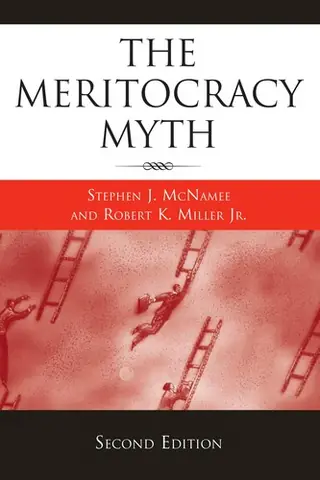
The meritocracy myth
by Stephen J. McNamee · first published 2009
5mentions
2recommended by
4HN commenters
2013–2021first – last mentioned
50% recommend50% neutral
"The Meritocracy Myth challenges the widely held American belief in meritocracy_that people get out of the system what they put into it based on individual merit. Fully revised and updated throughout, the second edition includes compelling new case studies, such as the impact of social and cultural capital in the cases of George W. Bush and Barack Obama, and new material on current topics such as the impact of the financial and credit crisis, intergenerational mobility, and the impact of racism and sexism. The Meritocracy Myth examines talent, attitude, work ethic, and character as elements of
Affiliate links. As an Amazon Associate I earn from qualifying purchases.
…knowing what helps them remain wealthy. In contrast, many underprivileged families don't know much about saving money at all. There's a great book that goes into a lot of detail about this. It's called the Meritocracy Myth. http://www.amazon.com/Meritocracy-Myth-Stephen-J-McNamee/dp/...
on “The Ivy League Was Another Planet” ↗…article meritocracy is mentioned. Meritocracy is a joke in America. People at the top basically have it rigged for their kids, even worse than what aristocracy brought (which offered a leisurely life). The Meritocracy Myth by Yale Law Professor Stephen McNamee is a good read regarding this. It is shocking, as in the statistics.
on “Talented People Frequently Don’t Rise to the Top” ↗It is basically a status and class indicator in American society, particularly for the upper middle class and the upper class. If you read "The Meritocracy Myth" by Yale University law professor Stephen McNamee, you will understand the game being played here quite well. There are upper class Americans in particular who basically work extremely long hours (80-105…
on “Why do we buy into the 'cult' of overwork?” ↗…not only tend to think that is how the system should work, but most Americans also think that is how the system does work (Huber and Form 1973, Kluegel and Smith 1986, Ladd 1994). In our book The Meritocracy Myth (Rowman & Littlefield, 2004), we challenge the validity of these commonly held assertions, by arguing that there is a gap between how people think the system works and how the system actually does work.…
on “The Late, Great American WASP” ↗…only tend to think that is how the system should work, but most Americans also think that is how the system does work (Huber and Form 1973, Kluegel and Smith 1986, Ladd 1994). In our book The Meritocracy Myth (Rowman & Littlefield, 2004), we challenge the validity of these commonly held assertions, by arguing that there is a gap between how people think the system works and how the system actually…
on “The Late, Great American WASP” ↗