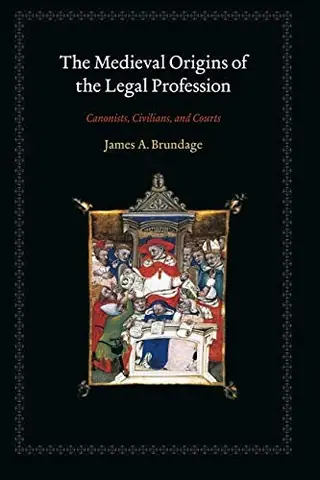
The Medieval Origins of the Legal Profession
by James A. Brundage · first published 2008
9mentions
2recommended by
2HN commenters
2019–2024first – last mentioned
100% recommend
Affiliate links. As an Amazon Associate I earn from qualifying purchases.
…(amongst other factors): the independence of the judiciary (even from the Church, even though clergy sometimes acted as judges) and a focus on a documented due process acted as checks on runaway power. The Medieval Origins of the Legal Profession by Brundage is also an interesting read: * https://www.press.uchicago.edu/ucp/books/book/chicago/M/bo56... It even covers Roman law, and how it managed to be salvaged (to an extent) and be used as…
on “China’s liberalization and structural reform drives growth” ↗The medieval origins of the legal profession: canonists, civilians, and courts by Brundage The origins of reasonable doubt: theological roots of the criminal trial by Whitman
on “Ask HN: What's the best book you read in 2021?” ↗…and the Scientific Revolution and The Rise of Early Modern Science by Toby Huff: * https://en.wikipedia.org/wiki/Toby_Huff If you're doing philosophy and science, you may be curious about law: see The Medieval Origins of the Legal Profession by Brundage: * https://en.wikipedia.org/wiki/James_A._Brundage
on “Ask HN: Any recommendation for a good History of Science book?” ↗See The Medieval Origins of the Legal Profession by Brundage, which has some early chapters on the Roman time period: * https://press.uchicago.edu/ucp/books/book/chicago/M/bo562094... * Review: https://forhistiur.net/2011-05-munzinger/ * https://en.wikipedia.org/wiki/James_A._Brundage
on “The Life of a Lawyer in the Late Roman Republic” ↗…shows how Christianity moved the needle from slaves to serfs to individual freedom: * https://www.goodreads.com/book/show/18740986-inventing-the-i... This can further be expounded on in Brundage's The Medieval Origins of the Legal Profession illustrating how everyone—pauper to Pope—was afforded a fair shake at justice (due process in law) going back to (at least) the Middle Ages: * https://press.uchicago.edu/ucp/books/book/chicago/M/bo562094...…
on “Hospitals that make profits should pay taxes” ↗…was one of the very first universities created, as a type of 'union' / guild of students, and it focused on the study of law: * https://en.wikipedia.org/wiki/University_of_Bologna Also Oxford. See The Medieval Origins of the Legal Profession by Brundage, which while focusing on law, covers a lot on universities because this was a big component of its development from 1000-1200AD. There were quite a few secularly-incorporated institutions:…
on “How the 'Western mind' was shaped by the Medieval Church” ↗> It took the Holy Roman Emperor to install courts of justice See The Medieval Origins of the Legal Profession by Brundage: > In the aftermath of sixth-century barbarian invasions, the legal profession that had grown and flourished during the Roman Empire vanished. Nonetheless, professional lawyers suddenly reappeared…
on “Tiberius, Imperial Detective” ↗I would think it would depend on the books and their genre. I just finished The Dark Forest, which is 512 pages, in a few days: * https://en.wikipedia.org/wiki/The_Dark_Forest Meanwhile The Medieval Origins of the Legal Profession, at 560 pages, took me two weeks: * https://www.goodreads.com/book/show/3624887-the-medieval-ori... * https://en.wikipedia.org/wiki/James_A._Brundage It depends on what you want out of the book(s).…
on “How to easily read 50 books a year” ↗> So basically, corporations are legal persons because of Capitalism. See The Medieval Origins of the Legal Profession by Brundage, which has a few chapters on law during the Roman period, as well as chapters on the creation of universities, along with mentions of things like guilds and town charters, which were collective…
on “5th Circuit Rules Internet Companies Have No Right to Moderate” ↗