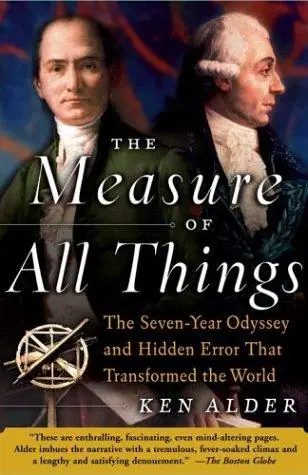
The Measure of All Things
The Seven-Year Odyssey and Hidden Error That Transformed the World
by Ken Alder · first published 2001
90% recommend10% neutral
Why HN recommends it
Narrative history of the seven-year effort to define the meter during the French Revolution; readers value how it mixes science, politics and adventure, and it suits anyone curious about the metric system's origins.
Summarised by Claude from recommending comments
In June 1792, the erudite and cosmopolitan Jean-Baptiste-Joseph Delambre and the cautious and scrupulous Pierre-Francois-Andre Mechain set out from Paris -- one north to Dunkirk, the other south to Barcelona to calculate the length of the meter. In the face of death threats from village revolutionary councils, superstitious peasants, and civil war, they had only their wits and their letters to each other for support. Their findings would be used to create what we now know as the metric system. Despite their painstaking and Herculean efforts, Mechain made a mistake in his calculations that he c
Affiliate links. As an Amazon Associate I earn from qualifying purchases.
Mentions per year
What Hacker News says
Related books
 2008–2025
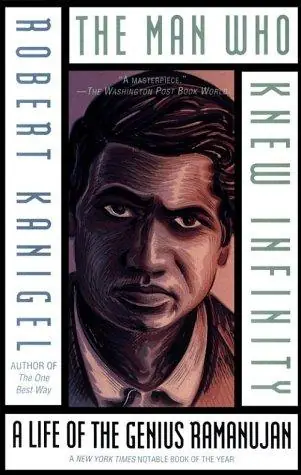
The Man Who Knew Infinity
Robert Kanigel
Recommended by 22 · mentioned by 2522 recommend · 25 mention22 recommend · 2522 recommend
 2008–2025
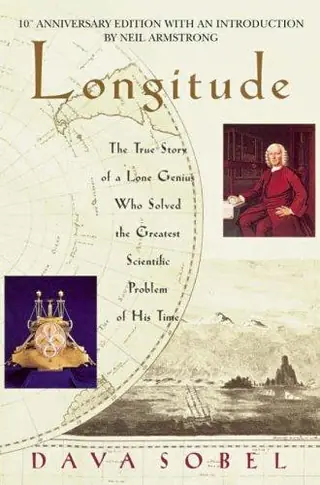
Longitude
Dava Sobel, William J. H. Andrewes, Irene Aldasoro Katarain
Recommended by 41 · mentioned by 4941 recommend · 49 mention41 recommend · 4941 recommend
…I doubt it will be the last. It probably goes back much further, but I know that the French tried to decimalize time in the revolution when they were rationalizing all the other measurements. (see The Measure of All Things by Ken Alder, without question the finest nonfiction book Ive ever read.) The reason I think it doesn't catch on is that what we have really isn't too bad. If I'm thinking locally, everything works perfectly.…
on “Swatch Internet Time (1998)” ↗…fiction" have you looked into narratives of science? They can be written with the fun aspects of historical fiction, but you come out with knowledge about real events. My favorite that comes to mind is "The Measure of All Things" about the history of the meter: http://www.amazon.com/Measure-All-Things-Seven-Year-Transfor...
on “Ask HN: What should I read after "Gödel, Escher, Bach"?” ↗They actually tried to introduce decimal time[1], as well as a decimal week[2]. They didn't stick though. If you are interested on the topic of the history of the metric system, check out The Measure of All Things[3], an absolutely fantastic read [1] https://en.wikipedia.org/wiki/Decimal_time [2] https://en.wikipedia.org/wiki/French_Republican_Calendar [3] https://www.amazon.com/Measure-All-Things-Seven-Year-Transfo...
on “The fifth hyperfactorial: 5⁵×4⁴×3³×2²×1¹=86400000 milliseconds is exactly 1 day” ↗…interested in the science and politics of the French Revolution period and how methods like least squares were first applied, a wonderful history (in which Legendre plays a supporting role) is Ken Alder’s The Measure of All Things: The Seven-Year Odyssey and Hidden Error That Transformed the World. (“The truth belongs to everyone, but error is ours alone.”)
on “Changing Faces: The Mistaken Portrait of Legendre (2009) [pdf]” ↗On this topic, I recommend reading "Measure of All Things" by Ken Alder. It is a book about the origins of the metric system and how it is partially based on forged data. Méchain did not trust his own excellent surveying observations (the meter was defined as…
on “Obsolete German Units of Measurement” ↗Relatedly, I recommend reading "The Measure of All Things" by Ken Alder about the origins of the metric system and the first scientific conference ever. It is a surprisingly gripping read. https://www.simonandschuster.com/books/The-Measure-of-All-Th...
on “A wonderful coincidence or an expected connection: why π² ≈ g” ↗The Measure of All Things: The Seven-Year Odyssey and Hidden Error That Transformed the World by Ken Alder These guys went through quite some hardships to define the length of a meter. Good read!
on “Ask HN: Books about people who did hard things” ↗“The Measure of All Things” by Ken Adler[0] is a good, extremely readable book about their adventure, which was indeed wild. [0] https://en.wikipedia.org/wiki/Special:BookSources/978-0-349-...
on “The metre originated in the French Revolution” ↗…peak. 38. Soul of a New Machine by Tracy Kidder - Data General engineers. 39. Showstopper by G. Pascal Zachary - Development of Windows NT. 40. Unbroken by Laura Hillenbrand - WWII survival. 41. The Measure of All Things by Ken Alder - Defining the meter. 42. The Cuckoo’s Egg by Clifford Stoll - Tracking a hacker. 43. The Man Who Knew Infinity by Robert Kanigel - Srinivasa Ramanujan. 44. The Power Broker by Robert…
on “Ask HN: Books about people who did hard things” ↗Fun topic which inspires me to mention two goodies that help fuel in-depth conversations about measurement and conversion: 1) The Measure of All Things - http://www.kenalder.com/measure/ (science history goodness) 2) Frink - http://futureboy.us/frinkdocs/ (one of my first discoveries on HN and still one of the most fun to return to)
on “Why is a minute divided into 60 seconds, an hour into 60 minutes?” ↗The Measure Of All Things is a book about the effort to measure the circumference of the earth to establish the length of the metre, about twenty years after these maps were made. The book goes into a bit of the technology used…
on “Using QGIS to apply a 1777 style to today's OpenStreetMap data” ↗