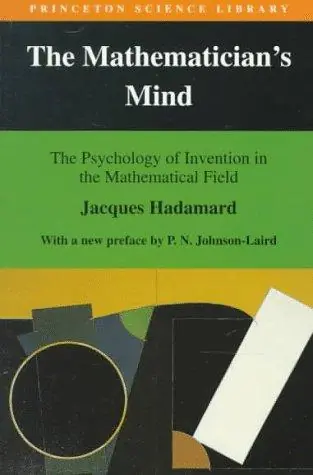
The mathematician's mind
the psychology of invention in the mathematical field
by Jacques Hadamard · first published 1996
50% recommend50% neutral
Fifty years ago when Jacques Hadamard set out to explore how mathematicians invent new ideas, he considered the creative experiences of some of the greatest thinkers of his generation, such as George Polya, Claude Levi-Strauss, and Albert Einstein. It appeared that inspiration could strike anytime, particularly after an individual had worked hard on a problem for days and then turned attention to another activity. In exploring this phenomenon, Hadamard produced one of the most famous and cogent cases for the existence of unconscious mental processes in mathematical invention and other forms o
Affiliate links. As an Amazon Associate I earn from qualifying purchases.
Some interesting entries I know about: * Where Mathematics Comes From: How the Embodied Mind Brings Mathematics Into Being by George Lakoff and Rafael Nunez * The Mathematician's Mind by Jacques Hadamard * Mathematics Form and Function by Saunders MacLane * On the Brink of Paradox: Highlights from the Intersection of Philosophy and Mathematics by Agustin Rayo The preface and chapter…
on “Philosophy of mathematics – a reading list (2020)” ↗Missed opportunity to quote Einstein: "The words of the language, as they are written or spoken, do not seem to play any role in my mechanism of thought." [1] [1] A Mathematician's Mind, Testimonial for An Essay on the Psychology of Invention in the Mathematical Field by Jacques S. Hadamard, Princeton University Press, 1945
on “AGI is not multimodal” ↗