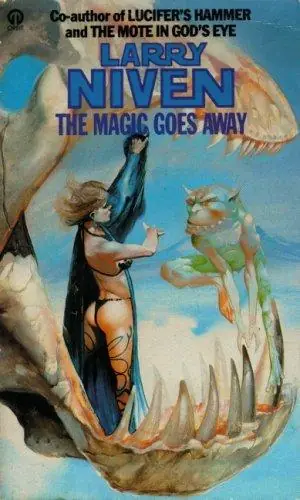
The Magic Goes Away
by Larry Niven · first published 1978
14% recommend86% neutral
Once there was magic in the world... But hordes of selfish, short-sighted magicians have used up the mana that moved the world, and the magic goes away. Even the most powerful spells are fast becoming futile, and so Orolandes, sad Achaean with half a sword, goes on a quest in search of the lost power. But all the gods and Fair Atlantis are dead. The creatures of spirit, the unicorns and centaurs, are dying. Soon all the sparkling things will be gone from the world and only clay will remain - and those damned stupid barbarians with their damned stupid swords will win after all... from the
Affiliate links. As an Amazon Associate I earn from qualifying purchases.
Mentions per year
What Hacker News says
Related books
 2015–2026
Seveneves
Neal Stephenson
Recommended by 182 · mentioned by 417182 recommend · 417 mention182 recommend · 417182 recommend
 2008–2026
Anathem
Neal Stephenson
Recommended by 207 · mentioned by 393207 recommend · 393 mention207 recommend · 393207 recommend
 2007–2026
Cryptonomicon
Neal Stephenson
Recommended by 324 · mentioned by 628324 recommend · 628 mention324 recommend · 628324 recommend
 2007–2026
The Diamond Age
Neal Stephenson
Recommended by 284 · mentioned by 596284 recommend · 596 mention284 recommend · 596284 recommend
 2007–2026
Snow Crash
Neal Stephenson
Recommended by 364 · mentioned by 977364 recommend · 977 mention364 recommend · 977364 recommend
 2011–2026
Thinking, fast and slow
Daniel Kahneman
Recommended by 373 · mentioned by 879373 recommend · 879 mention373 recommend · 879373 recommend
Larry Niven. His older stuff: Ringworld. and all his short-story collections, especially Neutron Star. He also did a scifi take on magic, in The Magic Goes Away. I see Vinor Vinge's AFUTD and ADITS as the closest thing to Niven.
on “The Realism of Our Times: Kim Stanley Robinson on how science fiction works” ↗…which prevented that from happening. So thinks like the inverse square law and conservation of (magical) energy really help out in keeping the game from becoming radically unbalanced. When I read "The Magic Goes Away" by Niven I felt it was an interesting take on 'magic as alternate scientific thing' and Zelazny's unfinished "Changling" trilogy about magic in an alternate world an interesting 'magic is where you find…
on “Breaking Out of Scientific Magic Systems in RPGs” ↗Did they write a whole article on the subject without mentioning Larry Niven's role? Per Wikipedia, "Not Long Before the End" was first published in 1969. http://en.wikipedia.org/wiki/The_Magic_Goes_Away That said, I must confess that there was a difference between his concept and the modern computer-RPG one -- his mana was present in the environment in general, rather than being specific to any one…
on “The History of Mana: How an Austronesian Concept Became a Video Game Mechanic” ↗…aren't to be taken literally. Rather, they are meant as cautionary tales and as a sort of map to the maze of inner feelings and impulses within all human beings. [1] There is a scene in Larry Niven's The Magic Goes Away where one wizard (Clubfoot) is talking about being one of many young apprentices taken up to a mountaintop by his master. The master wizard enchanted a cloud and let them play bouncing around on it, no…
on “How Inuit parents teach kids to control their anger” ↗…thinking in a first principles, physics-based mindset, but just instead just recalling previous memories and reasoning in an intuitive, fuzzy kind of pattern-matching. In the Niven/Pournelle book The Magic Goes Away, one of the wizards takes his apprentices up to a high peak and casts a spell to enable his apprentices to walk on clouds. There is a hidden purpose: In every group class, some of his apprentices goes…
on “Myth: The astronauts didn’t float away because they had heavy boots” ↗Missed opportunity dept.: the title should have been "The Magic Goes Away", in reference to the Larry Niven novel.
on “Losing the Magic” ↗That is strangely reminiscent of Larry Niven's "The Magic Goes Away."
on “Germany's forest fires come with an explosive twist: WWII munitions” ↗…still ends up being much cheaper than buying individual audiobooks. It definitely pushes you to strike a balance between longer and shorter books, though. It's kinda crazy that a 4-hour story like The Magic Goes Away and a a 50-hour novel like A Dance with Dragons both end up consuming 1 credit.
on “Books Are Getting Longer” ↗