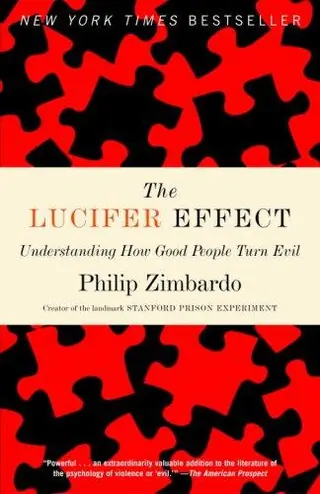
The Lucifer Effect
by Philip G. Zimbardo · first published 2007
64% recommend27% neutral9% critical
Why HN recommends it
A detailed account of the Stanford Prison Experiment with the author's own notes, plus a broad look at how ordinary people come to do harmful things; for readers of social psychology and the psychology of evil.
Summarised by Claude from recommending comments
What makes good people do bad things? How can moral people be seduced to act immorally? Where is the line separating good from evil, and who is in danger of crossing it?Renowned social psychologist Philip Zimbardo has the answers, and in The Lucifer Effect he explains how--and the myriad reasons why--we are all susceptible to the lure of "the dark side." Drawing on examples from history as well as his own trailblazing research, Zimbardo details how situational forces and group dynamics can work in concert to make monsters out of decent men and women. Zimbardo is perhaps best known as the creat
Affiliate links. As an Amazon Associate I earn from qualifying purchases.
#2 (Milgram), #7 (Stanford Prison), and #19 (Shock the Puppy) are all mentioned in Phil Zimbardo's just-published book, The Lucifer Effect. It's fascinating reading - he gives the blow-by-blow on the Stanford Prison Experiment, including some of his notes that didn't make it into the popular press treatment.
on “20 most bizarre experiments - check out #16 (found on octopart news)” ↗I know of no better or more accessible review of the psychology of evil than "The Lucifer effect" (2007) by Philip Zimbardo, a psychologist who, in spite of a long and illustrious career, probably is still best known for the infamous Stanford prison study. The companion website to the book is still…
on “NSA tracking cellphone locations worldwide, Snowden documents show” ↗I have found psychology books to be rather interesting in understanding social engineering. http://www.amazon.com/Mistakes-Were-Made-But-Not/dp/01510109... http://www.amazon.com/Lucifer-Effect-Understanding-Good-Peop... ..You get the idea.
on “Ask HN: Resources on social engineering” ↗…heroism, later referenced exactly how he himself came to recognize the mistake: his fiancee came in, took one look, and was terrified by what she observed. I don't know how your author managed to read The Lucifer Effect and miss that. The last page he quotes from is page 194. The book is a good 400 pages long. The "unreflective" echo that Zimbardo gives ends a chapter offering evidence. He spends the next two chapters…
on “Can We Reverse The Stanford Prison Experiment?” ↗The Lucifer Effect by Philip Zimbardo is a satisfactory primer. https://www.amazon.com/Lucifer-Effect-Understanding-Good-Peo...
on “CEO of ThinkPenguin, Inc arrested for filming police” ↗One of my favorite books is "The Lucifer Effect" by Philip Zimbardo, who ran the Stanford Prison Experiment and was called in as an expert witness in a 2004 court martial on Abu Ghraib. By his logic, it's not hard to argue that higher-ups share complicity…
on “Inside the CIA’s black site torture room” ↗…persistent culture. On the other hand, a police department does have a persistent culture, and we don't exactly understand how or why some police departments engender more brutality than others. "The Lucifer Effect" is a very interesting book on the institutional dynamics that lead otherwise normal people to do horrific things. It is written by Philip Zimbardo, of Stanford Prison Experiment fame. He is a proponent…
on “White nationalist group posing as antifa called for violence on Twitter” ↗The Lucifer Effect is a great book. It's thesis is "what makes good people do bad things". I recommend it to anyone considering doing bad things, or to anyone who knows good people who do bad things.
on “Remembering Phil Zimbardo (1933-2024)” ↗…repeated ad nauseum, that things like this are the fault of "a few bad apples", is just plain false. Philip Zimbardo, the architect of the Stanford Prison Experiment and author, more recently, of The Lucifer Effect, argues that it's not "bad apples" that spoil the barrel, but a "bad barrel" that spoils the apples. Here's Zimbardo's TED talk on what makes people do evil: http://www.youtube.com/watch?v=OsFEV35tWsg
on “Woman Who Couldn’t Be Intimidated by Citigroup Wins $31 Million” ↗> (see the Stanford prison experiment) The principal investigator for this ended up writing a book on the subject: http://www.amazon.com/The-Lucifer-Effect-Understanding-Peopl... He goes into his own culpability as the person who designed the system and then talks about his expert witness testimony at Abu Ghraib. There are several sibling comments who seem…
on “Judge rules TSA no-fly procedures unconstitutional” ↗…seems like Zimbardo always wanted to be a "thought leader" rather than a scientist. He has a history of promoting novel theories/diagnoses/techniques with catchy names that don't especially pan out (the Lucifer Effect, Social Intensity Syndrome, time perspective therapy).
on “Interview with Philip Zimbardo of the Stanford Prison Experiment” ↗…Design and Computer Architecture: ARM Edition 2. The Evolution of Cooperation: Revised Edition 3. The Ego Tunnel: The Science of the Mind and the Myth of the Self (in backpack until I finish it). The Lucifer Effect: Understanding How Good People Turn Evil
on “Ask HN: What books do you keep on your desk?” ↗Have you read the Lucifer Effect? It seems like you might not have read the book.
on “Remembering Phil Zimbardo (1933-2024)” ↗