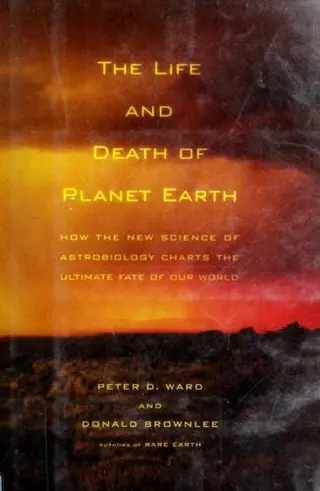
The life and death of planet Earth
by Peter Douglas Ward · first published 2003
2mentions
0recommended by
2HN commenters
2024first – last mentioned
100% neutral
Planet Earth is middle-aged. Science has worked hard to piece together the story of the evolution of our world up to this point, but only recently have we developed the understanding and the tools to describe the entire life cycle of a planet. Ward and Brownlee, a geologist and an astronomer respectively, combine their knowledge of how the critical sustaining systems of our planet evolve through time with their understanding of the life cycles of stars and solar systems, to tell the story of the second half of Earth's life. The process of evolution will essentially reverse itself: life as we k
Affiliate links. As an Amazon Associate I earn from qualifying purchases.
Yes, it is. There was a pop-sci book that came out twenty years ago, The Life and Death of Planet Earth, which contains some speculation about the consequences of this: https://en.wikipedia.org/wiki/The_Life_and_Death_of_Planet_E.... They give a low-end estimate of 500-800 million years before plate tectonics…
on “New findings point to an Earth-like environment on ancient Mars” ↗…likely coincide with the loss of plants. It will start with large animals, then smaller animals and flying creatures, then amphibians, followed by reptiles, and finally, invertebrates. In the book The Life and Death of Planet Earth, authors Peter D. Ward and Donald Brownlee state that some animal life may be able to survive in the oceans. Eventually, however, all multicellular life will die out.
on “In Cleveland, mushrooms digest entire houses” ↗