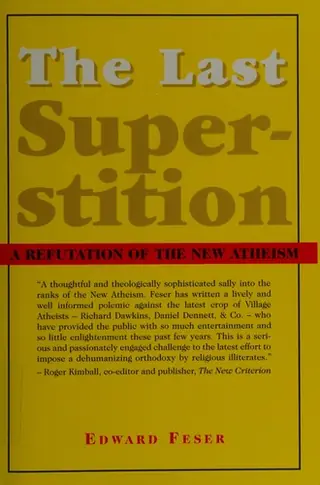
The last superstition
by Edward Feser · first published 2008
100% recommend
But as Edward Feser shows in The Last Superstition, there is not, and never has been, any war between science and religion at all. There has instead been a conflict between two entirely philosophical worldviews: the classical "teleological vision" of Plato, Artistotle, Augustine, and Aquinas, on which purpose or goal-directedness is as inherent a feature of the material world as mass or electric charge; and the modern "mechanical" vision of Descartees, Hobbes, Locke, and Hume, according to which physical reality is comprised of nothing more than purposeless, meaningless particles in motion.
Affiliate links. As an Amazon Associate I earn from qualifying purchases.
Mentions per year
What Hacker News says
Related books
 2009–2024
Natural theology
William Paley
0 recommend · 5 mentioned0 recommend · 5 mention0 recommend · 50 recommend
 2008–2026
Consciousness explained
Daniel C. Dennett
Recommended by 35 · mentioned by 7235 recommend · 72 mention35 recommend · 7235 recommend
 2009–2026
This is water
David Foster Wallace
Recommended by 48 · mentioned by 8748 recommend · 87 mention48 recommend · 8748 recommend
…failure to explain their arguments at the highest intellectual level, publicly, consistently. Once I was exposed to better theology and philosophy of Christianity I was blown away. Edward Feser’s ‘The Last Superstition’ helped open this up. I have no idea why the level of discourse is on average so primitive, I think church leaders have been systematically underestimating the populace.
on “Gallup: U.S. church membership dips below 50% for first time” ↗There is a lot of non revealed theology. For an intro I would suggest The Last Superstition by Edward Feser. Basically Aristotle lays out the framework without getting anywhere near a religious text.
on “For natural theologians, proving God was beside the point” ↗…But I'm neither, so all I can do is provide you with a book recommendation: check out Edward Feser's work, especially Aquinas and Five Proofs. If you want to see Dawkins refuted in his own tone, see The Last Superstition. What research have you done up to this point to answer your questions?
on “What if I’m wrong? (2023)” ↗…If you aren't really familiar with the contents of the Summa Theologica, you probably won't get much out of Feser's essays. Again, not true. He writes in an eminently accessible manner. His book "The Last Superstition" is 101 material. Having some familiarity with basic Aristotelian notions can sometimes expedite understanding, perhaps, but you don't need to be a scholar to grasp much of what he writes. And often,…
on “The Problem with the "Hard Problem"” ↗…high ground here. Only someone ignorant of philosophical work of the last two millenia could find Dawkins impressive here. For you and others here, I would recommend beginning with Edward Feser's "The Last Superstition: A Refutation Of The New Atheism" [0] to begin to grasp how crude, unsophisticated, and incoherent their intellectual positions are. The author wrote this book during the height of the New Atheist craze…
on “The Demon-Haunted World” ↗…conclusion, and you can face a retorsion argument, a paradox of the sort skepticism generally faces (“there is no truth!” type of stuff). I recommend some of Edward Feser’s books on the subject. “The Last Superstition” is a light read in that respect, but “Scholastic Metaphysics” is more of a proper manual.
on “Hylomorphism” ↗…can't possibly be true! Oh, but it is true... >> Love to hear any suggestions for reading to challenge this viewpoint if it is obviously flawed in some way As an intro, I might suggest Feser's "The Last Superstition" [0]. It's a book for philosophical beginners written during the height of the relatively brief but noisy New Atheist craze of Dawkins fame. The style is polemical (which is not typical of Feser's works;…
on “The space of minds” ↗…one source of potential error is a shared, but discredited metaphysical stance. However, if you have a sincere and humble interest in this subject matter, one open to correction, I would recommend "The Last Superstition"[0] as a starting point. There is no point in running in circles, because you can examine your presuppositions to discover the sources of your errors. And once you do so, you will see the intuitions you…
on “Could the cosmos, in fact, be conscious?” ↗…before the 17th century are and always will be running in endless circles with arguments that are intrinsically unsolvable by nature of the way they are framed. I just got through about 1/2 of Feser’s The last Superstition which basically makes the same argument. That claim to me seems more an objection to hand-wavvy philosophy rather than an application of it.
on “Five decades of majestic failure to explain consciousness” ↗