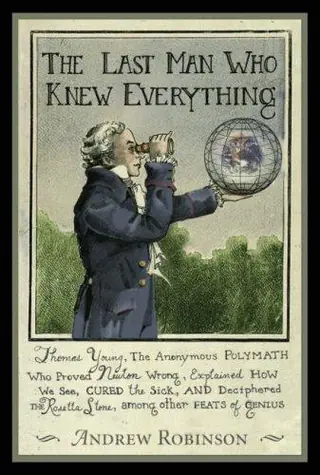
The Last Man Who Knew Everything
by Andrew Robinson · first published 2005
7mentions
2recommended by
6HN commenters
2011–2026first – last mentioned
33% recommend67% neutral
No one has given the polymath Thomas Young (1773–1829) the all-round examination he so richly deserves—until now. Celebrated biographer Andrew Robinson portrays a man who solved mystery after mystery in the face of ridicule and rejection, and never sought fame. As a physicist, Young challenged the theories of Isaac Newton and proved that light is a wave. As a physician, he showed how the eye focuses and proposed the three-colour theory of vision, only confirmed a century and a half later. As an Egyptologist, he made crucial contributions to deciphering the Rosetta Stone. It is hard to grasp
Affiliate links. As an Amazon Associate I earn from qualifying purchases.
For a fun read, check out: "The Last Man Who Knew Everything: Thomas Young, The Anonymous Polymath Who Proved Newton Wrong, Explained How We See, Cured the Sick, and Deciphered the Rosetta Stone, Among Other Feats of Genius" I think it's fun to play across disciplines…
on “Polymaths No More?” ↗…ham-handed point at the end. It was a decent movie if you treat it as a fictional story instead of an actual retelling. I'd stick with the book. (And if you specifically care about Fermi, I recommend "The Last Man Who Knew Everything" by David Schwartz)
on “The Pile is a 825 GiB diverse, open-source language modelling data set (2020)” ↗…at least, and made some effort to amass wealth. But the best strategies he came up with were publishing textbooks and maybe some dabbling in the stock market (That is if I remember my details from The Last Man Who Knew Everything [2] correctly) [1]: https://www.goodreads.com/book/show/11797471-the-idea-factor... [2]: https://www.goodreads.com/book/show/34746094-the-last-man-wh...
on “One of Wall Street’s Most Popular Trading Strategies Is Now Failing” ↗…a compleat collection of J.R.R. Tolkien's writings, and am probably going to collect (and read/re-read) all of Isaac Asimov's non-fiction. There are at least five books with the (partial) title _The Last Man Who Knew Everything_ about: - Leibniz https://www.goodreads.com/book/show/15770928-the-last-man-wh... - Athanasius Kircher https://www.goodreads.com/book/show/119131.Athanasius_Kirche... - Thomas Young https://www.goodreads.com/book/show/763029.The_Last_Man_Who_...…
on “Timemap.org – Interactive Map of History” ↗"The Last Man Who Knew Everything" (2018) https://www.nytimes.com/2018/01/24/books/review/david-n-schw... "The Last Man Who Knew Everything" (2006) https://www.theguardian.com/books/2007/jan/20/featuresreview...
on “The impossibly wide learning of Sabine Baring-Gould” ↗There has never been a time when most technology in use was understood by the general population. "The Last Man Who Knew Everything"[0] was 1773–1829 and the trend towards compulsory education was only beginning, 2 countries at the start of his life and 7 at the end[1]. [0] https://en.wikipedia.org/wiki/The_Last_Man_Who_Knew_Everythi...…
on “Intel vs. Samsung vs. TSMC” ↗…but also consider that this is true of any team: All managers hire people to outsource some entire cognitive process, letting themselves focus on their own personal comparative advantage. The book "The Last Man Who Knew Everything" is about Thomas Young, who died in 1829; since then, the sum of recorded knowledge has broadened too much for any single person to learn it all, so we need specialists, including specialists in managing…
on “Brain on ChatGPT: Accumulation of Cognitive Debt When Using an AI Assistant” ↗