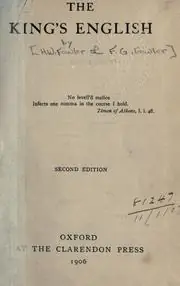
The King's English
by H. W. Fowler, F. G. Fowler · first published 1906
71% recommend29% neutral
Why HN recommends it
Opinionated, well-written guide to plain, precise English, built on preferring familiar, concrete, and short words over pretentious or wordy ones. Suited to anyone who writes and wants clearer prose.
Summarised by Claude from recommending comments
"When it was first published in 1906, The King's English was a radical and contentious work. Through examples from the works of journalists and novelists of the day the Fowler brothers illustrate grammatical slips and infelicities of style and how best these should be avoided. Had Dickens, for example, owned a copy of The King's English he would not have written 'your great ability and trustfulness'; he would have recognized the malapropism and realized that the context demanded trustworthiness." "The book provoked a flurry of debate in The Times and its acceptance of Americanisms caused one L
Affiliate links. As an Amazon Associate I earn from qualifying purchases.
Mentions per year
What Hacker News says
Related books
 2007–2026
The Elements of Style
William Strunk, Jr., E. B. White
Recommended by 131 · mentioned by 231131 recommend · 231 mention131 recommend · 231131 recommend
 2014–2026
The Sense of Style
Steven Pinker, José C. Vales
Recommended by 45 · mentioned by 5645 recommend · 56 mention45 recommend · 5645 recommend
 2007–2026
On Writing Well
William Zinsser
Recommended by 137 · mentioned by 170137 recommend · 170 mention137 recommend · 170137 recommend
 2008–2026
Politics and the English language
George Orwell
Recommended by 112 · mentioned by 210112 recommend · 210 mention112 recommend · 210112 recommend
…plain. By plain, I mean both clear and unpretentious. This kind of writing doesn't have to sound informal. This advice is not my own. It is ancient, and you could say it is the gist of books like The King's English by the brothers Fowler (1906), The Elements of Style by Strunk and White (1959), On Writing Well by William Zinsser (1976), and The Sense of Style by Steven Pinker (2014). Bureaucratic language to me…
on “Mary Dash's Writing Tips” ↗Another good reference, although less advertising oriented, The King's English, by H.W. Fowler, insists on solid principles: Prefer the familiar word to the far-fetched. Prefer the concrete word to the abstract. Prefer the single word to the circumlocution. Prefer the short…
on “How to Write by David Ogilvy ” ↗The King’s English by Henry and Francis Fowler
on “Ask HN: Any great books about technical writing?” ↗…because it presupposes the offense of a deity whose nature and will can be comprehended, yet it depends entirely on the culture and politics of the time. At one time, merely owning a Bible printed in the King's English was the vilest of offenses. Yet I doubt one could find many modern Christians who would condemn their ability to read their own Bibles as a clear heresy, and submit themselves to the stake forthwith for…
Along that vein, The King's English. First edition 110 year ago (and therefore beyond copyright), last in 1931, so it's officially out of date, but well written and opinionated: https://en.wikipedia.org/wiki/The_King's_English
on “Ask HN: What is your favorite book on English grammar?” ↗…prescriptive books. While I'm not sure I'd recommend it as a second or even a fourth book, I'm rather fond of the rather old fashioned (OK, it's a century old...) and most certainly not American The King's English: http://en.wikipedia.org/wiki/The_King%27s_English There's an on-line copy of the 2nd edition linked in the above that should give you an idea of if and when you want to try it; at the very least you…
on “Ask HN: Books to improve my English.” ↗…rules are not rules anywhere but in the imagination of White and his acolytes. No admired writer of English knows them, never mind obeys them. The gist of the book is the same as other books, such as The King's English, On Writing Well, and A Sense of Style. Stephen King praises the book in his own book, On Writing. I've also read a few articles on writing that say the same basic thing. The gist of these books is to…
on “Ask HN: Mind bending books to read and never be the same as before?” ↗…sentence would sound nicer like this: Most of them have a good reason for being around. After all, clarity in communication is a good thing, a virtue even. As for the rules, I think I read it in the King's English or perhaps in an essay by Bernard that rules are made to be broken, but you must know what they are so that you can break them, otherwise most likely you are wrong.
on “Three Grammar Rules You Can (And Should) Break” ↗Ah you're right, it's in Fowler and in fact, in the earlier (first edition 1906) The King's English. Fittingly, for something that evolved into a classic, it touches on almost all the points discussed in this thread, in one paragraph and a footnote: http://www.bartleby.com/116/101.html#5
on “Writing English as a Second Language” ↗