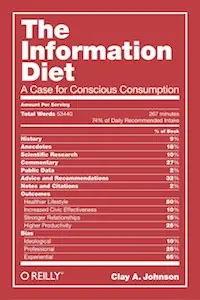
The Information Diet
by Clay A. Johnson · first published 2011
54% recommend31% neutral15% critical
Why HN recommends it
Offers a practical framework for consuming news and online information more deliberately, with methods for seeking original sources and spotting bias. Its actionable ideas suit anyone who feels overwhelmed by media.
Common criticism: Several commenters found the book disappointing or thin on substance.
Summarised by Claude from recommending comments
"The modern human animal spends upwards of 11 hours out of every 24 in a state of constant consumption. Not eating, but gorging on information ceaselessly spewed from the screens and speakers we hold dear. Just as we have grown morbidly obese on sugar, fat, and flour--so, too, have we become gluttons for texts, instant messages, emails, RSS feeds, downloads, videos, status updates, and tweets.We're all battling a storm of distractions, buffeted with notifications and tempted by tasty tidbits of information. And just as too much junk food can lead to obesity, too much junk information can lead
Affiliate links. As an Amazon Associate I earn from qualifying purchases.
…don't think this idea is the way to do it. You're talking about taking a glass full of water out of an ocean. If you're a developer wanting to make a difference I HIGHLY recommend checking out "The Information Diet: A Case For Conscious Consumption" by Clay Johnson. I spent many years working in broadcast news and I can say that many of Clay's observations rang true with what I've observed over the years.
on “Ask HN: Disrupt Sensationalistic Media” ↗…Mathematics for Computer Scientists - http://www.amazon.com/Discrete-Mathematics-Computer-Science-... 3. Imagine: How Creativity Works - http://www.amazon.com/Imagine-Creativity-Works-Jonah-Lehrer/... 4. The Information Diet: A Case for Conscious Consumption -http://www.amazon.com/Information-Diet-Case-Conscious-Consum...
on “Ask HN: Summer reading” ↗…some years ago, and really just felt miserable for no good reason. Now the next part of my suggestion is going to sound rough for a second, but please take it seriously. Check out a book called "The Information Diet" by Clay Johnson. After reading (it's a really good book, and helped me a lot in avoiding this sort of stuff), watch a ridiculous conspiracy show on TV. My favorite recently was about whether mermaids…
on “Why I’m Worried About Google” ↗…IG. I don't look into Twitter much anymore, because it's not too different from FB. Social media isn't news. Most of what we call news isn't. There's very little useful news out there. I read "The Information Diet: A Case for Conscious Consumption" by Clay Johnson which covered the topic quite well.
on “Facebook quitters report more life satisfaction, less depression and anxiety” ↗I'm suprised nobody has mentioned Clay Johnson's new book, "The Information Diet." Pretty interesting read that goes with everything in this article. Side effect to overconsumption is increased personalization of information which makes us more ignornant to new/foreign ideas. Also,…
on “The Dangerous Effects of Reading” ↗This echoes a lot of the ideas from Clay Johnson's book "Information Diet: a case for conscious consumption". That book has a few good actionable ideas about how to modify your sources and methods of getting news so you get better information and learn to identify bias.
on “Did You Hear We Got Osama?” ↗…(https://www.darkpatterns.org/) or in a different way the work on addictive apps by Tristan Harris and his "Time Well Spent" (http://www.timewellspent.io/) efforts. Somewhat related from a self-help perspective is Clay Johnson's "Information Diet" (http://informationdiet.com/) model (See also and https://player.vimeo.com/video/63368251)
on “Customer Support Tools Violate Privacy” ↗Clay Johnson, author of "The Information Diet," wrote about this 10 years ago: https://web.archive.org/web/20120205012403/http://www.inform... It really made me much more conscious about seeking out and reading original sources, rather than relying…
on “Please read the paper before you comment” ↗I do like the concept of information obesity, and the importance of budgeting one's attention. The article seemed to borrow it from The Information Diet: http://www.amazon.com/Information-Diet-Case-Conscious-Consum...
on “News is bad for you – and giving up reading it will make you happier” ↗This is valuable information, though depressingly presented. The article reminds me strongly, and for similar reasons, of Clay Johnson's The Information Diet, a book I found overall tremendously disappointing -- this review describes most of the reasons: https://www.goodreads.com/review/show/254961608?book_show_ac... In particular, Johnson keeps presenting…
on “We Analyzed 100M Headlines” ↗Clay Johnson has a book and website, "The Information Diet: a case for conscious consumption", on this topic: http://www.informationdiet.com/
on “Consumption Addiction” ↗related, possibly of interest: [1] R. Dobelli. Avoid News. Aug 2010. --> http://dobelli.com/wp-content/uploads/2010/08/Avoid_News_Par... [2] C. A. Johnson. The Information Diet: A Case for Conscious Consumption. O’Reilly, 2012. i myself am conflicted about the news. i agree with most of the negative points both by OP and the above; but i also feel i actually do learn something…
on “I hate the news” ↗Not sure if it was intentional, but Crichton here uses the same Pollan metaphor that Johnson makes in his book, The Information Diet. In fact the tagline is right on his site: http://informationdiet.com/ I just got finished reading the Information Diet a couple weeks ago and was pretty disappointed in the book overall. Same with this…
on “Brainjunk and the killing of the internet mind” ↗Clay Johnson's 2012 book, The Information Diet, discusses this phenomenon in the context of CNN going from a prime place in the news firmament to an also-ran when TV stations started driving news based on primary on their audience's political preferences.…
on “Who isn't a big fan of "impartial" news? People who don't have power” ↗