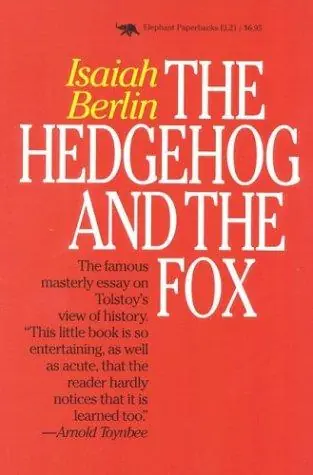
The hedgehog and the fox
by Isaiah Berlin · first published 1901
21mentions
1recommended by
20HN commenters
2008–2025first – last mentioned
5% recommend90% neutral5% critical
"The fox knows many things, but the hedgehog knows one big thing." This ancient Greek aphorism, preserved in a fragment from the poet Archilochus, describes the central thesis of Isaiah Berlin's masterly essay on Leo Tolstoy and the philosophy of history, the subject of the epilogue to War and Peace. Although there have been many interpretations of the adage, Berlin uses it to mark a fundamental distinction between human beings who are fascinated by the infinite variety of things and those who relate everything to a central, all-embracing system. Applied to Tolstoy, the saying illuminates a pa
Affiliate links. As an Amazon Associate I earn from qualifying purchases.
Those interested in the generalist/specialist debate could do worse than to read Isaiah Berlin's classic essay on the subject, The Hedgehog and the Fox: https://www.blogs.hss.ed.ac.uk/crag/files/2016/06/the_hedgeh...
on “Skill Stacking: A Practical Strategy to Achieve Career Success” ↗…Great Man Theory is best expressed in War and Peace, where Tolstoy goes on long discussions on the imaginary significance of great men, including obviously Napoleon. Or, as Isaiah Berlin says in the "Hedgehog and the Fox: An Essay on Tolstoy's View of History," Tolstoy perceived a "central tragedy" of human life: ...if only men would learn how little the cleverest and most gifted among them can control, how little they…
on “Peter Thiel on "Founder as Victim, Founder as God"” ↗This seems like an overly-complex derivation of Isaiah Berlin's concept of The Hedgehog and the Fox: Berlin...divides writers and thinkers into two categories: hedgehogs, who view the world through the lens of a single defining idea (examples given include Plato, Lucretius, Dante Alighieri, Blaise…
on “Turtleocracy” ↗Some of the comments make me remind of an Isaiah Berlin’s best known essay in which he distinguishes between two archetypes: the hedgehog and the fox. “The fox knows many things; the hedgehog knows but one.” To paraphrase him in his 1953 essay— The Hedgehog and the Fox: "There is a line among the fragments of the Greek poet Archilochus which says:…
on “On Being Narrow” ↗It comes from an essay by Isaiah Berlin, The Hedgehog and the Fox. Hedgehogs know "one big thing" and Foxes know "lots of little things". In the expert prediction study, experts who had a universal framework which they extended rigidly to every problem performed poorly…
on “Kaggle Post-Mortem: The dangers of overfitting” ↗I think you're thinking of Isaiah Berlin's The Hedgehog and the Fox: https://en.wikipedia.org/wiki/The_Hedgehog_and_the_Fox If you like that, you might also like the book Expert Political Judgement by Philip Tetlock which uses the Hedgehog and Fox metaphor to analyze…
on “The Death Of Expertise” ↗…a wider perspective she might be a specialist: concentrating on hacking rather than literature, or business, or physics. It's all relative. [Incidentally, I'll mention that Isaiah Berlin's essay 'the hedgehog and the fox' is a classic of the 'generalists vs. specialists' genre, applying the division to writers and philosophers. I'm not a massive fan of it (dividing people up like that gets a bit superficial), but looking…
on “Coding: Generalists vs. specialists” ↗This seems like a good spot to link to one of my favorite essays on the theme you've raised here - the historian and philosopher Isaiah Berlin (of the hedgehog and the fox fame) on "The Concept of Scientific History." (Short version: he argues that there's no such thing). By the way, I'm happy to see such an interesting discussion of my favorite historical topic on HN -…
on “The General Crisis of the 17th Century” ↗For those not familiar with the fox/hedgehog analogy the parent is using, it's something Isaiah Berlin originally wrote about: https://en.wikipedia.org/wiki/The_Hedgehog_and_the_Fox
on “Does the world need polymaths?” ↗…always thought of him as a superman who could survey the entire landscape of mathematics. Dyson does give some persuasive reasons why this may not be true. 2. Dyson reminds me of Isaiah Berlin's THE HEDGEHOG AND THE FOX essay: https://www.blogs.hss.ed.ac.uk/crag/files/2016/06/the_hedgeh...
on “Freeman Dyson – Birds and Frogs (2009)” ↗>The hedgehog/fox classification isn't mine, it is Philip Tetlock's I know it from Isaiah Berlin, but it looks like he took it from Archilochus. https://en.wikipedia.org/wiki/The_Hedgehog_and_the_Fox
on “The Death of a Public Intellectual” ↗There is an Isaiah Berlin essay called The Hedgehog and the Fox. In it he divides artists/philosophers into two categories: foxes and hedgehogs. It is inspired by a fragment of ancient Greek poetry which reads, "the fox knows many things, but the hedgehog knows one…
on “Math is still catching up to the genius of Ramanujan” ↗Somewhat related: Isaiah Berlin's "The Hedgehog and the Fox". From wiki: > hedgehogs ... view the world through the lens of a single defining idea, and foxes, who draw on a wide variety of experiences and for whom the world cannot be boiled down to a single…
on “Wikipedia searches reveal differing styles of curiosity” ↗…off to specialists as your company/project grows. Edit: You might also just be a fox and not a hedgehog — that’s what I would consider myself. An interesting read: https://en.m.wikipedia.org/wiki/The_Hedgehog_and_the_Fox.
on “Ask HN: Is it better to generalise or specialise as a developer?” ↗Is the Hedgehog and the Fox just an overly-complex (but more concrete) derivation of monism vs pluralism?
on “Turtleocracy” ↗