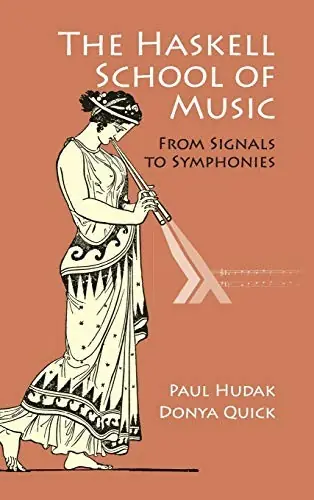
The Haskell School of Music
by Paul Hudak, Donya Quick · first published 2018
17mentions
7recommended by
14HN commenters
2012–2022first – last mentioned
50% recommend50% neutral
Why HN recommends it
Teaches Haskell and functional programming through music, building a parser, renderer and player with the Euterpea library; valued by programmers curious about audio, signals and synthesis.
Summarised by Claude from recommending comments
Affiliate links. As an Amazon Associate I earn from qualifying purchases.
Mentions per year
What Hacker News says
Related books
Beginning HaskellAlejandro Serrano Mena2014–2019
Beginning Haskell
Alejandro Serrano Mena
Recommended by 9 · mentioned by 119 recommend · 11 mention9 recommend · 119 recommend
 2008–2026
Real World Haskell
Bryan O'Sullivan, John Goerzen, Don Stewart
Recommended by 122 · mentioned by 208122 recommend · 208 mention122 recommend · 208122 recommend
…like extempore because of its CAAS (compiler as a service) model, scheme language, and the ability to create from the note up, or to create sounds from scratch (sine waves and such). I splurged for the Haskell School of Music book based on the Euterpea library that was originally written by Paul Hudak, but finished by one of his students, Donya Quick. This is how I originally learned Haskell, and it was a lot of fun and educational…
on “Sonic Pi – Code based live music creation tool” ↗As far as I know, Hudak has updated and renamed his book to The Haskell School of Music, and it's available for free from the Yale Haskell Group's website here: http://haskell.cs.yale.edu/?post_type=publication&p=112 The book is a really awesome way to learn Haskell. However, very little…
on “Principles of Reactive Programming” ↗‘The Haskell School of Music, From Signals to Symphonies’ by Paul Hudak and Donya Quick. Cambridge University Press, 2018. The beauty of this book is that it’s a very good way of learning Haskell and functional programming, but…
on “Ask HN: What's your favorite tech related book if you'd chose one?” ↗One thing that helps alot is the various undergrad course syllabuses that have been given with emphasis on type systems and aspects of FP, immutability, segregating and strictly marking side effects etc. http://shuklan.com/haskell/ http://www.cs.tufts.edu/~kfisher/teaching.html https://www.inf.ed.ac.uk/teaching/courses/inf1/fp/ (P Wadler) http://www.cs.princeton.edu/~dpw/cos441-11/schedule.htm
on “What I Wish I Knew When Learning Haskell 2.0” ↗Though Haskell isn't a lisp, the book Haskell School of Music teaches it by exploring the authors' Euterpea music library. https://www.euterpea.com
on “Melrōse, a language to program and play music (2021)” ↗…honking, sibillant, and I'm pretty sure there's no way to write down the loops i get on fretless guitar, bass and cello. Also I've been trying to get used to Don Ellis quarter tone system, and work thru haskell school of music (fantastic book, for anybody interested not just in notations, but production, composition and capture(A/D conversion/DSP etc. Also shoudl read books by Gould and Read someday: http://www.amazon.com/Behind-Bars-Definitive-Guide-Notation/...…
on “Hummingbird – A fresh take on music notation” ↗You might want to know that there is a book related to Haskell and Music: http://haskell.cs.yale.edu/euterpea/haskell-school-of-music/
on “Becoming Productive in Haskell” ↗I'm curious to find out what problems you ran into in your music library, but I suspect you were downvoted because of your tone. That being said, the reason I'm curious is because there is an entire book about writing a music parser, renderer, and player in Haskell: http://haskell.cs.yale.edu/euterpea/haskell-school-of-music/
on “Becoming Productive in Haskell” ↗I use Extempore[0], but I have played with Haskell-based Euterpea[1] too. I bought the book by Paul Hudak and Donya Quick, "The Haskell School of Music". Common Music has Grace, an all-in-one, Lisp-based, cross-platform GUI [2]. They all have signal and note level music capabilities. That means you can synthesize sounds from scratch and also code at…
on “Overtone is live programmable music and visualization” ↗Here are two related books that are freely available (and that I haven't read): The Haskell School of Music — From Signals to Symphonies, by Paul Hudak (pdf available at http://www.cs.yale.edu/homes/hudak/Papers/HSoM.pdf). Music: a Mathematical Offering, by David J. Benson (pdf available at http://homepages.abdn.ac.uk/mth192/pages/html/music.pdf)
on “Show HN: Music for Geeks and Nerds” ↗…on FP Complete great but I've always been a bit confused about their IDE. It's web-only right? Could I use it to develop something that uses local graphics (like SDL or such), or play around with the Haskell School of Music lessons with actual audio output? What do people generally use for a local IDE? Is Leksah any good? I'm on Windows, FWIW.
on “School of Haskell 2.0” ↗…Everyone could define themselves as a mathematician, hacker, new mom, etc. It would be kinda like social networking gone Amazon. P.S. Upvote for letting me know about a few really cool books, like the Haskell School of Music which I intend to read.
on “Ask HN: who started something in 2012 that didn't or won't become profitable?” ↗…i read it), he refers to Platform when he shd be referring to GHC ______________________________________________________________ there's also recent books by Richard Bird and Simon Thompson, and the Haskell School of Music, which was recently discussed: https://news.ycombinator.com/item?id=9487881 http://www.amazon.com/Thinking-Functionally-Haskell-Richard-...
on “Haskell at Front Row Education” ↗…very well (as always in Haskell, they are more general). The sugar in Haskell to use them similar to do-notion is really a joy to use. I was exposed to them in the Haskell music library Euterpea in the Haskell School of Music [2]. The signal processing API uses arrows. [1] Generalizing Monads to Arrows. John Hughes. http://www.cse.chalmers.se/~rjmh/Papers/arrows.pdf [2] http://haskell.cs.yale.edu/?post_type=publication&p=112
on “Thinking with Lazy Evaluation” ↗Perhaps related: Haskell School of Music http://www.euterpea.com/haskell-school-of-music/
on “Basic Music Theory in ~200 Lines of Python” ↗