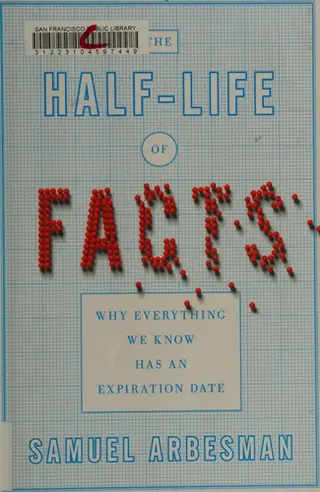
The half-life of facts
by Samuel Arbesman · first published 2012
8mentions
3recommended by
7HN commenters
2012–2018first – last mentioned
43% recommend43% neutral14% critical
"A new approach to uderstanding the ever-changing information that bombards us. Arbesman is an expert in scientometrics, literally the science of science--how we know what we know. It turns out that knowledge in most fields evolves in systematic and predictable ways, and understanding that evolution can enormously powerful"--
Affiliate links. As an Amazon Associate I earn from qualifying purchases.
The Half Life of Facts Most useful explanation I have found to explain why the pre-internet age grown-ups (that would also be me) get stuck thinking that facts remain always the same.
on “Ask HN: What interesting books are you reading now?” ↗…quantify it for various disciplines. It's interesting to see how slow/fast facts in Medicine change versus philosophy versus religion. A nice read about this topic is a book by Samuel Arbesman, "The Half-Life of Facts".
on “High doses of vitamin D rapidly reduce arterial stiffness” ↗The wikipedia article links to it, but I'd recommend "The Half Life of Facts", which introduced me to this concept - it's an entertaining and insightful read.
on “90 percent of everything is crap” ↗Not to mention how easy it is to forget the historical track record of science being overturned by better science: http://arbesman.net/the-half-life-of-facts/
on “The Science of Why We Don’t Believe Science” ↗There is a excerpt from chapter 1 of the book at the authors website. http://arbesman.net/the-half-life-of-facts/
on “The half-life of facts” ↗Can anyone with access to the book please answer whether or not Geoffrey West, Joseph Tainter, or W. Brian Arther are among the cited references? I'm flipping quickly through a copy of Arbesman's The Half-Life of Facts and am disappointed to see that he (or his editors) have fallen prey to the gross misconception that numbered footnotes and bibliographies somehow diminish a book's value. Quite the opposite. (THLoF…
on “Are Cities Too Complicated?” ↗Some people have researched this. I remember reading "The Half-Life of Facts: Why Everything We Know Has an Expiration Date" by Arbesman, and IIRC psychology papers had some of the lowest half-lives of all the sciences. In math the half-life of a paper was something like 85 years,…
on “Best-selling introductory psychology books give misleading view of intelligence” ↗…like GEO or TCGA, but with full clinical, from healthcare providers, you might find some interesting things. I would like to see more research as dashboards more than research as reports. The book “The Half-life of Facts” is relevant: many bio conclusions we’ve made in the past hundred years seems to later be contradicted or at least tweaked as new tech and data come out. NIH and others now have big pushes for personalized…
on “There are now 141 bio and healthcare companies funded by YC” ↗