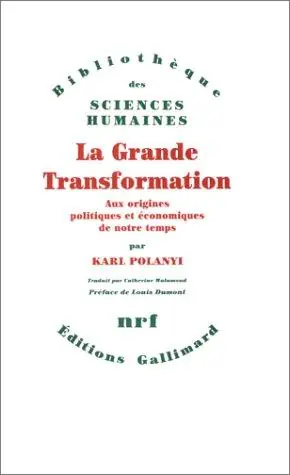
The Great Transformation
by Karl Polanyi · first published 1944
71% recommend29% neutral
Why HN recommends it
Economic history arguing that markets were not a natural state but were imposed on society. Often suggested to readers wanting a broader view of the Industrial Revolution and capitalism.
Summarised by Claude from recommending comments
"In this classic work of economic history and social theory, Karl Polonyi analyzes the economic and social changes brought about by the "great transformation" of the Industrial Revolution. His analysis explains not only the deficiencies of the self-regulating market, but the potentially dire social consequences of untempered market capitalism. New introductory material reveals the renewed importance of Polanyi's seminal analysis in an era of globalization and free trade."--BOOK JACKET.
Affiliate links. As an Amazon Associate I earn from qualifying purchases.
Mentions per year
What Hacker News says
Related books
 2013–2021
Expectations Investing
Michael J. Mauboussin, Alfred Rappaport
Recommended by 2 · mentioned by 32 recommend · 3 mention2 recommend · 32 recommend
 2010–2020
How an economy grows and why it crashes
Peter D. Schiff
Recommended by 8 · mentioned by 128 recommend · 12 mention8 recommend · 128 recommend
 2014–2026
Science and civilisation in China
Joseph Needham
Recommended by 3 · mentioned by 63 recommend · 6 mention3 recommend · 63 recommend
 2009–2026
Sources of Power
Gary Klein
Recommended by 14 · mentioned by 1714 recommend · 17 mention14 recommend · 1714 recommend
 2012–2026
Why the West Rules--for Now
Ian Morris
Recommended by 12 · mentioned by 1712 recommend · 17 mention12 recommend · 1712 recommend
The big two analyses are Smith and Marx. For some reason, few people know about Polanyi. Read "the Great Transformation". It's worth the effort. I'll summarize: Smith says people like to haggle; Marx says people like to be the boss; Polanyi says people change.
on “Finance is Not the Economy” ↗…someone from psychology or behavioral science had to win. The same just happen to someone two rungs below their level, Esther Duflo. If she comes out with a popular book, don't buy it. Read Polanyi's "The Great Transformation", if inclined to left-ish ideas, or Richard Powers' novel "Gain", otherwise.
on “Why books don't work (2019)” ↗…because it is “healthier that way”. Seems to be a big price to pay for a very nebulous benefit. Thoughts like that led to World War 1. (I highly suggest “Lords of Finance” from Liaquat Ahmad and “The Great Transformation” by Polanyi). As opposed to what we ARE doing loosening the liquidity strings to allow the real economy to continue to function, albeit damaged by the lack of regulations + greed in the financial economy…
on “America's 1% Has Taken $50T From the Bottom 90%” ↗…its societal by-effects is malicious by definition, unfortunately there's no need to "ascribe" anything. Time and again people tend to forget this. Related to this I highly recommend Karl Polanyi's "The Great Transformation" [1] which sort of addressed this phenomenon back in the 1940s: > On a broader theoretical level, the Great Transformation argues that markets can not solely be understood through economic theory. Rather,…
on “Dude, where’s my stuff” ↗…though at far greater length (not always relevance), and slightly unevenly. Daniel Yergin's The Prize addresses specifically oil's impact (and history), and was mind-opening for me. Karl Polanyi, The Great Transformation. The Industrial Revolution and emergence of the modern technological world. http://www.worldcat.org/title/origins-of-our-time-the-great-... David Christian, Big History. This goes back somewhat before…
on “Ask HN: Which are the best books on history from ancient times to present?” ↗…state of affairs among humans and that classical economists were merely specialized anthropologists observing behaviour in the wild. That’s not accurate though - Karl Polanyi and his great old book the Great Transformation really explores this (and the causes of WW1). The “free market” was deliberately imposed on western society in the 18th-19th century by politicians believing classical economists WERE these anthropological…
on “Larry Ellison allegedly tried to have a professor fired for benchmarking Oracle” ↗…accommodate these issues were rather fierce, but mostly forgotten now. Our current laws regarding nuisance and abuse of rights are both hacks of the property system to make urban life work. Karl Polanyi's Great Transformation is a fantastic book which recounts the shift, if anyone is interested. I'm interested in seeing what types of norms and rules would need to exist in order to fulfill the infrastructure requirement that…
on “FlightCar (YC W13) Raises $5.5M Round to Expand and Hire” ↗Chapters 1 and 2 of Karl Polanyi's The Great Transformation provide one popular theory as to why it collapsed around World War 1, from a cultural anthropology perspective. http://uncharted.org/frownland/books/Polanyi/POLANYI%20KARL%... Liaquat Ahamed's _Lords…
on “Thoughts on Bitcoin” ↗You might enjoy Karl Polanyi's The Great Transformation if you haven't read it. https://en.wikipedia.org/wiki/The_Great_Transformation_(book...
on “How one bank’s failure triggered the Panic of 1857” ↗"The Great Transformation" by Karl Polanyi. It's a tough read, because it was translated from Hungarian. It's an important read, because it provides an alternative analysis to both Smith and Marx. Polanyi was informed by recent…
on “Ask HN: What are the must-read books about economics/finance?” ↗…Revolution emerge in 19th century England, and not elsewhere, or earlier, or later? I've been exploring that and could venture some suggestions. In aaddition to Needham, there are Karl Polanyi (The Great Transformation), Kenneth Boulding (The Meaning of the Twentieth Century), Jared Diamond (Guns, Germs, and Steel) and many of the titles in the series the Princeton economic history of the world (http://www.worldcat.org/search?qt=hotseries&q=se%3A"Princeto...).…
on “When Roman “Barbarians” Met the Asian Enlightenment” ↗…Gordon's book is part of a series edited by Joel Mokyr on modern industrial history and development, there are several other good books within it. I've yet to read, but still recommend, Karl Polanyi's Great Transformation. And yes, the obsession with economic growth was a post-WWII thing. Mostly, people didn't want to see a return of the Great Depression and pre-war crisis.
on “Happy nations don't focus on growth” ↗…improvement over peasantry/starvation actually. Yes, they were still horrible, and we've improved since; but there was a reason people moved en masse to the industrial towns. I suggest Polanyi's The Great Transformation if you want to find out more about this.
on “The Fall of Travis Kalanick” ↗…either contributing to "value" or worthless. Every social interaction is an exchange of value. Every relationship is "optimized." Everyone is an atomized economic actor. You might want to check out The Great Transformation by Karl Polanyi. I'm about 3/4 of the way through, and it's been eye-opening.
on “Is presentation the cause of loneliness? (2017)” ↗…money. Schiff on Bitcoin: https://www.foxbusiness.com/markets/bitcoin-is-a-fools-gold-... Going back to the gold standard would not be an improvement. I highly recommend reading Karl Polanyi’s The Great Transformation for an analysis of the problems of the gold standard.
on “America's 1% Has Taken $50T From the Bottom 90%” ↗