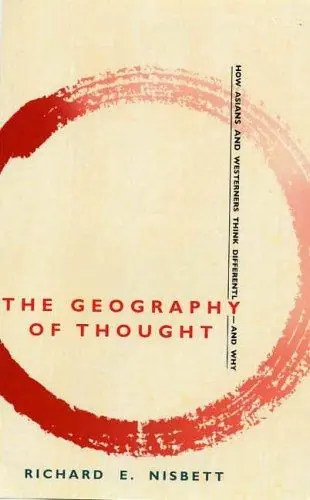
The Geography of Thought
How Asians and Westerners Think Differently... and Why
by Richard E. Nisbett · first published 2003
6mentions
1recommended by
3HN commenters
2022–2025first – last mentioned
33% recommend67% neutral
A professor of psychology examines the divergent ways in which eastern and western cultures view the world, offering suggestions about how today's interdependent global cultures may be bridged.
Affiliate links. As an Amazon Associate I earn from qualifying purchases.

…to overrate one’s own abilities is a stable feature of human psychology. And i might add, more pronounced in the American Culture than others. For more understanding on this see Richard Nisbett's The Geography of Thought: How Asians and Westerners Think Differently...and Why - https://en.wikipedia.org/wiki/The_Geography_of_Thought
on “The H-1B Visa Program and Its Impact on the U.S. Economy” ↗You might find The Geography of Thought: How Asians and Westerners Think Differently...and Why by Richard Nisbett interesting. Like you, having experienced both Eastern/Western values i had come to the conclusion that this is the main reason…
on “Friendships form via shared context, not shared activities” ↗See also the psychologist Richard Nisbett's (https://en.wikipedia.org/wiki/Richard_E._Nisbett) works specifically; The Geography of Thought: How Asians and Westerners Think Differently...and Why - https://en.wikipedia.org/wiki/The_Geography_of_Thought
on “The architecture of “not bad”: Decoding the Chinese source code of the void” ↗…is hard to quantify directly but can be measured via its effects on Science/Technology/Economy etc. See the psychologist Richard Nisbett's (https://en.wikipedia.org/wiki/Richard_E._Nisbett) works; The Geography of Thought: How Asians and Westerners Think Differently...and Why (https://en.wikipedia.org/wiki/The_Geography_of_Thought) and Intelligence and How to Get It: Why Schools and Cultures Count (https://en.wikipedia.org/wiki/Intelligence_and_How_to_Get_It)…
on “The US is the world’s science superpower — but for how long?” ↗…attitudes towards work such as this one are highly influenced by the underlying behavioral norms. Without acknowledging this I don't think you can have a productive conversation on the topic. [1] The Geography of Thought: How Asians and Westerners Think Differently...and Why - Richard Nisbett
on “On loyalty to your employer (2018)” ↗…demonstration in the linguistic and neuroscientific fields. Keep your minds open. If you need some background that goes into the statement, I'd do some research, here's a section of the citations from Nisbett's Geography of Thought that delineate how distinct Eastern and Western perception and language are: Gentner, D. (1982) Why are nouns learned before verbs: Linguistic relativity versus natural partitioning. In S. A. Kuczaj…
on “The Wind, a Pole, and the Dragon” ↗