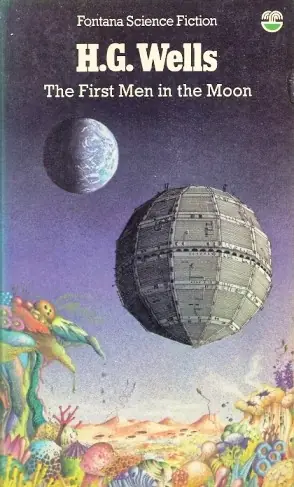
The First Men in the Moon
by H. G. Wells · first published 1900
3mentions
0recommended by
3HN commenters
2013–2024first – last mentioned
100% neutral
When penniless businessman Mr Bedford retreats to the Kent coast to write a play, he meets by chance the brilliant Dr Cavor, an absent-minded scientist on the brink of developing a material that blocks gravity. Cavor soon succeeds in his experiments, only to tell a stunned Bedford the invention makes possible one of the oldest dreams of humanity: a journey to the moon. With Bedford motivated by money, and Cavor by the desire for knowledge, the two embark on the expedition. But neither are prepared for what they find - a world of freezing nights, boiling days and sinister alien life, on which t
Affiliate links. As an Amazon Associate I earn from qualifying purchases.
> I hope it's all fungi and I hope it's edible. That reminds me of a passage from H.G. Wells's «The First Men In The Moon», where the narrator protagonist is so hungry that he can't help but take a bite out of some fungi-like lunar vegetation, and convinces his colleague Cavor to indulge in it as well... but the fungi happens…
on “Fungi on Mars? Evidence of Growth and Behavior from Sequential Images [pdf]” ↗…0.0337 m/s², several orders of magnitude larger (and just about perceptible as a gentle tendency to float up). (A similar example to your red pebble would be "Cavorite" from the H. G. Wells story "The first men in the moon", which also negated gravity causing objects to shoot violently upwards. The explanation given however was buoyancy, which makes more sense I suppose.)
on “Myth: The astronauts didn’t float away because they had heavy boots” ↗H.G. Wells and C.S. Lewis intersect in more ways than one; in Out of the Silent Planet, one of the characters references Wells's The First Men in the Moon (1900), and the plot of the two parallel each other when the inhabitants of Mars (in Lewis's work) find out about the violent nature of Earth's inhabitants.
on “Science fiction and the death of the sun” ↗