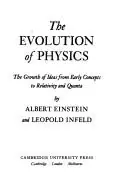
The evolution of physics
the growth of ideas from early concepts to relativity and quanta
by Albert Einstein · first published 1938
83% recommend17% neutral
Why HN recommends it
Readable, non-technical survey of how physics concepts developed, praised as more engaging than textbooks; suits curious students and recreational learners who want the ideas without heavy math.
Summarised by Claude from recommending comments
The book is a simple chat between you and us. You may find it boring or interesting, dull or exciting, but our aim will be accomplished if these pages give you some idea of the eternal struggle of the inventive human mind for a fuller understanding of the laws governing physical phenomena. A. E. L. I.
Affiliate links. As an Amazon Associate I earn from qualifying purchases.
Mentions per year
What Hacker News says
Related books
 2016–2025
The Gene
Siddhartha Mukherjee, Dennis Boutsikaris
Recommended by 27 · mentioned by 3527 recommend · 35 mention27 recommend · 3527 recommend
 2010–2026
The Emperor of All Maladies
Siddhartha Mukherjee, Nessa Carey
Recommended by 77 · mentioned by 9877 recommend · 98 mention77 recommend · 9877 recommend
 2007–2026
A short history of nearly everything
Bill Bryson
Recommended by 102 · mentioned by 123102 recommend · 123 mention102 recommend · 123102 recommend
 2008–2026
A Brief History of Time
Stephen Hawking
Recommended by 76 · mentioned by 16876 recommend · 168 mention76 recommend · 16876 recommend
Must read classic: The Evolution of Physics by Albert Einstein and Leopold Infeld
on “Ask HN: Best general-audience science books” ↗Not a biography but I like Einstein's book "Evolution of physics". It is supposed to be popular scifi book, and covers same topics as high school physics for layman. But, it is still good to hear his perspective: https://www.amazon.com/Evolution-Physics-Albert-Einstein/dp/...
on “What Life Means to Einstein (1929) [pdf]” ↗…write popular works. There are several scientists who have written great works which are neither difficult, nor dumbed down - for example, Steinhaus' "Mathematical Snapshots", Einstein and Infeld's "The Evolution of Physics", Schrodinger's "What is life?" and even delightful works such as Faraday's "Chemical history of a candle". With the hypercompetitiveness of modern scientific careers, scientists who take time off to…
on “Should we stop believing Malcolm Gladwell?” ↗Koyre's From the Closed World to Infinite Universe Koyre is basically the orginator of the history of science. This was his popularization. Einstein & Infeld's Evolution of Physics Picks up where Koyre leaves off.
on “Ask HN: Any recommendation for a good History of Science book?” ↗…hypercomplex numbers, the entangled quantum world, gravity's role in quantum state reduction etc which sound pretty deep and complex for a recreational learner. Beyond that, you can also read books such as The Evolution of Physics by Einstein himself, Thirty Years that Shook Physics by George Gamow to get a historical perspective on the development of advanced physics. For a midway academic treatment, you can read Feynman's lecture…
on “Ask HN: How do I learn math/physics in my thirties?” ↗…can use either the sun or the earth as your frame of reference to calculate this. It's explained quite well on wikipedia so I'll just quote that here: > Albert Einstein and Leopold Infeld wrote in The Evolution of Physics (1938): "Can we formulate physical laws so that they are valid for all CS (=coordinate systems), not only those moving uniformly, but also those moving quite arbitrarily, relative to each other? If this…
on “The Zen Anti-Interpretation of Quantum Mechanics” ↗