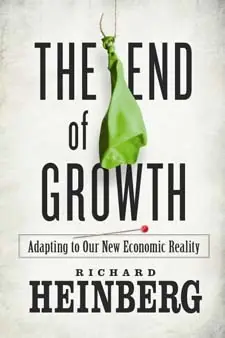
The end of growth
by Richard Heinberg · first published 2011
5mentions
2recommended by
2HN commenters
2013–2016first – last mentioned
100% recommend
"Economists insist that recovery is at hand, yet unemployment remains high, real estate values continue to sink, and governments stagger under record deficits. The End of Growth proposes a startling diagnosis: humanity has reached a fundamental turning point in its economic history. The expansionary trajectory of industrial civilization is colliding with non-negotiable natural limits. Richard Heinberg's latest landmark work goes to the heart of the ongoing financial crisis, explaining how and why it occurred, and what we must do to avert the worst potential outcomes. Written in an engaging, hi
Affiliate links. As an Amazon Associate I earn from qualifying purchases.
…recommend for more on what the actual dynamics are. http://www.ourfiniteworld.com (her "getting started" links are a great primer) http://www.postcarbon.org/ Heinberg's published numerous books, The End of Growth covers much of the economic impact, Snake Oil addresses oil and fracking specifically.
on “China mulls high-speed train to US” ↗…supply less than seven percent of that. The only thing likely to boost that percentage much would be a dramatic reduction in growth of energy demand to, say, two percent annually." I like this from The End of Growth (2011) by Richard Heinberg. As much as the numbers are incredible we are really undermining the amount of energy produced by fossil sources. Similar problem with nuclear. Are we really on the exponential…
on “64% of new energy from Solar Power in Q1 is not enough” ↗…in this club, for having been wrong. No one is dis-invited from presenting papers at later annual meetings. And still less is anyone from the outside invited in. (Quoted in Robert Heinberg's The End of Growth).
on “Here’s why economists hate software patents” ↗…peaked in 1943), copper (1998), iron ore (1951), magnesium (1966), phosphate rock (1980), potash (1967), rare earth metals (1984), tin (1945), titanium (1964), and zinc (1969)" (from Richard Heinberg's The End of Growth[1]) I've explored the concept of decoupling in greater length using Wolfram+Alpha data to show the relationship between energy use and GDP for the G8 nations plus China, India, and Brazil, as well as…
on “2014 Gates Annual Letter: Myths that block progress for the poor” ↗…peaked in 1943), copper (1998), iron ore (1951), magnesium (1966), phosphate rock (1980), potash (1967), rare earth metals (1984), tin (1945), titanium (1964), and zinc (1969)" (from Richard Heinberg's The End of Growth[1]) I've explored the concept of decoupling in greater length using Wolfram+Alpha data to show the relationship between energy use and GDP for the G8 nations plus China, India, and Brazil, as well as…
on “Bill Gates predicts there will be almost no poor countries by 2035” ↗